
Catalogue Search | MBRL


Are you sure you want to remove the book from the shelf?

{{itemTitle}}
19
result(s) for
"American poetry Explication."
Sort by:

The lyric in the age of the brain
\"Exploration of our inner life--perception, thought, memory, feeling--once seemed a privileged domain of lyric poetry. Scientific discoveries, however, have recently supplied physiological explanations for what was once believed to be transcendental; the past sixty years have brought wide recognition that the euphoria of love is both a felt condition and a chemical phenomenon, that memories are both representations of lived experience and dynamic networks of activation in the brain. Caught between a powerful but reductive scientific view of the mind and traditional literary metaphors for consciousness that have come to seem ever more naive, American poets since World War II have struggled to articulate a vision of human consciousness that is both scientifically informed and poetically truthful. The Lyric in the Age of the Brain examines several contemporary poets--Robert Lowell, A. R. Ammons, Robert Creeley, James Merrill, John Ashbery, Jorie Graham, and experimentalists such as Harryette Mullen and Tan Lin--to discern what new language, poetic forms, and depictions of selfhood this perplexity forces into being. Nikki Skillman shows that under the sway of physiological conceptions of mind, poets ascribe ever less agency to the self, ever less transformative potential to the imagination. But in readings that unravel factional oppositions in contemporary American poetry, Skillman argues that the lyric--a genre accustomed to revealing expansive aesthetic possibilities within narrow formal limits--proves uniquely positioned to register and redeem the dispersals of human mystery that loom in the age of the brain.\"--Provided by publisher.
Book

Reading the Difficulties
The bold essays that make up
Reading the Difficulties offer case studies in and
strategies for reading innovative poetry. Definitions of what
constitutes innovative poetry are innumerable and are offered
from every quarter. Some critics and poets argue that innovative
poetry concerns free association (John Ashbery), others that
experimental poetry is a “re-staging” of language
(Bruce Andrews) or a syntactic and cognitive break with the past
(Ron Silliman and Lyn Hejinian). The tenets of new poetry abound.
But what of the new reading that such poetry demands? Essays in
Reading the Difficulties ask what kinds of stances allow
readers to interact with verse that deliberately removes many of
the comfortable cues to comprehension—poetry that is
frequently nonnarrative, nonrepresentational, and indeterminate
in subject, theme, or message. Some essays in Thomas Fink and
Judith Halden-Sullivan’s collection address issues of
reader reception and the way specific stances toward reading
support or complement the aesthetic of each poet. Others suggest
how we can be open readers, how innovative poetic texts change
the very nature of reader and reading, and how critical language
can capture this metamorphosis. Some contributors consider how
the reader changes innovative poetry, what language reveals about
this interaction, which new reading strategies unfold for the
audiences of innovative verse, and what questions readers should
ask of innovative verse and of events and experiences that we
might bring to reading it. CONTRIBUTORS Charles Bernstein /
Carrie Conners / Thomas Fink / Kristen Gallagher / Judith
Halden-Sullivan / Paolo Javier / Burt Kimmelman / Hank Lazer /
Jessica Lewis Luck / Stephen Paul Miller / Sheila E. Murphy /
Elizabeth Robinson / Christopher Schmidt / Eileen R.
Tabios
eBook

Don't read poetry : a book about how to read poems
\"In Don't Read Poetry, award-winning poet and literary critic Stephanie Burt offers an accessible introduction to the seemingly daunting task of reading, understanding, and appreciating poetry. Burt dispels preconceptions about poetry and explains how poems speak to one another--and how they can speak to our lives. She shows readers how to find more poems once they have some poems they like, and how to connect the poetry of the past to the poetry of the present. Burt moves seamlessly from Shakespeare and other classics to the contemporary poetry circulated on Tumblr and Twitter. She challenges the assumptions that many of us make about \"poetry,\" whether we think we like it or think we don't, in order to help us cherish--and distinguish among--individual poems. A masterful guide to a sometimes confounding genre, Don't Read Poetry will instruct and delight ingénues and cognoscenti alike\"-- Provided by publisher.
Book
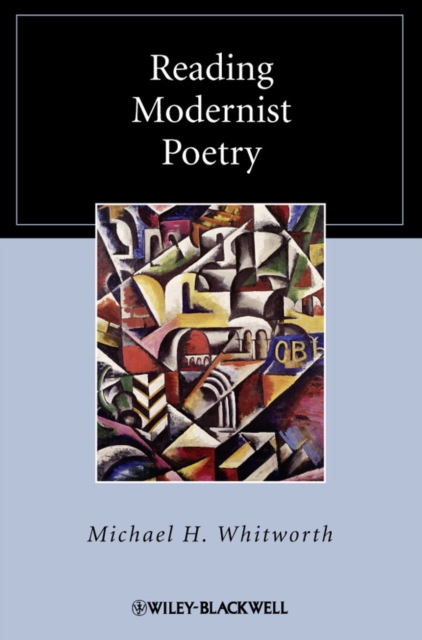
Reading modernist poetry
This essential guide to modernist poetry enables readers to make sense of a literary movement often regarded as difficult and intimidating.Provides close examinations of key poems by T.S.Eliot, Ezra Pound, W.B.
eBook


Culture, 1922
Culture, 1922traces the intellectual and institutional deployment of the culture concept in England and America in the first half of the twentieth century. With primary attention to how models of culture are created, elaborated upon, transformed, resisted, and ignored, Marc Manganaro works across disciplinary lines to embrace literary, literary critical, and anthropological writing. Tracing two traditions of thinking about culture, as elite products and pursuits and as common and shared systems of values, Manganaro argues that these modernist formulations are not mutually exclusive and have indeed intermingled in complex and interesting ways throughout the development of literary studies and anthropology.
Beginning with the important Victorian architects of culture--Matthew Arnold and Edward Tylor--the book follows a number of main figures, schools, and movements up to 1950 such as anthropologist Franz Boas, his disciples Edward Sapir, Ruth Benedict, and Zora Neale Hurston, literary modernists T. S. Eliot and James Joyce, functional anthropologist Bronislaw Malinowski, modernist literary critic I. A. Richards, the New Critics, and Kenneth Burke. The main focus here, however, is upon three works published in 1922, the watershed year of Modernism--Eliot'sThe Waste Land, Malinowski'sArgonauts of the Western Pacific, and Joyce'sUlysses. Manganaro reads these masterworks and the history of their reception as efforts toward defining culture. This is a wide-ranging and ambitious study about an ambiguous and complex concept as it moves within and between disciplines.
eBook

Modern American poetry, \echoes and shadows\
Explores modern American poetry, including biographies of twelve poets such as Robert Frost and Langston Hughes; excerpts of poems, literary criticism, poetic technique, and explication.
Book

Goldilocks Meets Gertrude Stein: Poetry Explication for the Verse-Averse
Literature students often fear poetry explication, supposing it is beyond their intellectual reach. As with many preconceptions that surface in the classroom, this is an impression I find helpful to tackle forthrightly. Years of teaching literature have convinced me that even English majors can become timid in the face of assignments calling for poetry explication. Given this common response, I have experimented with many methods for acclimating students to poetry as a form. The activity described here has proven helpful in this regard.
Journal Article

Contemporary American poetry : \not the end, but the beginning\
\"Discover some of the poetry of leading contemporary American poets, including: Roethke, Bishop, Stafford, Lowell, Brooks, Wilbur, Ginsberg, Merwin, Rich, Plath, Collins, and Gluck\"--Provided by publisher.
Book

Conceptual History in Context
Finding arguments in support of an intellectual enterprise like conceptual history would seem easy enough. In the various strands of the ongoing ‘conversation of mankind’, to use Michael Oakeshon’s felicitous phrase, I what one may expect to find are continuations, transformations and adaptations of arguments, followed by disruptions, distortions, and reductions which, in turn, can be undone by revivals, rediscoveries, and renascences of strands of conversation. What one is unlikely to encounter, since there is no epistemology shared by all participants of that conversation through the ages, are caregorial beginnings and endings like rhose demanded of a good tragedy by
Book Chapter