
Catalogue Search | MBRL


Are you sure you want to remove the book from the shelf?

{{itemTitle}}
50
result(s) for
"Anschluss"
Sort by:

The order of the day
\"February 20, 1933: on an unremarkable day during a harsh Berlin winter, a meeting of twenty-four German captains of industry and senior Nazi dignitaries is being held in secret in the plush lounges of the Reichstag. They are there to \"stump up\" funding for the accession to power of the National Socialist Party and its fearsome Chancellor. This inaugural scene sets the tone of consent which will lead to the worst possible repercussions. March 12, 1938: the annexation of Austria is on the agenda and a grotesque day ensues that is intended to make history: the newsreels capture for eternity a motorized army, a terrible, inexorable power. But behind Goebbels's splendid propaganda, it is an ersatz Blitzkrieg which unfolds, the Panzers breaking down en mass on the roads of Austria. The true behind-the-scenes story of the Anschluss--a patchwork of minor shows of strength and fine words, a string of fevered telephone calls and vulgar threats--reveals a starkly different picture: it is no longer strength of character or the determination of a people that wins the day, but rather a combination of intimidation and bluff. With this vivid, compelling history, âEric Vuillard warns against the perils of willfully blind acquiescence, and offers a crucial reminder that, ultimately, the worst is not inescapable\"-- Provided by publisher.
Book

Imagining a Greater Germany
In Imagining a Greater Germany , Erin R. Hochman offers
a fresh approach to the questions of state- and nation-building in
interwar Central Europe. Ever since Hitler annexed his native
Austria to Germany in 1938, the term \"Anschluss\" has been linked to
Nazi expansionism. The legacy of Nazism has cast a long shadow not
only over the idea of the union of German-speaking lands but also
over German nationalism in general. Due to the horrors unleashed by
the Third Reich, German nationalism has seemed virulently
exclusionary, and Anschluss inherently antidemocratic.
However, as Hochman makes clear, nationalism and the desire to
redraw Germany's boundaries were not solely the prerogatives of the
political right. Focusing on the supporters of the embattled Weimar
and First Austrian Republics, she argues that support for an
Anschluss and belief in the großdeutsch idea (the
historical notion that Germany should include Austria) were central
to republicans' persistent attempts to legitimize democracy. With
appeals to a großdeutsch tradition, republicans fiercely
contested their opponents' claims that democracy and Germany,
socialism and nationalism, Jew and German, were mutually exclusive
categories. They aimed at nothing less than creating their own form
of nationalism, one that stood in direct opposition to the
destructive visions of the political right. By challenging the
oft-cited distinction between \"good\" civic and \"bad\" ethnic
nationalisms and drawing attention to the energetic efforts of
republicans to create a cross-border partnership to defend
democracy, Hochman emphasizes that the triumph of Nazi ideas about
nationalism and politics was far from inevitable.
In Imagining a Greater Germany , Erin R. Hochman offers
a fresh approach to the questions of state- and nation-building in
interwar Central Europe. Ever since Hitler annexed his native
Austria to Germany in 1938, the term \"Anschluss\" has been linked to
Nazi expansionism. The legacy of Nazism has cast a long shadow not
only over the idea of the union of German-speaking lands but also
over German nationalism in general. Due to the horrors unleashed by
the Third Reich, German nationalism has seemed virulently
exclusionary, and Anschluss inherently antidemocratic.However, as
Hochman makes clear, nationalism and the desire to redraw Germany's
boundaries were not solely the prerogatives of the political right.
Focusing on the supporters of the embattled Weimar and First
Austrian Republics, she argues that support for an Anschluss and
belief in the großdeutsch idea (the historical notion that Germany
should include Austria) were central to republicans' persistent
attempts to legitimize democracy. With appeals to a großdeutsch
tradition, republicans fiercely contested their opponents' claims
that democracy and Germany, socialism and nationalism, Jew and
German, were mutually exclusive categories. They aimed at nothing
less than creating their own form of nationalism, one that stood in
direct opposition to the destructive visions of the political
right. By challenging the oft-cited distinction between \"good\"
civic and \"bad\" ethnic nationalisms and drawing attention to the
energetic efforts of republicans to create a cross-border
partnership to defend democracy, Hochman emphasizes that the
triumph of Nazi ideas about nationalism and politics was far from
inevitable.
eBook
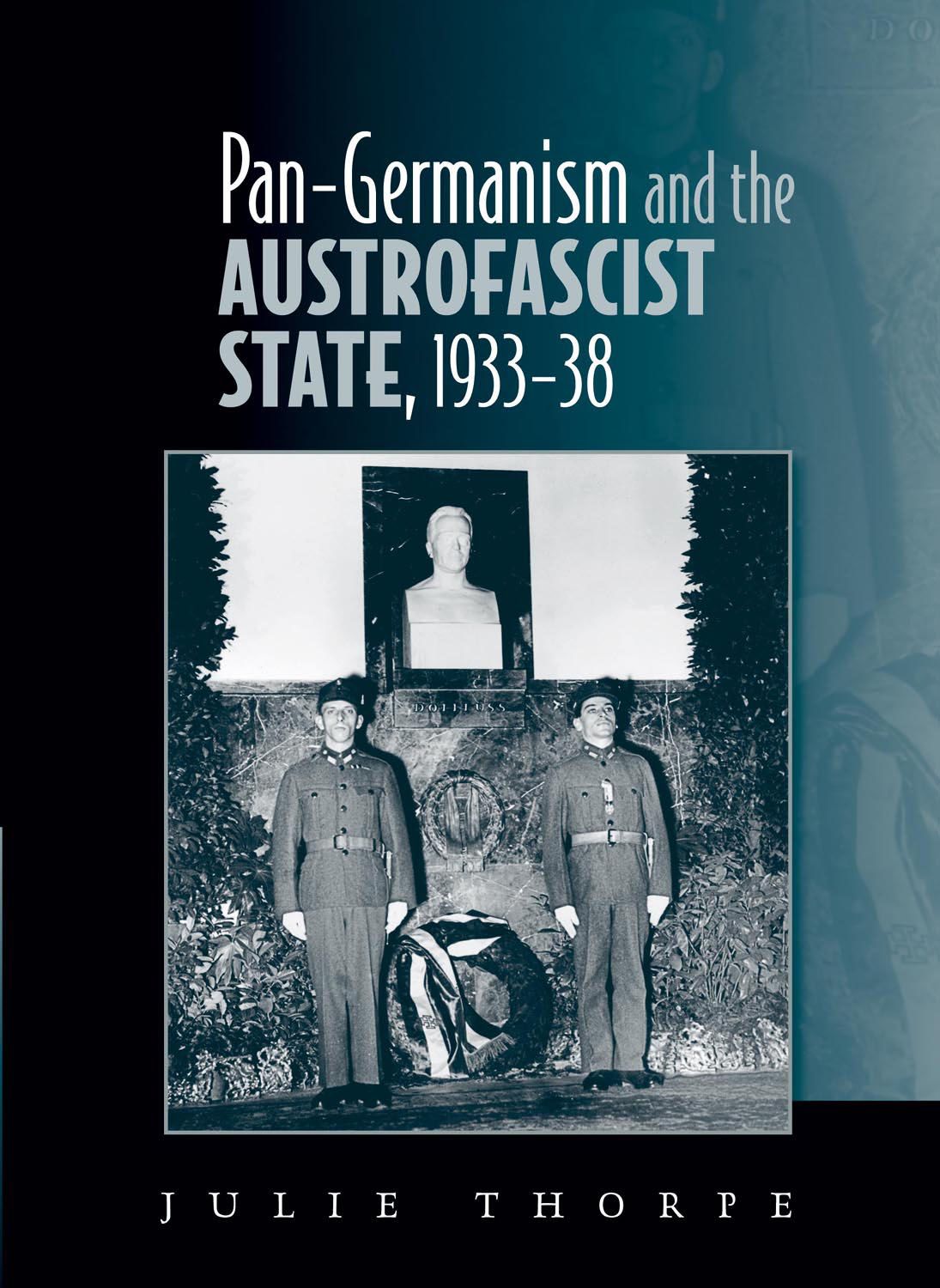
Pan–Germanism and the Austrofascist State, 1933–38
This book is about the ideas and policies that characterised the rightward trajectory of Austrofascism in the 1930s. It is the first major Anglophone study of Austrofascism in over two decades and provides a fresh perspective on the debate over whether Austria was an authoritarian or fascist state. The book is designed to introduce specialists, general scholars of fascism, and undergraduate students of interwar Austrian and Central European history, to the range of issues confronting Austrian policy and opinion makers in the years prior to the Anschluss with Nazi Germany.The book makes an original contribution to studies of interwar Austria by introducing several new case studies, including press and propaganda, minority politics, regionalism, immigration and refugees, as the issues that shaped Austria’s political culture in the 1930s.Its arguments and findings will be of value for scholars as well as students of interwar fascism and twentieth-century Austrian and Central European history.
eBook

Electronic two-terminal bistable graphitic memories
Transistors are the basis for electronic switching and memory devices as they exhibit extreme reliabilities with on/off ratios of 10
4
–10
5
, and billions of these three-terminal devices can be fabricated on single planar substrates. On the other hand, two-terminal devices coupled with a nonlinear current–voltage response can be considered as alternatives provided they have large and reliable on/off ratios and that they can be fabricated on a large scale using conventional or easily accessible methods. Here, we report that two-terminal devices consisting of discontinuous 5–10 nm thin films of graphitic sheets grown by chemical vapour deposition on either nanowires or atop planar silicon oxide exhibit enormous and sharp room-temperature bistable current–voltage behaviour possessing stable, rewritable, non-volatile and non-destructive read memories with on/off ratios of up to 10
7
and switching times of up to 1 μs (tested limit). A nanoelectromechanical mechanism is proposed for the unusually pronounced switching behaviour in the devices.
Carbon-based structures are being intensively investigated for their use in electronic devices. A pronounced non-volatile switching is now observed in two-terminal devices made from graphitic sheets. The highly reliable switching mechanism is explained by the local breaking and rejoining of atomic bonds in the sheets.
Journal Article

Las ciudades de Gregor von Rezzori
Este artículo se propone relacionar la extraordinaria vida de Gregor von Rezzori (1914-1998) con las ciudades que formaron su personalidad y su obra. Desde su Czernowitz natal hasta Viena, patria cultural, y Bucarest, donde pasa una etapa importante de su vida. Todas ellas son fuente de inspiración para sus novelas y se estudian en relación con su biografía. Para su análisis, el artículo se apoya en métodos de investigación propios del estudio del espacio urbano y del análisis literario con incursiones en la investigación de tipo histórico literario desde un punto de vista semiótico, lo que permite tratar la ciudad como un texto.
Journal Article
‘Sidelight on an unwilling grey eminence – Schlosser as “Schlüsselfigur”’. A paper originally presented at the conference Viennese Art Historiography 1854-1938, University of Glasgow, 1-4 October 2009
While Riegl, Dvořák, Sedlmayr and Pächt have each of them aroused widespread enthusiasm at one point or another, the same cannot be said of Julius Schlosser (1866-1938). To speak in general terms about his intellectual trajectory and its significance, one meets two questions, the first rather obvious, and the other quite opaque. Although he wrote and lectured in a style that was difficult, his arguments were consistent and perhaps predictable – a continuation of Wickhoff’s approach, and the principles upheld by the Institut für Geschichtsforschung, as well as something later called structure and system, which is most apparent today in his thoughts about what he called the language and grammar of art, but also in his study from 1889 of the original architectural layout of western European abbeys which is a very early example of a functional analysis. In the last decade or two of his life he seems by contrast to have made some generalizations apparently difficult to reconcile with his earlier devotion to the particularity of historical sources.
Journal Article


Reviled, Repressed, Resurrected: Vienna 1900 in the Nazi Imaginary
Encompassing the final decades of Habsburg rule and the rise of modern culture, the cosmopolitan and Jewish Vienna of the fin de siècle was a despised locus in the Nazi historical imaginary. Vienna 1900 was a polyglot, multicultural city, a place where European Jewry had risen to unforeseen heights of economic prosperity and cultural influence; many Nazi ideologues, historians, and authors focused on the verjudet nature of late imperial Vienna. A variety of strategies were employed to distance the Nazi present from Vienna 1900; it was alternately suppressed and ignored, or deeply vilified. Yet the period was also inseparable from two figures celebrated in Nazi Vienna: Mayor Karl Lueger and artist Gustav Klimt. This article examines Nazi discourse on Vienna 1900, especially that originating from Viennese writers, ideologues, and political figures. Reflecting both scholarly and popular views, I examine academic texts, books for popular readers, films, and art exhibitions. After examining the perception and appropriation of Vienna 1900 between the years 1938 and 1945, I end by exploring its instrumentalization in a different context. In an ironic twist of history, the very period suppressed and derided in Nazi discourse would in turn be called upon, by the 1970s, to distract from the shadow of the Nazi era that still hung over the city.
Journal Article

Anschluss: The Chamberlain Government and the First Test of Appeasement, February-March 1938
The union of Austria and Germany in March 1938 - the Anschluss - forced by Adolf Hitler's Nazi Germany with the acquiescence of Italy was the first test of the appeasement strategy of the Neville Chamberlain government. Austro-German Anschluss did not occur unexpectedly: after Habsburg collapse in 1918, it had been desired by pan-Germans in Austria and Germany but denied by the Paris Peace Settlement; its possibility arose a couple of times in the early 1930s; and by 1937, the majority of Austrians seemed willing to unite with their Nazi neighbour. Even before Chamberlain became Premier in May 1937 and changed the strategic basis of British foreign policy, the Foreign Office and other ministries wrestled over whether to thwart Anschluss and, until 1937, worked to keep the two German-speaking Powers apart. After Chamberlain took power, the willingness to oppose abated as Hitler's pan-German solution spoke to both national self-determination and Austrian ambivalence about independence. Chamberlain's government submitted expecting that they might use the absorption of Austria as a means to divide Nazi Germany from Fascist Italy. 'Good relations' with the dictators existed as a cardinal element of Chamberlain's brand of appeasement.
Journal Article

Learning the Lessons of History and Literature: The Case of Eric Vuillard's L'Ordre du jour
History has exchanged ideas, themes, techniques and methods with literature throughout its existence, even though the two domains are commonly viewed as entirely distinct, if not incompatible. The debate over the legitimacy and value of literature as opposed to academic history has recently reemerged with the French press's quasi-unanimous endorsement of Eric Vuillard's L'Ordre du jour, a best-selling novel focusing on a few select \"behind the scenes\" aspects of the Anschluss, yet claiming to offer nothing less than the \"real truth\" of the Nazis' rise to power. The present article offers a critical analysis of the assumptions and illusions behind the French press's largely unreflective enthusiasm for Vuillard's narrative.
Journal Article