
Catalogue Search | MBRL


Are you sure you want to remove the book from the shelf?

{{itemTitle}}
26,028
result(s) for
"Art, Abstract"
Sort by:

Abstract art
Abstract art might seem hard to define. But, by introducing readers to the major artists of the style, they'll have a good idea of the general characteristics of an abstract piece. In addition to biographical information about Henri Matisse, Jasper Johns, Paul Klee, and more important abstract artists, readers learn about each masters most famous pieces and ways they were able to achieve the look of the work. Fun, colorful projects accompany each artists spreads, showing readers how they, too, can make cool abstract art.
Book

Foreshadowed
An exploration of Kasimir Malevich's radical 1915 artwork, its predecessors, and its continuing relevance. When Kasimir's Malevich's Black Square was produced in 1915, no one had ever seen anything like it before. And yet it does have precedents. In fact, over the previous five hundred years, several painters, writers, philosophers, scientists, and censors—each working independently towards an absolute statement of their own—alighted on the form of the black square or rectangle, as if for the first time. This book explores the resonances between Malevich's Black Square and its precursors, showing how a so-called genealogical thread binds them together into an intriguing, and sometimes quirky, sequence of modulations. Andrew Spira's book explores how each predecessor both foreshadows Malevich's work and, paradoxically, throws light on it, revealing layers of meaning that are often overlooked but which are as relevant today as ever.
eBook

Abstract painting and abstraction
Abstract painting and abstraction can be a daunting and frustrating genre of art. How should you approach a surface? How can you use colour effectively? How can you make better, more expressive paintings? This inspiring book answers these questions and many more. By looking at his own work, Emyr Williams covers the practical issues of abstract art before explaining techniques to develop your own personal style and approach. He emphasises the relationship of colour to surface and the importance of seeking a profound connection with your art.
Book

“Found in Translation”: An Evolutionary Framework for Auditory–Visual Relationships
The development of computational artifacts to study cross-modal associations has been a growing research topic, as they allow new degrees of abstraction. In this context, we propose a novel approach to the computational exploration of relationships between music and abstract images, grounded by findings from cognitive sciences (emotion and perception). Due to the problem’s high-level nature, we rely on evolutionary programming techniques to evolve this audio–visual dialogue. To articulate the complexity of the problem, we develop a framework with four modules: (i) vocabulary set, (ii) music generator, (iii) image generator, and (iv) evolutionary engine. We test our approach by evolving a given music set to a corresponding set of images, steered by the expression of four emotions (angry, calm, happy, sad). Then, we perform preliminary user tests to evaluate if the user’s perception is consistent with the system’s expression. Results suggest an agreement between the user’s emotional perception of the music–image pairs and the system outcomes, favoring the integration of cognitive science knowledge. We also discuss the benefit of employing evolutionary strategies, such as genetic programming on multi-modal problems of a creative nature. Overall, this research contributes to a better understanding of the foundations of auditory–visual associations mediated by emotions and perception.
Journal Article
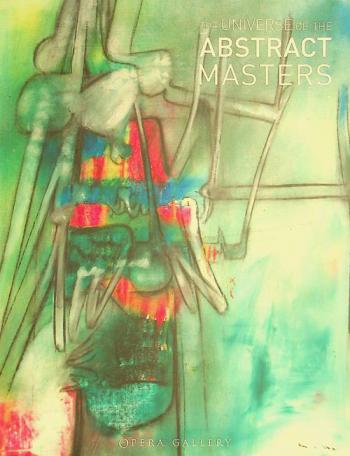
The universe of the abstract masters
Catalog of painting exhibition held by Opera Gallery Singapore.
Book

L'attrait de l'ambigüité visuelle
Many artists today develop their work based on material considerations, in particular those offered by painting, in order to lay claim to an expression of thoughts, ideas, sensations, or emotions produced by formal information. Such artists include Ianick Raymond, Jérôme Bouchard, and Sabrina Ratté. Notwithstanding the specific characteristics of their respective aesthetic universes, these three artists strive to combine paint and digital media. Through this pairing, as surprising as it is promising, they move away from a purity of form in favor of hybridity, reassessing the handmade, revisiting painting techniques, and, indirectly, more broadly considering the repercussions of technology and the ideology of progress on visual arts and society.
Journal Article
Torkwase Dyson
Torkwase Dyson's art practice is a form of critical theory, focusing on her theoretical concept of \"Black Compositional Thought\" to address the spatial strategies responding to Black unfreedom. She explores the infrastructure created by anti-Black expropriation, highlighting how Black labor has shaped the landscape. Dyson's paintings, with a limited color palette, incorporate engineer-like diagrams to impose structure on the canvas. While her work references painterly abstraction, she does not consider herself an abstract artist due to the problematic history of abstraction. Dyson's sculptures challenge viewers to reconsider their relationship with the object, utilizing abstraction for subversive purposes.
Journal Article

De l'abstraction entre guillemets
The plural form, \"abstractions,\" is significant; it immediately neutralizes the modern tendency to consider abstraction the \"truest\" and most accomplished form of expression in painting due to its being supposedly faithful to the medium. Inherited from a linear and progress-oriented model of history, this idea no longer holds sway. Yet the term \"abstraction\" still drags it in its wake, as peremptory affirmations of this concept long marked its history, from the early manifestos up to the dogmatic positions of Clement Greenberg and Ad Reinhardt in the 1960s. Here, Loubiere examines works and practices in which some abstraction is manifested.
Journal Article