
Catalogue Search | MBRL


Are you sure you want to remove the book from the shelf?

{{itemTitle}}
426
result(s) for
"COMPUTERS / Computer Graphics / Game Programming "
Sort by:
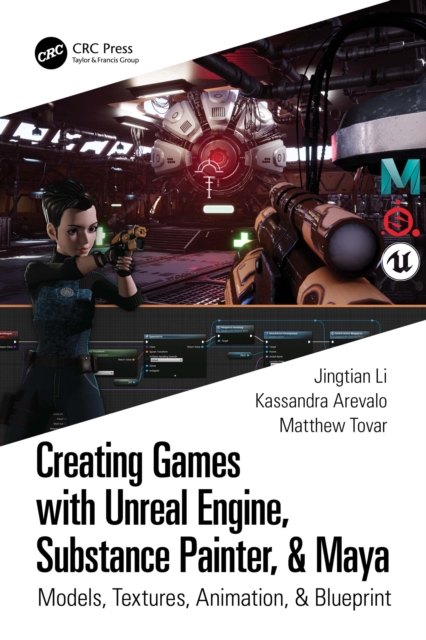
Creating Games with Unreal Engine, Substance Painter, & Maya
This tutorial-based book allows readers to create a first-person game from start to finish using industry-standard (and free to student) tools of Maya, Substance Painter, and Unreal Engine. The first half of the book lays out the basics of using Maya and Substance Painter to create game-ready assets. This includes polygonal modeling, UV layout, and custom texture painting. Then the book covers rigging and animation solutions to create assets to be placed in the game including animated first-person assets and motion captured NPC animations. Finally readers can put it all together and build interactivity that allows the player to create a finished game using the assets built and animated earlier in the book.
Written by industry professionals with real-world experience in building assets and games.
Build a complete game from start to finish.
Learn what the pros use: construct all assets using the tools used at tools across the world.
All software used are free to students
When complete students will have a playable version of a FPS game
eBook

Anyone Can Code
\"Ali Arya guides you in a fantastic journey full of creativity in a coherent way that allows the traveler to learn and build up over the knowledge acquired in previous chapters until the reader accomplishes skills to develop solutions using programming.\"
-
Andrés A. Navarro Newball
, Professor, Pontificia Universidad Javeriana Cali Colombia
\"An excellent book that teaches programming and software development the way it should be done: independent from a specific implementation language and focusing on the main principles that are fundamental and substantive to any kind of software production.\"
-
Dr Marc Conrad
, Principal Lecturer, University of Bedfordshire
Anyone Can Code: The Art and Science of Logical Creativity
introduces computer programming as a way of problem-solving through logical thinking. It uses the notion of Modularization as a central lens through which we can make sense of many software concepts. The book takes the reader through fundamental concepts in programming by illustrating them in three different and distinct languages, C/C++, Python, and Javascript.
Key features:
Focuses on problem-solving and algorithmic thinking instead of programming functions, syntax, and libraries.
Includes engaging examples, including video games and visual effects
Provides exercises and reflective questions.
It gives the beginner and intermediate learners a strong understanding of what they are doing so that they can do it better and with any other tool or language that they may end up using later.
About the Author:
Ali Arya is an Associate Professor of Information Technology at Carleton University, Ottawa, Canada. He received his Ph.D. in Computer Engineering from the University of British Columbia in 2003. Ali has over 25 years of experience in professional and academic positions related to software development and information technology. He is passionate about computer programming that brings together logical and creative abilities.
eBook

Understanding CATIA
This book provides a key understanding of CATIA which is a solid modeling software. By using screen shots of step-by-step training, the reader will obtain comprehensive knowledge of all tools provided in CATIA for use in a variety of engineering fields.
The book introduces CATIA basics, covers part design, discusses sheet metal design, talks about assembly, presents drawings and shows modeling an engineered component. The primary aim of this book is to assist in learning the use of CATIA software through examples taken from various areas of engineering.
The content and treatment of the subject matter is most appropriate for university students studying engineering and practicing engineers who wish to learn the use of CATIA.
eBook

Costume Design for Video Games
Costume Design for Video Games: An Exploration of Historical and Fantastical Skins explores the rich and colorful history of fashion throughout the ages. Each page goes into detail concerning the social significance of Iconic period pieces. From the real and the imagined, Costume Design for Video Games highlights the development of costumes and characters that pertain to plots, scenarios, and visionary goals, while also exploring silhouettes and the aesthetics of various eras. This survey of costume design for the video game market includes an exploration of the aesthetics of historical, fantasy, and futuristic influences.
eBook
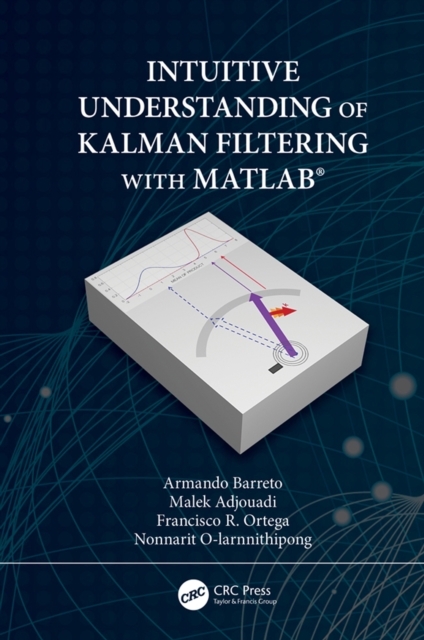
Intuitive Understanding of Kalman Filtering with MATLAB
The emergence of affordable micro sensors, such as MEMS Inertial Measurement Systems, which are being applied in embedded systems and Internet-of-Things devices, has brought techniques such as Kalman Filtering, capable of combining information from multiple sensors or sources, to the interest of students and hobbyists. This will book will develop just the necessary background concepts, helping a much wider audience of readers develop an understanding and intuition that will enable them to follow the explanation for the Kalman Filtering algorithm.
Key Features:
Provides intuitive understanding of Kalman Filtering approach
Succinct overview of concepts to enhance accessibility and appeal to wide audience
Interactive learning techniques with code examples
eBook
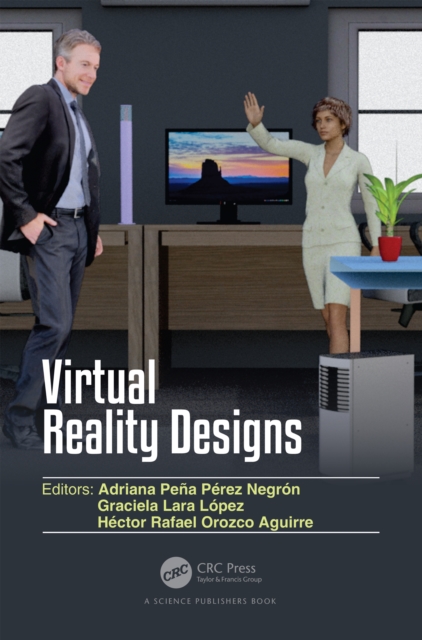
Virtual Reality Designs
Virtual Reality is not real life. Instead it is life-like creations using computergenerated scenarios. Human behavior is replicated in virtual scenarios, where every detail is controlled by computers, and in situations that can be repeated under the same conditions.
Based on technology and design, the user can experience presence. In the virtual world, users are embodied in avatars that represent them and are the means to interact with the virtual environment. Avatars are graphical models that behave on behalf of the human behind them. The user avatar is a proxy that also backs interaction with others, allowing computer-mediated interactions.
Analyses directed to understand people's perceptions, personal and social behavior in computer mediated interactions, comprise a multidisciplinary area of study that involves, among others, computer science, psychology and sociology. In the last two decades a number of studies supported by Virtual Reality have been conducted to understand human behavior, in some cases the implications of the technology, or to reproduce artificial human behavior. This book presents a collection of studies from recognized researchers in the area.
eBook
Component-Based Software Engineering
Component Based Software Engineering: Methods and Metrics focuses on a specialized branch of the vast domain of software engineering, that is, Component-based software engineering (CBSE). This book enhances the basic understanding of components by defining categories, characteristics, repository, interaction, complexity and composition. It divides the research domain of CBSE into three major sub-domains: Reusability issues, Interaction and integration issues and Testing and reliability issues. This book covers the state-of-art literature survey of atleast 20 years in the domain of reusability, interaction and integration complexities, testing and reliability issues of component-based software engineering.
The aim of this book is not only to review and analyze the previous works conducted by eminent researchers, academicians and organizations in the context of CBSE, but also suggests innovative, efficient and better solutions. A rigorous and critical survey of traditional and advanced paradigms of software engineering is provided in the book.
Features:
In-interactions and Out-Interactions both are covered to assess the complexity.
In the context of CBSE both white-box and black-box testing methods and their metrics are described.
This work covers reliability estimation using reusability which is an innovative method.
Case studies and real life software examples are used to explore the problems and their solutions.
Students, research scholars, software developers and software designers or individuals interested in software engineering, especially in component-based software engineering can refer this book to understand the concepts from the scratch. These measures and metrics can be used to estimate the software before the actual coding commences.
eBook
Applications of Cloud Computing
In the era of the Internet of Things and with the explosive worldwide growth of electronic data volume, and associated need of processing, analysis, and storage of such a humongous amount of data, it has now become mandatory to exploit the power of massively parallel architecture for fast computation. Cloud computing provides a cheap source of such a computing framework for a large volume of data for real-time applications. It is, therefore, not surprising to see that cloud computing has become a buzzword in the computing fraternity over the last decade.
Applications of Cloud Computing: Approaches and Practices
lays a good foundation for the core concepts and principles of cloud computing applications, walking the reader through the fundamental ideas with expert ease. The book progresses on the topics in a step-by-step manner. It reinforces theory with a full-fledged pedagogy designed to enhance students' understanding and offer them a practical insight into the applications of it.
It is a valuable source of knowledge for researchers, engineers, practitioners, and graduate and doctoral students working in the field of cloud computing. It will also be useful for faculty members of graduate schools and universities.
eBook
The Multiplayer Classroom
Go beyond gamification’s badges and leaderboards with the new edition of the book, first published in 2011, that helped transform education. Going far beyond the first edition ofThe Multiplayer Classroom, forthrightly examining what worked and what didn’t over years of development, here are the tools to design any structured learning experience as a game to engage your students, raise their grades, and ensure their attendance. Suitable for use in the classroom or the boardroom, this book features a reader-friendly style that introduces game concepts and vocabulary in a logical way. Also included are case studies, both past and present, from others teaching in their own multiplayer classrooms around the world. You don't need any experience making games or even playing games to use this book. You don’t even need a computer. Yet, you will join many hundreds of educators who have learned how to create multiplayer games for any age on any subject.
eBook

JavaScript for Data Science
JavaScript is the native language of the Internet. Originally created to make web pages more dynamic, it is now used for software projects of all kinds, including scientific visualization and data services. However, most data scientists have little or no experience with it, and most introductions to it are written for people who want to build shopping carts rather than share maps of coral reefs.
This book will introduce you to JavaScript's power and idiosyncrasies and guide you through the key features of the language and its tools and libraries. The book places equal focus on client- and server-side programming, and shows readers how to create interactive web content, build and test data services, and visualize data in the browser.
Topics include:
The core features of modern JavaScript
Creating templated web pages
Making those pages interactive using React
Data visualization using Vega-Lite
Building a data service with Express
Unit testing with Mocha
Using Data-Forge to wrangle tabular data
All of the material is covered by the Creative Commons Attribution-Noncommercial 4.0 International license (CC-BY-NC-4.0) and is included in the book's companion website at http://js4ds.org.
eBook