
Catalogue Search | MBRL


Are you sure you want to remove the book from the shelf?

{{itemTitle}}
210
result(s) for
"CONFISCATION ORDER"
Sort by:

Label V. content: the problem of non-recognition of civil confiscation orders in Europe
The paper discusses the problem of non-recognition of civil confiscation orders in Europe. Despite the breakthrough in international cooperation in the freezing and confiscation of crime proceeds in the criminal law domain, the formal approach in some European states destroys the potential of one of the most advanced instruments against crime proceeds—civil confiscation orders. The study offers a comparative analysis of the concepts of the confiscation of crime proceeds within and outside the frameworks of criminal proceedings. The analysis serves as the basis for the discussion of whether there is reasonable ground for the formal distinction between these concepts. The author concludes that the formal elimination of the civil confiscation orders has no substantial background. The analysis of both extended powers of confiscation in the criminal law domain in Europe and the Lithuanian Law on Civil Confiscation in the light of principles of proportionality and fair proceedings shows that civil confiscation regimes outside the framework of criminal proceedings may provide adequate safeguards to those provided in the confiscation regimes within criminal proceedings. The paper contributes to the discussion that is relevant to any European state that considers enacting or amending the civil confiscation legal framework or the legal regulation on recognising and executing crime proceeds confiscation orders. The paper elaborates on the approach that could enhance cooperation among European states in the prevention of organised crime.
Journal Article

Barriers to Asset Recovery
It is estimated that the proceeds of crime, corruption and tax evasion represent between $1 trillion and $1.6 trillion per year, with half coming from developing countries. Proceeds are typically transferred abroad and hidden in foreign jurisdictions, thus requiring international cooperation. Various international conventions and agreements require international cooperation on this issue, in particular the United Nations Convention against Corruption; however, only $5 billion in stolen assets have been repatriated over the last 15 years. This enormous gap reveals that significant barriers continue to impede asset recovery despite the commitments taken by governments, civil society and the private sector. Drawing on the experience of practitioners with hands-on experience, the Stolen Asset Recovery (StAR) Initiative launched this study to identify the barriers to stolen asset recovery internationally, provide brief analysis of the impact of these barriers, and propose recommendations for overcoming these obstacles. This volume is intended to guide policy makers in their efforts to ensure necessary resources and the development of a plan, policy or strategy aimed at eradicating the barriers to asset recovery. In addition, this study proposes actions to be taken by the G20, international organizations, financial institutions, developmental agencies and civil society.
eBook

The Back-Door Governance of Crime: Confiscating Criminal Assets in the UK
The policy and practice of confiscating criminal assets to control crime and recover illicit wealth has come to occupy a central position in national and international policing and security agendas. However, this practice has raised many questions about agencies’ abilities to measure success and also the social impacts of asset confiscation. This article contributes to the crime control debates by exploring contemporary literature and drawing upon a subset of data from the Joint Asset Recovery Database (JARD). The first part of the article briefly outlines the key legislative provisions of asset recovery in the UK. The second part explores what the JARD data tells us about the performance of the confiscation of proceeds of crime approach and it will argue that seizing illicit wealth has not been the main priority for government. It will argue instead that the proceeds of crime approach, originally designed to target the most serious and organised crime, has effectively become a disciplining and symbolic tool against relatively lower level acquisitive crimes. It concludes that while technical measures of impact remain inconclusive, it is more important to subject the ideological underpinnings of the proceeds of crime law to critical scrutiny.
Journal Article

Soccer as Resistance and Hope: A Partnership Between Maryland and Wadi Foquin, Palestine
More than 100 Maryland soccer players met at Bullis Park, Silver Spring in late July to participate in the First Annual Soccer for Palestine tournament. Organized by MD2Palestine, a local grassroots organization, the playing fees and other donations from the tournament were to benefit the West Bank village of Wadi Foquin. According to Yasmeen Abdelkarim, an MD2Palestine organizer of the fundraising event, soccer represents both the resistance and hope of the youth in Wadi Foquin so it became a natural choice for us to use that as an organizing fundraiser to help the village. Abdelkarim was referring to the difficulties facing Wadi Foquin, not only in the construction of their own soccer field but in keeping their community's land. Located in the Bethlehem district of Palestine, the village is surrounded by the illegal settlements of Betar Illit and Hadar Betar. In addition to ongoing land confiscation orders, the village has seen acres of farmland destroyed and has endured sewage intentionally dumped from the settlements onto their crops and groundwater.
Journal Article

Learning from failure: cross-border confiscation in the EU
Purpose
The purpose of this paper is to critically examine the strengths and weaknesses of a new European Union (EU) initiative attempting an interesting paradigm shift in the field of cross-border asset freezing and confiscation. The entry into force of the Lisbon Treaty and lessons learned from the manifest failure of past EU initiatives (Framework Decisions 2003/577/JHA and 2006/783/JHA) have allowed for such a paradigm shift for the strengthening of mutual recognition of freezing and confiscation orders in the EU.
Design/methodology/approach
This paper draws on reports, legal scholarship and other open source data to examine a legislative innovation for the mutual recognition of freezing and confiscation orders in the EU.
Findings
The EU legislative initiative that will be examined is innovative in nature and goes beyond international norms on cross-border asset freezing and confiscation. The new initiative needs to be integrated into the broader EU framework that targets criminal proceeds, and at the same time, to be anchored to respect for human rights.
Originality/value
This study examines the strengths and weaknesses of an important new EU initiative, its compatibility with human rights standards and its relationship to international standards of cross-border asset freezing and confiscation.
Journal Article
Evidence and Variation of Confiscation Orders: R v O'Flaherty (Carl Anthony) (Court of Appeal Criminal Division, 29th of October 2018)
The appellant (O'Flaherty) (O) was appealing against two confiscation orders. In short, this case demonstrates that a judge can increase the value of a confiscation order made pursuant to s. 22 of the Proceeds of Crime Act 2002 (POCA) where adequate evidence is presented. The increase resulted from the fact that the Crown had discovered a further asset (property) that could be realized. O contended that a third party had an interest in the property and the value of the confiscation orders should not be increased. After questioning O and the third party the judge concluded that O's claim was not made out and the judge had not erred.
Journal Article
Public wrongs, private actions
Corruption and thefts of public assets harm a diffuse set of victims, weakens confidence in public institutions, damages the private investment climate, and threatens the foundations of the society as a whole. In developing countries with scarce public resources, the cost of corruption is an impediment to development: developing countries lose between US
eBook
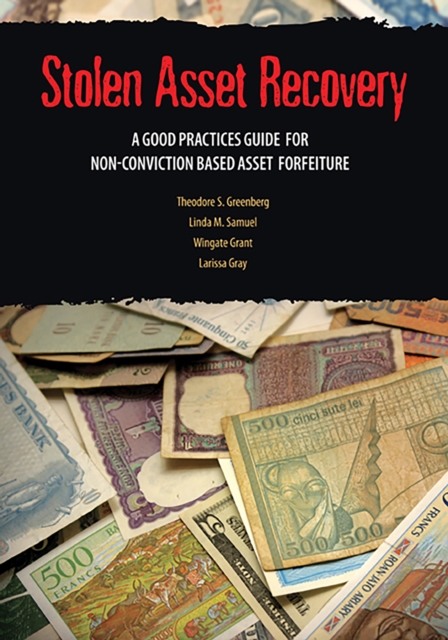
Stolen asset recovery : a good practices guide for non-conviction based asset forfeiture
A practical guide to recovering stolen assets and combating corruption. This guide provides a comprehensive overview of non-conviction based asset forfeiture, a powerful tool for recovering the proceeds of corruption, especially when assets are transferred abroad. It is designed for policy makers, legislators, prosecutors, investigators, and judges in countries considering or implementing these regimes. This guide identifies key concepts, legal frameworks, and best practices for effective asset recovery. It explores international treaties, asset tracing, and forfeiture procedures. Case studies and examples from various jurisdictions illustrate practical applications. It offers guidance on international cooperation, asset management, and balancing due process with effective enforcement. * Understand legal frameworks for asset forfeiture * Implement effective asset tracing and seizure strategies * Navigate international cooperation in asset recovery * Combat corruption and financial crime
eBook

Enforcement of foreign restraining orders
Purpose
– This article aims to discuss the problems that the USA encountered when it first attempted to enact and apply legislation designed to facilitate the enforcement of foreign asset-preservation orders, the remedial legislation enacted to address those problems, and the recent success the US Government has had under that new legislation in restraining assets at the request of foreign courts so that they may be forfeited under foreign law.
Design/methodology/approach
– The article reviews the legislative history of the statute enacted to permit the enforcement of foreign restraining orders and analyzes the cases applying that statute before and after its amendment in 2010.
Findings
– Legislation in the USA now permits the federal courts to register and enforce orders issued by foreign courts for the purpose of preserving assets that are subject to forfeiture under foreign law.
Originality/value
– This is a cutting edge topic in which there has been a great deal of new law in the past three years.
Journal Article

Public Wrongs, Private Actions : Civil Lawsuits to Recover Stolen Assets
Corruption and thefts of public assets harm a diffuse set of victims, weakens confidence in public institutions, damages the private investment climate, and threatens the foundations of the society as a whole. In developing countries with scarce public resources, the cost of corruption is an impediment to development: developing countries lose between US$20 to US$40 billion each year through bribery, misappropriation of funds, and other corrupt practices. Corruption is by no means a \"victimless crime.\" This study aims to explore the standing of States and Government entities as victims and the possible recourse to private actions to redress public wrongs. States and Government entities may act as private litigants and bring civil suits to recover assets lost to corruption. The goal of this work is to promote knowledge and understanding as well as to increase the use of civil remedies and private lawsuits to recover stolen assets in the context of the United Nations Convention against Corruption (UNCAC) offences. The UNCAC, the global standard for the fight against corruption, does not contain a legal definition of corruption itself but lists an array of offences, including public and private sector bribery and the embezzlement of public and private sector funds. The study will mainly focus on these two types of corruption, namely bribery and embezzlement of funds. This study is not intended in any way to minimize the importance of criminal proceedings and confiscation in addressing acts of corruption. Rather, it will show that civil law remedies can effectively complement criminal penalties by attacking the economic base of corrupt activities both in the public and the private sectors. In fact, given the magnitude of the challenges, all avenues of asset recovery, be they criminal or civil, should be explored simultaneously in order to tackle corruption from each and every angle and achieve the goals of deterrence and enforcement. Hence, while criminal law expresses society's disapproval of the corrupt acts and aims at dissuasion, punishment, and confiscation of illicit proceeds, civil law focuses on victims' interests and aims at compensation and restitution. These procedures may occur sometimes in parallel, sometimes sequentially. An effective response to corruption very often requires concomitant use of both criminal and civil law remedies to achieve the desired result.
Publication