
Catalogue Search | MBRL


Are you sure you want to remove the book from the shelf?

{{itemTitle}}
2,409
result(s) for
"Caricature"
Sort by:


The Cartoons That Shook the World
On September 30, 2005, the Danish newspaperJyllands-Postenpublished twelve cartoons of the Prophet Muhammad. Five months later, thousands of Muslims inundated the newspaper with outpourings of anger and grief by phone, email, and fax; from Asia to Europe Muslims took to the streets in protest. This book is the first comprehensive investigation of the conflict that aroused impassioned debates around the world on freedom of expression, blasphemy, and the nature of modern Islam.
Jytte Klausen interviewed politicians in the Middle East, Muslim leaders in Europe, the Danish editors and cartoonists, and the Danish imam who started the controversy. Following the winding trail of protests across the world, she deconstructs the arguments and motives that drove the escalation of the increasingly globalized conflict. She concludes that the Muslim reaction to the cartoons was not-as was commonly assumed-a spontaneous emotional reaction arising out of the clash of Western and Islamic civilizations. Rather it was orchestrated, first by those with vested interests in elections in Denmark and Egypt, and later by Islamic extremists seeking to destabilize governments in Pakistan, Lebanon, Libya, and Nigeria. Klausen shows how the cartoon crisis was, therefore, ultimately a political conflict rather than a colossal cultural misunderstanding.
eBook

Cartooning for a modern Egypt
\"The Egyptian caricature is generally studied as part of Egyptian mass culture, and mainly discussed in the context of Egypt's anti-colonial resistance to British foreign rule, as part of the forging of a \"national style\". In Cartooning for a Modern Egypt, Keren Zdafee foregrounds the role that Egypt's foreign-local entrepreneurs and caricaturists played in formulating and constructing the modern Egyptian caricature of the interwar years, that was designated for, and reflected, a colonial and cosmopolitan culture of a few. Keren Zdafee illustrates how Egyptian foreign-local caricaturists envisioned and evaluated the past, present, and future of Egyptian society, in the context of Cairo's colonial cosmopolitanism, by adopting a theoretical, semiotic, and historical approach\"-- Provided by publisher.
Book

Cartoons and caricatures of Mark Twain in context : reformer and social critic, 1869-1910
The first book-length treatment of Mark Twain’s public persona as depicted in newspaper and magazine illustrations
Cartoons and Caricatures of Mark Twain in Context: Reformer and Social Critic, 1869–1910 examines the production, reception, and history of Twain’s reputation as a social and political satirist. Myrick and Scharnhorst trace the evolution of Twain’s depiction throughout his life, career, and even death and across more than seventy illustrations—from portrayals of the famous author as a court jester adorned with cap and bells, to a regally haloed king with a royal train—offering a new perspective on his influence and reputation. Although he was among the most photographed figures of the nineteenth century, Myrick and Scharnhorst focus on a medium that Twain, an expert ofself-promotion and brand management, could not control. As a result, Myrick and Scharnhorst have compiled an innovative and incisive visual reception history.
Cartoons and Caricatures of Mark Twain in Context illustrates the popular and often critical response to many famous and infamous episodes in his career, such as the storm of controversy that surrounded the publication of his anti-imperialist writings at the turn of the twentieth century. Routinely depicted with hair like a fright wig, a beak-like nose, and a cigar in hand, no matter the context or the costume, Twain was instantly recognizable. Yet it was not merely the familiarity of his image that made him a regular feature in visual commentary, but also his willingness to speak out against corruption and to insert himself into controversies of his day.
eBook
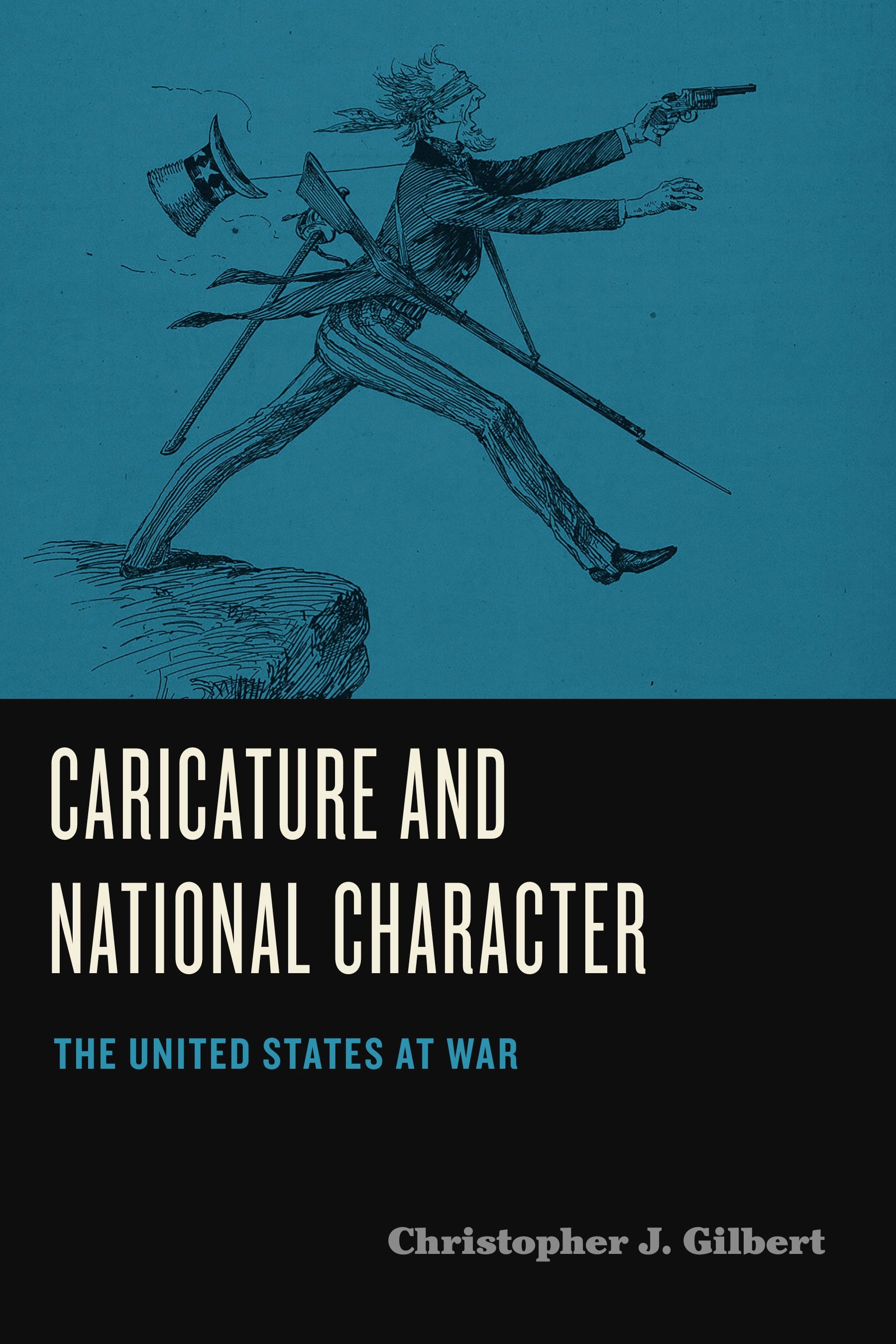
Caricature and National Character
According to the popular maxim, a nation at war reveals its true character. In this incisive work, Chris Gilbert examines the long history of US war politics through the lens of political cartoons to provide new, unique insights into American cultural identity.
Tracing the comic representation of American values from the First World War to the War on Terror, Gilbert explores the power of humor in caricature to expose both the folly in jingoistic virtues and the sometimes-strange fortune in nationalistic vices. He examines the artwork of four exemplary American cartoonists—James Montgomery Flagg, Dr. Seuss, Ollie Harrington, and Ann Telnaes—to craft a trenchant image of Americanism. These examinations animate the rhetorical, and indeed comic, force of icons like Uncle Sam, national symbols like the American Eagle, political stooges like President Donald J. Trump, and more, as well as the power of political cartoons to comment on issues of race, class, and gender on the home front. Throughout, Gilbert portrays a US culture rooted in and riven by ideas of manifest destiny, patriotism, and democracy for all, yet plagued by ugly forms of nationalism, misogyny, racism, and violence.
Rich with examples of hilarious and masterfully drawn caricatures from a diverse range of creators, this unflinching look at the evolution of our conflicted national character illustrates how American cartoonists use farce, mockery, and wit to put national character in the comic looking glass.
eBook

Style attention based global-local aware GAN for personalized facial caricature generation
Caricature is an exaggerated pictorial representation of a person, which is widely used in entertainment and political media. Recently, GAN-based methods achieved automatic caricature generation through transferring caricature style and performing shape exaggeration simultaneously. However, the caricature synthesized by these methods cannot perfectly reflect the characteristics of the subject, whose shape exaggeration are not reasonable and requires facial landmarks of caricature. In addition, the existing methods always produce the bad cases in caricature style due to the simpleness of their style transfer method.
In this paper, we propose a Style Attention based Global-local Aware GAN to apply the characteristics of a subject to generate personalized caricature. To integrate the facial characteristics of a subject, we introduce a landmark-based warp controller for personalized shape exaggeration, which employs the facial landmarks as control points to warp image according to its facial features, without requirement of the facial landmarks of caricature. To fuse the facial feature with caricature style appropriately, we introduce a style-attention module, which adopts an attention mechanism, instead of the simple Adaptive Instance Normalization (AdaIN) for style transfer. To reduce the bad cases and increase the quality of generated caricatures, we propose a multi-scale discriminator to both globally and locally discriminate the synthesized and real caricature, which improves the whole structure and realistic details of the synthesized caricature.
Experimental results on two publicly available datasets, the WebCaricature and the CaVINet datasets, validate the effectiveness of our proposed method and suggest that our proposed method achieves better performance than the existing methods.
The caricatures generated by the proposed method can not only preserve the identity of input photo but also the characteristic shape exaggeration for each person, which are highly close to the real caricatures drawn by real artists. It indicates that our method can be adopted in the real application.
Journal Article

Serials to Graphic Novels
\"A valuable and comprehensive survey of an enormous subject.\"--Paul Goldman, author ofReading Victorian Illustration, 1855-1875: Spoils of the Lumber Room \"A marvelous overview of how and why illustrations became an integral part of Victorian fiction. Golden documents a remarkable continuity from early nineteenth-century caricatures to realistic portrait-based illustrations to current graphic rewritings of familiar classics.\"--Martha Vicinus, author ofIntimate Friends: Women Who Loved Women, 1778-1928 \"A capacious and synthetic work that draws on a wide variety of scholarship, a very impressive command of the history of book illustration, a huge array of visual and verbal texts, and (most important) a commitment to the genreas a genre in the history of literary and artistic form.\"--Peter Betjemann, author ofTalking Shop: The Language of Craft in an Age of Consumption
The Victorian illustrated book came into being, flourished, and evolved during the nineteenth century. Catherine Golden offers a new framework for viewing the arc of this vibrant form and surveys the fluidity in styles of illustration in serial instalments, British and American periodicals, adult and children's literature, and--more recently--graphic novels.
Golden examines widely recognized illustrated texts, such asThe Pickwick Papers, Oliver Twist, Alice in Wonderland, andPeter Rabbit, and finds new expressions of this traditional genre in present-day graphic novel adaptations of the works of Austen, Dickens, and Trollope, as well as Neo-Victorian graphic novels likeThe League of Extraordinary Gentlemen. She explores the various factors that contributed to the early popularity of the illustrated book--the growth of commodity culture, a rise in literacy, new printing technologies--and how these ultimately created a mass market for new fiction.
While existing scholarship on Victorian illustrators largely centers on the Household Edition of Dickens or the realist artists of the \"Sixties,\" notably Fred Barnard and John Tenniel, this volume examines the lifetime of the Victorian illustrated book. It also discusses how a particular canon has been refashioned and repurposed for new generations of readers. Catherine J. Golden, professor of English at Skidmore College, is author of several books, includingPosting It: The Victorian Revolution in Letter Writing.\"A valuable and comprehensive survey of an enormous subject.\"--Paul Goldman, author ofReading Victorian Illustration, 1855-1875: Spoils of the Lumber Room \"A marvelous overview of how and why illustrations became an integral part of Victorian fiction. Golden documents a remarkable continuity from early nineteenth-century caricatures to realistic portrait-based illustrations to current graphic rewritings of familiar classics.\"--Martha Vicinus, author ofIntimate Friends: Women Who Loved Women, 1778-1928 \"A capacious and synthetic work that draws on a wide variety of scholarship, a very impressive command of the history of book illustration, a huge array of visual and verbal texts, and (most important) a commitment to the genreas a genre in the history of literary and artistic form.\"--Peter Betjemann, author ofTalking Shop: The Language of Craft in an Age of Consumption
The Victorian illustrated book came into being, flourished, and evolved during the nineteenth century. Catherine Golden offers a new framework for viewing the arc of this vibrant form and surveys the fluidity in styles of illustration in serial instalments, British and American periodicals, adult and children's literature, and--more recently--graphic novels.
Golden examines widely recognized illustrated texts, such asThe Pickwick Papers, Oliver Twist, Alice in Wonderland, andPeter Rabbit, and finds new expressions of this traditional genre in present-day graphic novel adaptations of the works of Austen, Dickens, and Trollope, as well as Neo-Victorian graphic novels likeThe League of Extraordinary Gentlemen. She explores the various factors that contributed to the early popularity of the illustrated book--the growth of commodity culture, a rise in literacy, new printing technologies--and how these ultimately created a mass market for new fiction.
While existing scholarship on Victorian illustrators largely centers on the Household Edition of Dickens or the realist artists of the \"Sixties,\" notably Fred Barnard and John Tenniel, this volume examines the lifetime of the Victorian illustrated book. It also discusses how a particular canon has been refashioned and repurposed for new generations of readers. Catherine J. Golden, professor of English at Skidmore College, is author of several books, includingPosting It: The Victorian Revolution in Letter Writing.
eBook
Economist video. How to draw Joe Biden
Kevin Callaher, cartoonist for the Economist, shows how to draw a caricature of Joe Biden.
Streaming Video

Playing the races : ethnic caricature and American literary realism
This book asks why so many of the writers who aligned themselves with the social and aesthetic aims of American literary realism apparently violated their most basic principles in relying on stock conventions of ethnic caricature in their treatment of immigrant and African American figures. As a self-described “tool of the democratic spirit”, designed to “prick the bubbles of abstract types” (William Dean Howells), literary realism would seem to have little in common with the aggressively dehumanizing comic imagery that began to proliferate in American magazines and newspapers after the Civil War. Indeed, Howells touted the democratic impulse of realist imagery, and Alain Locke hailed realism's potential to accomplish “the artistic emancipation of the Negro”. Yet in practice, Howells and his fellow realists regularly employed comic typification of ethnic subjects as a feature of their representational practice. Critics have generally dismissed such lapses in realist technique as vestiges of a genteel social consciousness that failed to keep pace with the movement's avowed democratic aspirations. Such explanations are useful to a point, but they overlook the fact that the age of realism in American art and letters was simultaneously the great age of ethnic caricature. This book argues that these two aesthetic programs, one committed to representation of the fully humanized individual, the other invested in broad ethnic abstractions, operate less as antithetical choices than as complementary impulses, both of which receive full play within the era's most demanding literary and graphic works.
eBook

Les caricatures comme manifestations de solidarité collective face au virus. Enjeux et perspectives de leur valeur référentielle
Der Beitrag „Karikaturen als Ausdruck der kollektiven Solidarität während der Pandemie. Referenzielle Perspektivierung” analysiert die Erfahrung der kollektiven Resilienz anhand der Untersuchung von humoristischen Bildern, Karikaturen, Wortwitzen und Fotomontagen, die das Leben in der Pandemie thematisieren und in den Jahren 2020 und 2021 im Netz erschienen sind. Die Frage nach einer Alternative zwischen der visuellen kommunikativen Erinnerung und der kulturellen Ära aus denen diese Karikaturen stammen, stand am Anfang der Untersuchung. Durch den Prozess der Fotomontage und der Entfremdung machen sich diese Texte und Bilder eine populäre visuelle Erinnerungskultur zu eigen, die illustrierte Bücher, Comics und Gemälde neu interpretiert und zugleich Zeuge einer Zeit wird, die durch restriktive Maßnahmen geprägt wurde. Der Beitrag stellt zwei Formen der Referentialität fest, die eng miteinander verbunden sind: der Bezug auf die Konjunktur durch den Hinweis auf die Covid-Krise sowie der Rückgriff auf die dauerhafte visuelle Erinnerung. Die Analyse der Art und Weise, wie sich das Korpus in einer gemeinsamen kulturellen Erinnerung einfügt, verdeutlicht die Verflechtung der sozialen Zusammenhänge in einer Zeit sozialer, ökonomischer und politischer Umbrüche.
L’article „les caricatures comme manifestations de solidarité csollective face au virus. Enjeux et perspectives de leur valeur référentielle” thématise l’expérience de résilience collective à travers l’étude des images humoristiques et caricatures, blagues, jeux de mots et photomontages ayant pour thème le vécu en contexte pandémique apparues sur le net en 2020 et 2021. La question initiale posée était celle d’une alternative entre la mémoire visuelle communicationnelle et l’aire culturelle respective dont dépendent ces caricatures. Par le biais du détournement et du montage, ces textes et images se réapproprient une culture populaire visuelle qui revisite livres illustrés, bandes dessinées et œuvres picturales classiques tout en se faisant témoins d’une période marquée par les mesures restrictives en période de crise sanitaire. L’article fait le constat de deux formes de référentialité étroitement liées : les références à la conjoncture à travers la référence à la crise du Covid et sa temporalité et le recours à la mémoire visuelle durable. L’analyse de la manière dont le corpus se réinscrit dans une mémoire culturelle commune démontre comment se retisse le lien social dans une période de bouleversements des rapports sociaux, économiques et politiques.
The article „Caricatures as an expression of collective solidarity. Issues and referential” deals with the experience of collective resilience through the analysis of humoristic pictures and caricatures, jokes, play on words and photomontage about the life in the pandemic context which appeared on the internet in 2020 and 2021. Initially the question was about an alternative between the visual communication memory and the cultural aera from which these caricatures depend. Through montage and diversion these texts and pictures suit a visual popular culture which reinterpret illustrated books, comic strips, classical works of art while witnessing the period of restrictive measures through the pandemic. The article comes to the conclusion of the existence of two kinds of referentiality: the references about the Covid-Crisis and its temporality and the use of long-lasting visual memory. The analysis of how the corpus reintegrates a common cultural memory shows how social cohesion rise again in a period of political economic and social changes.
Journal Article