
Catalogue Search | MBRL


Are you sure you want to remove the book from the shelf?

{{itemTitle}}
1,001
result(s) for
"Categorization (Linguistics)"
Sort by:

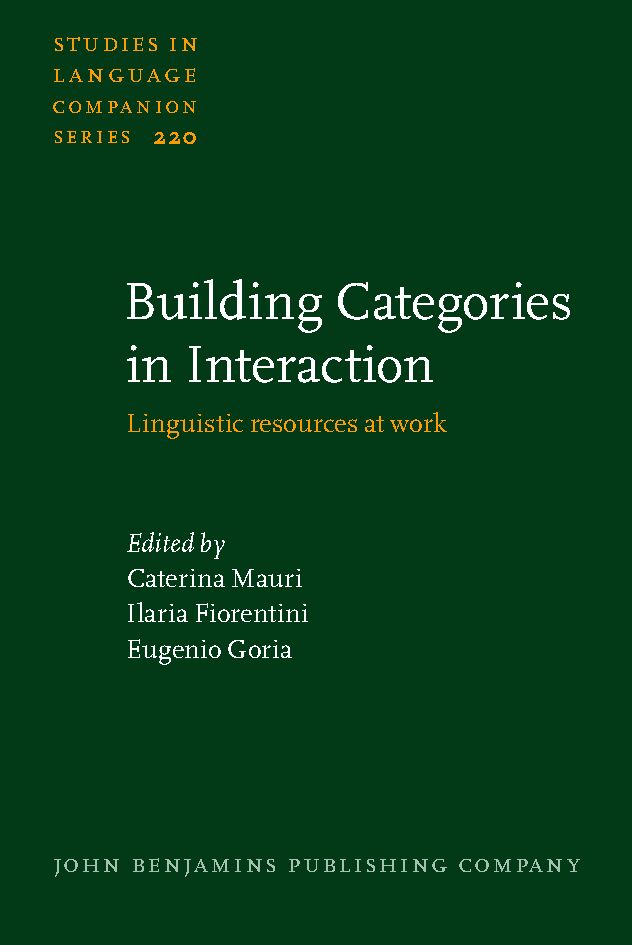
Building categories in interaction : linguistic resources at work
This book addresses the topic of linguistic categorization from a novel perspective. While most of the early research has focused on how linguistic systems reflect some pre-existing ways of categorizing experience, the contributions included in this volume seek to understand how linguistic resources of various nature (prosodic cues, affixes, constructions, discourse markers, …) can be 'put to work' in order to actively build categories in discourse and in interaction, to achieve social goals. This question is addressed in different ways by researchers from different subfields of linguistics, including psycholinguistics, conversation analysis, linguistic typology and discourse pragmatics, and a major point of innovation is represented in fact by the interdisciplinary nature of the volume and in the systematic search for converging evidence.
eBook

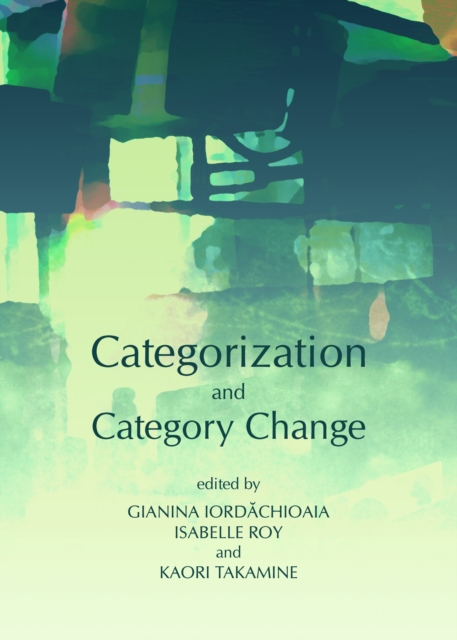
Categorization and Category Change
This collection of selected papers addresses theoretical and empirical issues related to lexical categories, categorization and category change. Any grammatical description makes use of parts-of-speech. The proper set of lexical categories and the definitions of their properties cross-linguistically has been a remnant issue in linguistics since the beginnings of grammatical description. Besides, the traditional classification of lexical classes with their morphological, syntactic and/or inter.
eBook

Language as a cue for social categorization in bilingual communities
This registered report article investigates the role of language as a dimension of social categorization. Our critical aim was to investigate whether categorization based on language occurs even when the languages coexist within the same sociolinguistic context, as is the case in bilingual communities. Bilingual individuals of two bilingual communities, the Basque Country (Spain) and Veneto (Italy), were tested using the memory confusion paradigm in a ‘ Who said what ? ’ task. In the encoding part of the task, participants were presented with different faces together with auditory sentences. Two different languages of the sentences were presented in each study, with half of the faces always associated with one language and the other half with the other language. Spanish and Basque languages were used in Study 1, and Italian and Venetian dialect in Study 2. In the test phase, the auditory sentences were presented again and participants were required to decide which face uttered each sentence. As expected, participants error rates were high. Critically, participants were more likely to confuse faces from the same language category than from the other (different) language category. The results indicate that bilinguals categorize individuals belonging to the same sociolinguistic community based on the language these individuals speak, suggesting that social categorization based on language is an automatic process.
Journal Article
Word learning as category formation
A fundamental question in word learning is how, given only evidence about what objects a word has previously referred to, children are able to generalize to the correct class. How does a learner end up knowing that “poodle” only picks out a specific subset of dogs rather than the broader class and vice versa? Numerous phenomena have been identified in guiding learner behavior such as the “suspicious coincidence effect” (SCE)—that an increase in the sample size of training objects facilitates more narrow (subordinate) word meanings. While SCE seems to support a class of models based in statistical inference, such rational behavior is, in fact, consistent with a range of algorithmic processes. Notably, the broadness of semantic generalizations is further affected by the temporal manner in which objects are presented—either simultaneously or sequentially. First, I evaluate the experimental evidence on the factors influencing generalization in word learning. A reanalysis of existing data demonstrates that both the number of training objects and their presentation-timing independently affect learning. This independent effect has been obscured by prior literature’s focus on possible interactions between the two. Second, I present a computational model for learning that accounts for both sets of phenomena in a unified way. The Naïve Generalization Model (NGM) offers an explanation of word learning phenomena grounded in category formation. Under the NGM, learning is local and incremental, without the need to perform a global optimization over pre-specified hypotheses. This computational model is tested against human behavior on seven different experimental conditions for word learning, varying over presentation-timing, number, and hierarchical relation between training items. Looking both at qualitative parameter-independent behavior and quantitative parameter-tuned output, these results support the NGM and suggest that rational learning behavior may arise from local, mechanistic processes rather than global statistical inference.
Journal Article
Language and the cognitive construal of the world
No detailed description available for \"Language and the Cognitive Construal of the World\".
eBook

LINGUISTIC CATEGORIZATION OF COLOR IN STATIC SYSTEMS AND SUBLTE DIFFERENCES DETECTED BY GENDER
Objective: The objective of this study was to evaluate how individuals in a specific culture perform the linguistic categorization of the dominant color in an image and to identify potential differences in such categorization. Theoretical Framework: Language is a fundamental component not only of culture but also of the mechanisms of the human brain, influencing both information processing and perception of the world. In this sense, linguistic categorization can provide insight into the functioning of the human mind, the perceptual experience of certain phenomena, and how language and visual perception interact across different cultures. Method: An empirical study was conducted in which participants were exposed to images with a dominant color. The linguistic categorization of this color was evaluated based on the participants' gender. Results and Discussion: The results showed variation in the linguistic categorization of the dominant color by gender. Women exhibited a broader range of categorization for different colors, which was also influenced by the intrinsic qualities of the object as well as by the visual processing derived from human structure Implications of the Research: The findings could influence how colors are used in products and advertising in a culturally sensitive manner, where color perception is critical based on gender differences. Originality/Value: This study examines how the intrinsic qualities of objects and human visual structure can alter perception and categorization, offering a new perspective on the relationship between language, culture, and the recognition of static systems.
Journal Article

