
Catalogue Search | MBRL


Are you sure you want to remove the book from the shelf?

{{itemTitle}}
6,384
result(s) for
"China Population policy."
Sort by:

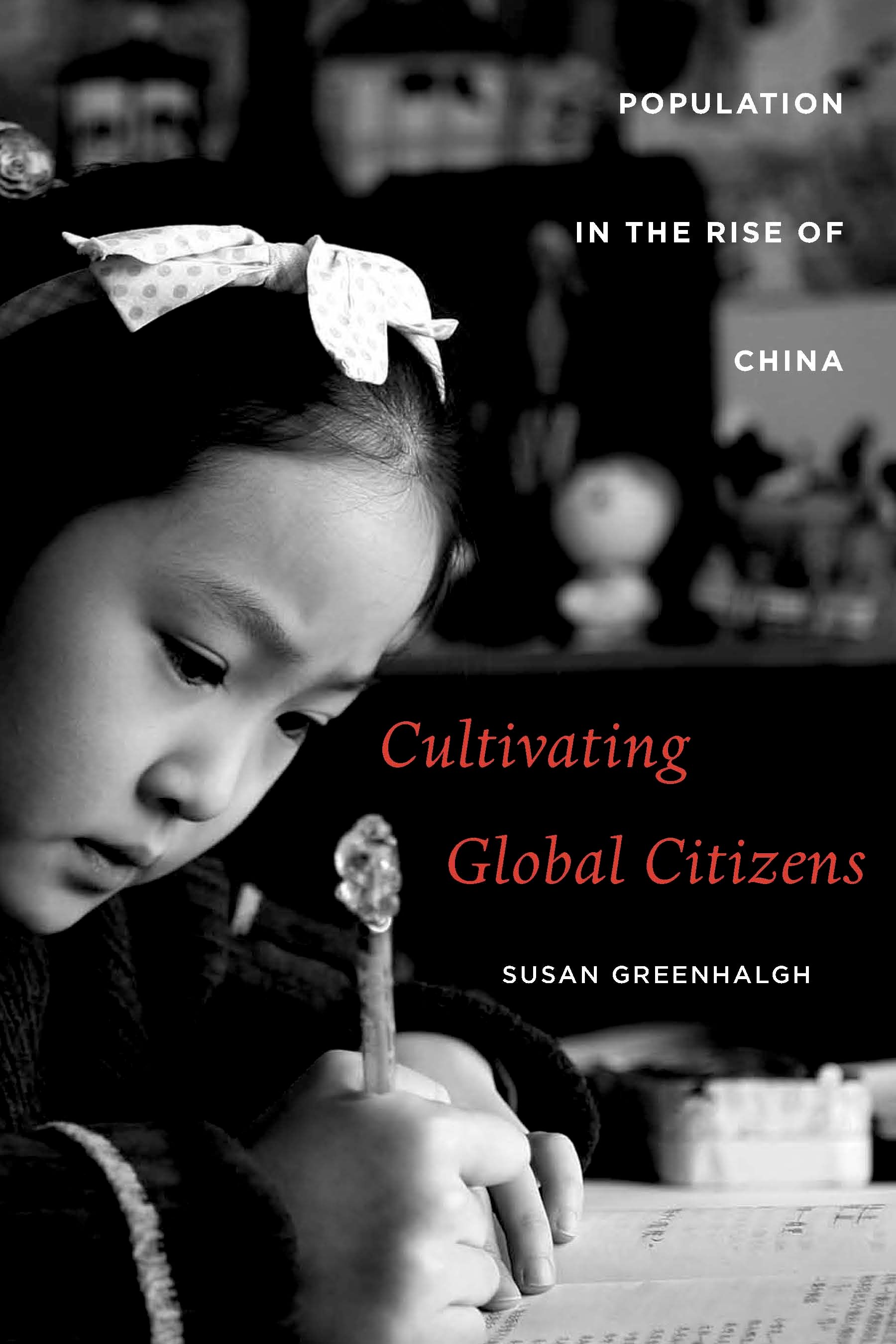
Cultivating global citizens : population in the rise of China
Current accounts of China's global rise emphasize economics and politics, largely neglecting the cultivation of China's people. Susan Greenhalgh, one of the foremost authorities on China's one-child policy, places the governance of population squarely at the heart of China's ascent.
Focusing on the decade since 2000, and especially 2004–09, she argues that the vital politics of population has been central to the globalizing agenda of the reform state. By helping transform China's rural masses into modern workers and citizens, by working to strengthen, techno-scientize, and legitimize the PRC regime, and by boosting China's economic development and comprehensive national power, the governance of the population has been critically important to the rise of global China.
After decades of viewing population as a hindrance to modernization, China's leaders are now equating it with human capital and redefining it as a positive factor in the nation's transition to a knowledge-based economy. In encouraging \"human development,\" the regime is trying to induce people to become self-governing, self-enterprising persons who will advance their own health, education, and welfare for the benefit of the nation. From an object of coercive restriction by the state, population is being refigured as a field of self-cultivation by China's people themselves.
eBook


Behind the silence
Behind the Silence is the first in-depth work in any language to explore the diverse perspectives of mainland Chinese regarding induced abortion and fetal life in the context of the world's most ambitious and intrusive family planning program. Bringing to light the range of Chinese views and experiences, Nie Jing-Bao draws on extensive primary sources and intensive fieldwork, including surveys by and interviews with hundreds of rural, urban, and overseas Chinese. Nie's exploration of the multi-layered meanings of public silence, official pronouncements, forgotten controversies from the Imperial era, public and private consensus and disagreement, women's personal stories, and doctors' narratives provides compelling evidence on the remarkably varied, sometimes critical, and often tormented voices of the Chinese people. Revealing a surprising range of beliefs and feelings concerning the morality of abortion and fetal life, the book nevertheless finds widespread acceptance of national population policies. It also examines the personal anguish and complex socio-cultural and ethical issues entwined with coerced abortion essential to enforce birth-control policies. In addition, the author argues, the abortion issue illustrates the importance of taking seriously China's internal plurality if Westerners and Chinese are to develop a fruitful cross-cultural dialogue.
eBook

Birth Control in China 1949-2000
This comprehensive volume analyzes Chinese birth policies and population developments from the founding of the People's Republic to the 2000 census. The main emphasis is on China's 'Hardship Number One Under Heaven': the highly controversial one-child campaign, and the violent clash between family strategies and government policies it entails.Birth Control in China 1949-2000 documents an agonizing search for a way out of predicament and a protracted inner Party struggle, a massive effort for social engineering and grinding problems of implementation. It reveals how birth control in China is shaped by political, economic and social interests, bureaucratic structures and financial concerns. Based on own interviews and a wealth of new statistics, surveys and documents, Thomas Scharping also analyzes how the demographics of China have changed due to birth control policies, and what the future is likely to hold. This book will be of interest to students and scholars of modern China, Asian studies and the social sciences.
eBook

Hong Kong Mobile
In this interdisciplinary study, the authors argue that Hong Kong must develop and strengthen the mobility, broadly defined, of its population. This is at the heart of its need to face the challenges from a changing global environment. Being a \"space of f
eBook

Birth Control in China 1949-2000
This comprehensive volume analyses Chinese birth policies and population developments from the founding of the People's Republic to the 2000 census. The main emphasis is on China's 'Hardship Number One Under Heaven': the highly controversial one-child campaign, and the violent clash between family strategies and government policies it entails.Birth Control in China 1949-2000 documents an agonizing search for a way out of predicament and a protracted inner Party struggle, a massive effort for social engineering and grinding problems of implementation. It reveals how birth control in China is shaped by political, economic and social interests, bureaucratic structures and financial concerns. Based on own interviews and a wealth of new statistics, surveys and documents, Thomas Scharping also analyses how the demographics of China have changed due to birth control policies, and what the future is likely to hold. This book will be of interest to students and scholars of Modern China, Asian studies and the social sciences.
eBook

Options for Fertility Policy Transition in China
This article compares five currently debated scenarios for fertility policy transition in China, in terms of their implications for future population growth and population aging, the proportions of elderly living alone, labor force trends, pension deficits, economic costs, the marriage squeeze, and other socioeconomic outcomes. Based on these comparative analyses, the author concludes that China needs to begin a gradual modification of its fertility policy as soon as possible. He proposes a three-stage \"soft-landing\" strategy for fertility policy transition: (1) a 7-year initial smooth transition period; (2) from approximately 2014-15 to 2032-35 a universal two-child policy combined with late childbearing in both rural and urban areas; (3) after 2032-35 all Chinese citizens would be free to choose family size and fertility timing. This strategy will enable China to have much more favorable demographic conditions and socioeconomic outcomes, as compared to keeping the current policy unchanged.
Journal Article

Chinese Economic Reforms and Fertility Bahaviour
Based on an intensive fieldwork in a southern Hebei village in northern China (1992/3), the author takes an institutional approach and focuses on the way deliberate Chinese state policies driven by new economic and social agendas since the late 1970s have impacted on marriage, family relations and consequently on the way fertility trends have been adversely affected; the study is also very much concerned with the human dimension and the way in which such social and economic changes are perceived and applied in a rural community. The research presented in this study goes a long way to unravelling the puzzle concerning the reasons for a very rapid decline in Chinese fertility rates, contrasting sharply with a very different fertility transition within western cultures.
eBook