
Catalogue Search | MBRL


Are you sure you want to remove the book from the shelf?

{{itemTitle}}
62
result(s) for
"Classic horror "
Sort by:

Lally's game
Some secrets are better left hidden. A forbidden artifact from her fiancé's past beckons to Selena. Jessica leads a double-life from her friends and coworkers in the children's wing of a hospital. Maya can't resist the temptation to explore an off-limits area of Freddy Fazbear's Mega Pizzaplex. But in the world of 'Five Nights at Freddy's', everything comes with a price to pay. Readers beware: this collection of terrifying tales is enough to unsettle even the most hardened 'Five Nights at Freddy's' fans.
BOOK

Agatha Christie and Gothic Horror
Agatha Christie's work has been adapted extensively resulting in transformations that are both textual and cultural. While many adaptations are best known for being quaint murder mysteries, there are many adaptations of her work that draw on horror aesthetics. This book will look at how the growth of Agatha Christie adaptations have grown increasingly darker. Of key relevance to this study is the work of Sarah Phelps, whose 'Witness for the Prosecution', 'And Then There Were None', 'Ordeal by Innocence', 'The ABC Murders' and 'The Pale Horse' all are darker than their precedents. Born out of their contemporary screen contexts, they use entrenched literary and filmic codes of Gothic horror as central reference points for audiences. Drawing on adaptation scholarship, where adapters are interpreters as well as creators, this study will look at how Agatha Christie is closer to Gothic horror than what we realise.
eBook

Poe : stories and poems : a graphic novel adaptation
A volume of graphic novel renderings of some of Edgar Allan Poe's best-known works includes \"The Cask of Amontillado,\" \"The Tell-Tale Heart\" and \"The Raven.\"
BOOK

Monstrous Beings and Media Cultures
Monstrous Beings of Media Cultures examines the monsters and sinister creatures that spawn from folk horror, Gothic fiction, and from various sectors of media cultures. The collection illuminates how folk monsters form across different art and media traditions, and interrogates the 21C revitalization of “folk” as both a cultural formation and aesthetic mode. The essays explore how combinations of vernacular and institutional creative processes shape the folkloric and/or folkoresque attributes of monstrous beings, their popularity, and the contexts in which they are received.
While it focuses on 21C permutations of folk monstrosity, the collection is transhistorical in approach, featuring chapters that focus on contemporary folk monsters, historical antecedents, and the pre-C21st art and media traditions that shaped enduring monstrous beings. The collection also illuminates how folk monsters and folk “horror” travel across cultures, media, and time periods, and how iconic monsters are tethered to yet repeatedly become unanchored from material and regional contexts.
eBook
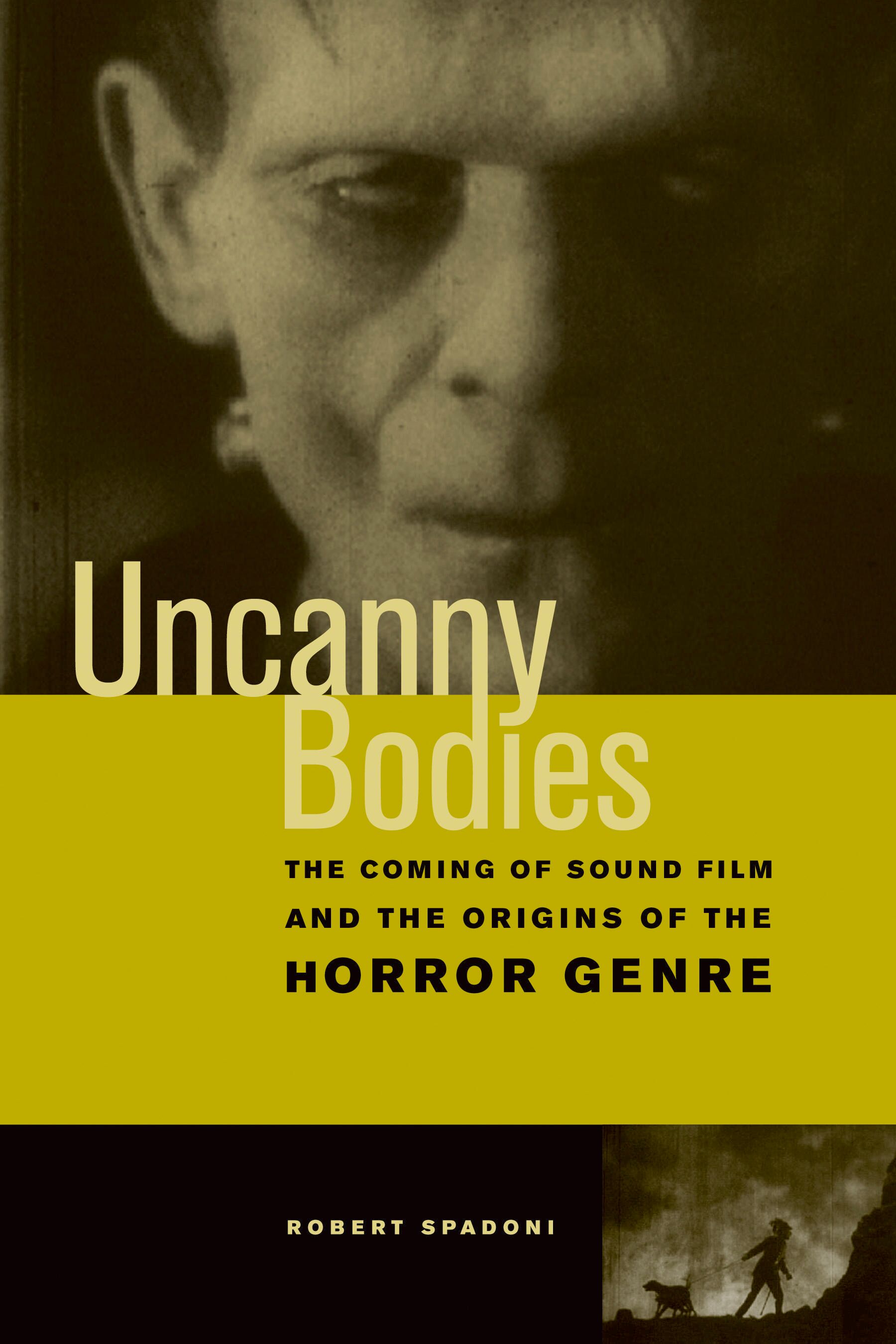
Uncanny Bodies
In 1931 Universal Pictures released Dracula and Frankenstein, two films that inaugurated the horror genre in Hollywood cinema. These films appeared directly on the heels of Hollywood's transition to sound film. Uncanny Bodies argues that the coming of sound inspired more in these massively influential horror movies than screams, creaking doors, and howling wolves. A close examination of the historical reception of films of the transition period reveals that sound films could seem to their earliest viewers unreal and ghostly. By comparing this audience impression to the first sound horror films, Robert Spadoni makes a case for understanding film viewing as a force that can powerfully shape both the minutest aspects of individual films and the broadest sweep of film production trends, and for seeing aftereffects of the temporary weirdness of sound film deeply etched in the basic character of one of our most enduring film genres.
eBook

Uncanny Bodies
In 1931 Universal Pictures released Dracula and Frankenstein, two films that inaugurated the horror genre in Hollywood cinema. These films appeared directly on the heels of Hollywood's transition to sound film. Uncanny Bodies argues that the coming of sound inspired more in these massively influential horror movies than screams, creaking doors, and howling wolves. A close examination of the historical reception of films of the transition period reveals that sound films could seem to their earliest viewers unreal and ghostly. By comparing this audience impression to the first sound horror films, Robert Spadoni makes a case for understanding film viewing as a force that can powerfully shape both the minutest aspects of individual films and the broadest sweep of film production trends, and for seeing aftereffects of the temporary weirdness of sound film deeply etched in the basic character of one of our most enduring film genres.
eBook

Detective Fiction and the Ghost Story
Detective Fiction and the Ghost Story is a lively series of case studies celebrating the close relationship between detective fiction and the ghost story. It features many of the most famous authors from both genres including Conan Doyle, Agatha Christie, M. R. James and Tony Hillerman.
eBook