
Catalogue Search | MBRL


Are you sure you want to remove the book from the shelf?

{{itemTitle}}
9,125
result(s) for
"Classroom Organization"
Sort by:

Middle School Teachers’ Mindfulness, Occupational Health and Well-Being, and the Quality of Teacher-Student Interactions
Building upon contemporary models of teaching that suggest that teachers’ own well-being is related to their classroom practice and student outcomes, we examined whether middle school teachers’ mindfulness skills were related to their concurrent occupational health and well-being (job stress, occupational burnout, and depressive and anxiety symptoms), and quality of their interactions with students in their “most stressful” class during the school day. Multivariate regression analyses of 58 middle school teachers indicated that teacher mindfulness was significantly associated with lower levels of job stress, occupational burnout, and depressive and anxiety symptoms; and higher levels of observers’ ratings of teachers’ emotionally supportive interactions with students in their most stressful classroom. Occupational burnout, in contrast, was negatively related to observers’ ratings of emotional support and organization in the classroom. Results suggest individual differences in middle school teachers’ mindfulness may affect their interactions with students in the middle school classroom directly and through reductions in burnout, though longitudinal studies of these relations are needed. Findings are discussed in relation to intervention efforts to improve teacher mindfulness through training in order to support occupational health and well-being, improve the quality of teacher-student interactions in the classroom, and increase student engagement and learning.
Journal Article

Classroom Peer Relationships and Behavioral Engagement in Elementary School: The Role of Social Network Equity
Applying social capital and systems theories of social processes, we examine the role of the classroom peer context in the behavioral engagement of low-income students (
N
= 80) in urban elementary school classrooms (
N
= 22). Systematic child observations were conducted to assess behavioral engagement among second to fifth graders in the fall and spring of the same school year. Classroom observations, teacher and child questionnaires, and social network data were collected in the fall. Confirming prior research, results from multilevel models indicate that students with more behavioral difficulties or less academic motivation in the fall were less behaviorally engaged in the spring. Extending prior research, classrooms with more equitably distributed and interconnected social ties—social network equity—had more behaviorally engaged students in the spring, especially in classrooms with higher levels of observed organization (i.e., effective management of behavior, time, and attention). Moreover, social network equity attenuated the negative relation between student behavioral difficulties and behavioral engagement, suggesting that students with behavioral difficulties were less disengaged in classrooms with more equitably distributed and interconnected social ties. Findings illuminate the need to consider classroom peer contexts in future research and intervention focused on the behavioral engagement of students in urban elementary schools.
Journal Article

How teachers can improve their classroom interaction with students: New findings from teachers themselves
Teachers are the most important agents in shaping education for students and to bring change and innovation in educational practices. There is a lack of knowledge about how teachers learn and transfer their knowledge into practice in the classrooms. Teacher educators have repeatedly argued that classroom management is a critical pedagogical skill that teachers must master in order to maximize classroom interaction. This study aims to contribute to the understanding of how lower secondary school teachers learn and improve classroom interaction in the context of an educational intervention. Three aspects of classroom interaction are addressed: emotional support, classroom organization and instructional support. The sample contained 81 teachers from 14 Norwegian lower secondary schools reporting, through digital logs, on learning experiences with respect to classroom interaction. Moreover, they reported on the types of learning activities they undertook. Findings indicated that teachers’ improvement in classroom interaction was, to a large extent, dependent on their own, or their colleagues’ strong knowledge of classroom interaction. The results of the study add to our understanding of teachers’ knowledge and skills within classroom interaction and how teachers can improve their knowledge, e.g., through reflection on situations in the classroom. Still, the authors suggest a stronger emphasis on the integration of research based knowledge and teacher learning strategies to support teachers to reach their full teaching potential.
Journal Article

Classroom organization and teacher stress predict learning motivation in kindergarten children
This study examined the extent to which observed teaching practices and self-reported teacher stress predict children's learning motivation and phonological awareness in kindergarten. The pre-reading skills of 1,268 children were measured at the beginning of their kindergarten year. Their learning motivation and phonological awareness were assessed in the following spring. Questionnaires measuring teacher stress were filled out by 137 kindergarten teachers. A pair of trained observers used the Classroom Assessment Scoring System (Pianta et al. 2008) to observe 49 kindergarten teachers from the whole sample on their emotional support, classroom organization, and instructional support. The results of multilevel modeling showed that low teacher stress and high classroom organization predicted high learning motivation in children and that the children's learning motivation contributed to their level of phonological awareness. Moreover, children's learning motivation mediated the association between teacher stress and children's phonological awareness. The results emphasize the importance of teachers' pedagogical well-being and classroom organizational quality for children's learning motivation.
Journal Article

An empirical study on integrating technology into statistics classroom practice
There has been much attention given to the use of technology in education; mostly concentrating on physical artifacts of technology to facilitate teaching delivery but little mentioning technology as a cultural resource to organize the learning environment promoting social interaction among students and between teacher and students. This paper thus attempts to derive a model of pedagogy in an IT environment taking social interaction in classroom learning into account and reports a process of validating the model through two observation studies and two questionnaire-based surveys. The first observation study took place in a lecture theatre where a teacher led a class discussion toward developing statistical concepts and showed that all students were attentive and participative. In the second observation study, the students in a computing laboratory were divided into small groups to solve statistical problems collaboratively. The first survey was conducted during the term time to interview students through which they reported their personal perceptions of and attitudes toward the educational use of technology. A questionnaire in the second survey was sent to the students via e-mail after the term time. In the questionnaire, they were asked to compare the experience of working in an IT environment between the classrooms using and not using a model of pedagogy in an IT environment. The students in the surveys reported that teacher facilitation of group learning in the statistics module with technology were different from other statistics modules they took in the same academic year because they appreciated group discussion that promoted social interaction and fostered working relationships, thus leading to construction of knowledge. These four studies show consistent results and evidence in supporting a successful implementation of the model into a statistics classroom practice. More importantly, the observation studies give a detailed account of peer collaboration, mutual assistance, and productive interaction in a process of discussion and the teacher sensitivity to adjust the means of scaffolding assistance that substantiate the survey findings.
Journal Article

Iranian EFL teachers' beliefs and practices regarding writing activities and class organization
This study aimed to find out the relationship among EFL university teachers' code-based and meaning-based beliefs in writing instruction, classroom writing activities and classroom organization. To this end, 120 university teachers, who were teaching writing to EFL learners at different universities in Iran, participated in the study. For the data collection, a valid and reliable questionnaire on writing was used. Descriptive statistics and Pearson Product-Moment correlation were carried out for analyzing the data. The results showed that the correlations between both teachers' meaning-based and code-based beliefs in writing and writing activities exist. It was also found that the correlations between meaning-based beliefs in writing and whole class activity and group work as ways of doing writing activities were significantly positive. However, meaning-based beliefs in writing and individual writing were not correlated significantly. Moreover, correlations between code-based beliefs in writing and individual writing and whole class were positively significant and there was a positive but not significant correlation between code-based beliefs in writing and group work. The results can be useful for teachers to consider their beliefs and match them with their practices, use the activities that are more beneficial in their classes, and organize their classes in a way that stimulate the learners' interest in writing.
Journal Article

Learning and teaching in the primary classroom
Providing a framework for understanding the individual needs of pupils, this book describes how to tailor teaching methods to maximize learning. Readers will learn how to take account of their pupils′ knowledge, skills and attitudes when selecting and applying principles of instruction, in order to make learning in the classroom as successful as possible. Packed with informative case studies and classroom examples, the book explores how learning is conceptualized, direct instruction, interactive teaching, teaching as scaffolding, and how to overcome obstacles to learning. Readers will learn how to best apply theories of instruction and provide effective, dynamic teaching.
eBook

Classroom Observation
Building on recent changes and debates surrounding the use of observation, this fully updated second edition of Classroom Observation explores the role of lesson observation in the preparation, assessment and professional learning of teachers, lecturers and educators at all levels and across all educational organisations. Offering practical guidance and detailed insights on an aspect of training that is a source of anxiety for many teachers, this thought-provoking book offers a critical analysis of the place, role and nature of lesson observation in the lives of education professionals.
Updated to incorporate the latest research, policy and practical developments on observation, this new edition also includes greater coverage of research and developments in the field of observation beyond the UK. Enabling readers to use observation as a lens for understanding, informing and improving teaching and learning, and equipping them with structured frameworks for applying observation, this book includes sections on:
Teacher autonomy and professional identity
Performance management, professional standards and accountability
Peer observation, self-observation and critical reflection
Educational assessment and evaluation
Peer-based models of observation
Using digital technology to inform learning.
Written for all student and practising teachers as well as teacher educators and those engaged in educational research, Classroom Observation is an essential introduction to how we observe, why we observe, and how it can be best used to improve teaching and learning.
eBook
The role of peer tutoring integrated with KWL charts in the development of students' inferential skills
Peer Tutoring is a widely used method of teaching English. Peer tutoring, a pedagogical strategy that has the potential to assist Indonesian advanced students in developing inferential understanding by combining it with KWL charts, has, however, received little attention in the context of Indonesian EFL (English as a Foreign Language). The aims are first to know the implementation of peer tutoring and KWL Charts in reading. Second, to know whether or not there is a significant difference in students' inferential understanding. Third, to know the factors affecting students' inferential understanding. Fourth, to know the students' attitudes toward the role of PT integrated with KWL charts in developing inference skills. For these purposes, 54 advanced students participated in the project. This research utilizes a mixed-method design, combining (a) one group pretest-posttest design, with (b) a qualitative study. The researcher uses various data collection methods, including pretest-posttests, interviews and questionnaires. The paired sample t-test was used to interpret the quantitative data. To analyze qualitative data, the researcher uses descriptive analysis. The study shows that peer tutoring integrated with KWL benefits students' positive attitudes toward reading comprehension. Moreover, there is a significant difference in students' inferential understanding when using peer tutoring integrated with KWL.
Journal Article
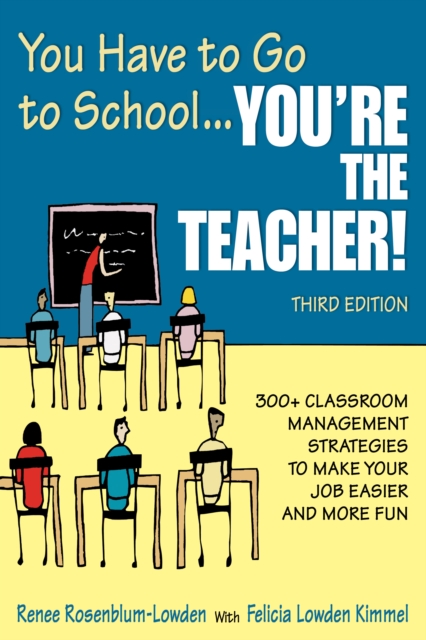
You Have to Go to School… You're the Teacher! 300+ Classroom Management Strategies to Make Your Job Easier and More Fun
Praise for the Second Edition:“This book should be required reading for all teachers. The multitude of classroom strategies offers teachers invaluable insights and techniques.”Praise for the Third Edition:“This book speaks to rookie teachers, veteran teachers, and every teacher in between. Through sharing stories, modeling behaviors, and holding up a mirror, the authors convey in a lighthearted way the truth of what teaching is all about—creating a classroom environment that encourages both students and educators to strive for and experience success.”Resolve classroom management challenges with more than 300 field-tested insights, tips, and strategies!In the third edition of this bestseller, teacher, trainer, and keynote speaker Renee Rosenblum-Lowden and school counselor Felicia Lowden Kimmel offer beginning and experienced teachers an abundance of techniques for dealing with everyday classroom management issues. Blending their professional knowledge, common sense, and wit, the authors provide new strategies for:Avoiding confrontations, defusing difficult situations, and encouraging honest communication; Empowering students by building their confidence and cultivating responsible behaviors; Getting students to complete homework assignments, come prepared, and stay on task; Working with parents and staffThis timeless collection of innovative ideas and teacher-tested methods is an ideal “mentor-in-a-book” that educators will use again and again throughout their careers.
eBook