
Catalogue Search | MBRL


Are you sure you want to remove the book from the shelf?

{{itemTitle}}
15
result(s) for
"Consumentisme."
Sort by:

Marketing modernity : Italian advertising from fascism to postmodernity
\"Marketing modernity traces the development of consumer culture in Italy from the 1920s to the present day. In so doing, Adam Arvidsson argues that the culture of consumption we see in Italy today has its direct roots in the social vision articulated by the advertising industry in the years following the First World War. He then goes on to discuss how that vision was further elaborated by advertising's interaction with subsequent major actors in twentieth-century Italy: Fascism, post-war mass political parties and the counter-culture of the 1960s and 1970s.\"--Jacket.
Book

Consumer Culture and Postmodernism
The First Edition of this contemporary classic can claim to have put ′consumer culture′ on the map, certainly in relation to postmodernism. Updated throughout, this expanded new edition includes a fully revised preface that explores the developments in consumer culture since the First Edition. Among the most noteworthy areas discussed are the effect of global warming on consumption, the rise of the new rich, changes in the North/South divide and the new diversity of consumer culture. The result is a book that shakes the boundaries of debate, from one of the foremost writers on culture and postmodernism of the present day.
eBook

The saturated society : governing risk and lifestyles in consumer culture
Detailed and thought-provoking discussion of lifestyle regulation and how preventive lifestyle policies need to be shaped with the ′saturated society′ - a society of self-controlled, fully autonomous individuals - in mind.
eBook

Crime, Gender and Consumer Culture in Nineteenth-Century England
Whilst the actual origins of English consumer culture are a source of much debate, it is
clear that the nineteenth century witnessed a revolution in retailing and consumption.
Mass production of goods, improved transport facilities and more sophisticated sales
techniques brought consumerism to the masses on a scale previously unimaginable. Yet
with this new consumerism came new problems and challenges. Focusing on retailing in
nineteenth-century Britain, this book traces the expansion of commodity culture and a
mass consumer orientated market, and explores the wider social and cultural implications
this had for society. Using trial records, advertisements, newspaper reports,
literature, and popular ballads, it analyses the rise, criticism, and entrenchment of
consumerism by looking at retail changes around the period 1800-1880 and society's
responses to them. By viewing this in the context of what had gone before Professor
Whitlock emphasizes the key role women played in this evolution, and argues that the
dazzling new world of consumption had beginnings that predate the later English, French
and American department store cultures. It also challenges the view that women were
helpless consumers manipulated by merchants' use of colour, light and display into
excessive purchases, or even driven by their desires into acts of theft. With its
interdisciplinary approach drawing on social and economic history, gender studies,
cultural studies and the history of crime, this study asks fascinating questions
regarding the nature of consumer culture and how society reacts to the challenges this
creates.
eBook

Dictatorship and Demand
Intro -- Contents -- Acknowledgments -- Abbreviations -- Introduction -- 1. Production and Consumption: Establishing Priorities -- 2. The Contest Begins: The Currency Reform, the Berlin Blockade, and the Introduction of the HO -- 3. The Planned and the Unplanned: Consumer Supply and Provisioning Crisis -- 4. The Rise, Decline, and Afterlife of the New Course -- 5. Demand Research and the Relations Between Trade and Industry -- 6. Crisis Revisited: The Main Economic Task and the Building of the Berlin Wall -- Epilogue -- Notes -- Index.
Book
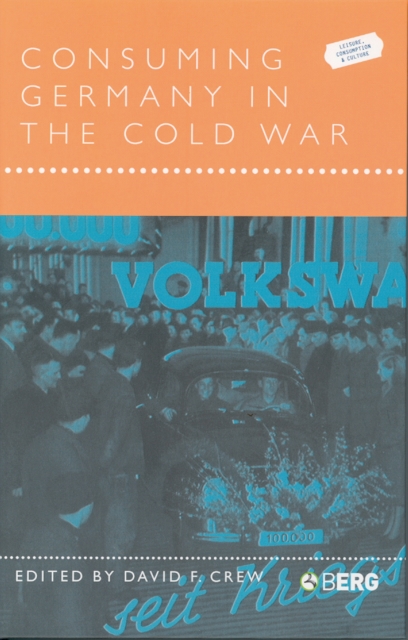
Consuming Germany in the Cold War
Sitting in the ruins of the Third Reich, most Germans wanted to know which of the two post-war German states would erase the material traces of their wartime suffering most quickly and most thoroughly. Consumption and the quality of everyday life quickly became important battlefields upon which the East-West conflict would be fought. This book focuses on the competing types of consumer societies that developed over time in the two Germanies and the legacy each left. Consuming Germany in the Cold War assesses why East Germany increasingly fell behind in this competition and how the failure to create a viable socialist “consumer society” in the East helped lead to the fall of the Berlin Wall in 1989. By the 1970s, East Germans were well aware that the regime’s bombastic promises that the GDR would soon overtake the West had become increasingly hollow. For most East German citizens, West German consumer society set the standards that East Germany repeatedly failed to meet. By exploring the ways in which East and West Germany have functioned as each other’s “other” since 1949, this book suggests some of the possibilities for a new narrative of post-war German history. While taking into account the very different paths pursued by East and West Germany since 1949, the contributors demonstrate the importance of competition and highlight the connections between the two German successor states, as well as the ways in which these relationships changed throughout the period. By understanding the legacy that forty-plus years of rivalry established, we can gain a better understanding of the current tensions between the eastern and western regions of a united Germany.
eBook

Consuming Germany in the Cold War
Consuming Germany in the Cold War : consumption and national identity in East and West Germany, 1949-1989, an introduction / David F. Crew -- \"A world in miniature\" : the Leipzig Trade Fairs in the 1950s and East German consumer citizenship / Katharine Pence -- On the seam between socialism and capitalism : East German fashion shows / Judd Stitziel -- The order of substitutes : plastic consumer goos in the Volkswirtschaft and everyday domestic life in the GDR / Eli Rubin -- Born again in the gospel of refreshment? : Coca-colonization and the re-making of postwar German identity / Jeff R. Schutts -- Miracles for sale : consumer displays and advertising in postwar West Germany / S. Jonathan Wiesen -- Drugs, consumption and internationalization in Hamburg, 1960-1968 / Robert P. Stephens
Book
Speeding Up Fast Capitalism
In his 1989 book, Fast Capitalism, Ben Agger presented a framework for understanding late-20th century social problems. Speeding Up Fast Capitalism, a sequel to his earlier book, assesses social changes since the end of the 1980s brought about by information technologies like the Internet, which have quickened the pace of everyday life. In Speeding Up Fast Capitalism, Agger assesses the impact of the Internet on consciousness, communication, culture and community, and evaluates the prospects of democratic social change. Where the earlier book was largely theoretical, Speeding Up applies critical theory to specific topics such as Internet culture, work, families, childhood, schooling, food, the body and fitness. Although indebted to Fast Capitalism, the sequel appeals to an audience wider than theorists, including empirical sociologists, social scientists and scholars in cultural disciplines.
eBook
