
Catalogue Search | MBRL


Are you sure you want to remove the book from the shelf?

{{itemTitle}}
3,714
result(s) for
"Consumers Biography."
Sort by:

Henry Poole & Co. : the first tailor of Savile Row
Known as the founding tailor of Savile Row, Henry Poole & Co. has been dressing the world's most important men and women for over two centuries. Their craft of bespoke tailoring has been meticulously documented through the generations in a complete set of ledgers. Telling the story of Poole's most colourful characters in six chapters, this fascinating account distills Sherwood's research into sixty iconic customers, men and women. Each client is profiled with details of their signature garment and connections with Poole's. From artists and writers, such as Henri de Toulouse-Lautrec and Wilkie Collins, to financiers J.P. Morgan and Baron Ferdinand de Rothschild, this book offers a unique window into an establishment at the very heart of 19th- and 20th-century public life. Illustrated with historic portraits and atmospheric photography of the premises as they are today, this intimate glimpse into the private lives of some of history's most influential figures is essential reading for anyone interested in Savile Row, the relationship between power and being well-dressed, and the evolution of style.
Book
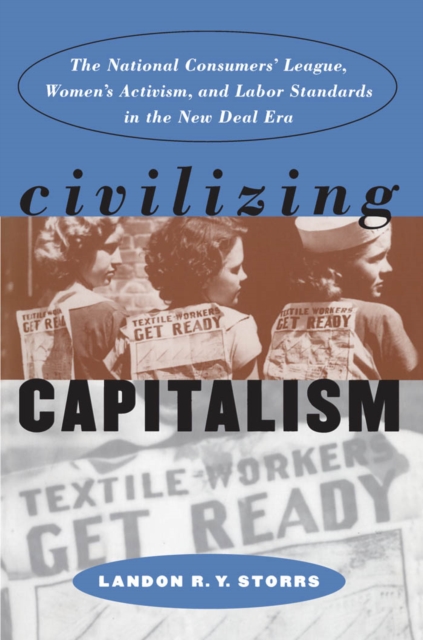
Civilizing capitalism : the National Consumers' League, women's activism, and labor standards in the New Deal era
Aiming to offer fresh insights into the history of labour policy, the New Deal, feminism, and southern politics, the author of this work examines the New Deal era of the National Consumers' League, one of the most influential reform organizations of the early 20th century
eBook

A question of value : stories from the life of an auctioneer
\"In thirty-one essays, each titled for a specific item Bob encountered in his long and increasingly successful auction career, objects are presented as windows, invitations to consider broad personal and collective histories, often leading to unresolved social inequities. The author, whose Mennonite background often conflicts with his career, wrestles with the complexities of ownership and value: possessions as self-definition, symbols of wealth and ambition, icons of family history, sources of addiction, or wells of comfort and inspiration. The result is a portrait of a man and a community that reflect the best and worst of ourselves as we grasp for meaning in objects-and then must decide what to do with our possessions when it's time to let them go\"-- Provided by publisher.
BOOK

Buying into the world of goods : early consumers in backcountry Virginia
Cowinner, 2008 Fred Kniffen Book Award. Pioneer America Society/Association for the Preservation of Landscapes and Artifacts How did people living on the early American frontier discover and then become a part of the market economy? How do their purchases and their choices revise our understanding of the market revolution and the emerging consumer ethos? Ann Smart Martin provides answers to these questions by examining the texture of trade on the edge of the upper Shenandoah Valley between 1760 and 1810. Reconstructing the world of one country merchant, John Hook, Martin reveals how the acquisition of consumer goods created and validated a set of ideas about taste, fashion, and lifestyle in a particular place at a particular time. Her analysis of Hook's account ledger illuminates the everyday wants, transactions, and tensions recorded within and brings some of Hook's customers to life: a planter looking for just the right clock, a farmer in search of nails, a young woman and her friends out shopping on their own, and a slave woman choosing a looking glass. This innovative approach melds fascinating narratives with sophisticated analysis of material culture to distill large abstract social and economic systems into intimate triangulations among merchants, customers, and objects. Martin finds that objects not only reflect culture, they are the means to create it.
eBook

Stars, fans, and consumption in the 1950s : reading Photoplay
\"The fan magazine Photoplay pioneered the construction of both female stars as social types and fans as aspiring consumers in the first mass consumption society. In the 1950s, stars embodied a leisured California lifestyle based on goods. Addressing working- and lower middle-class readers, Photoplay published beauty tips, fashion layouts, sewing patterns, home decorating advice, recipes, and vacation guidelines so that fans could live like the stars. This book traces the changing social mores regarding female behavior and the new relationship between stars and fans. When the magazine adopted tabloid conventions to report sex scandals like the Debbie-Eddie-Liz affair in 1958, stars were demystified and fans became scandalmongers. The construction of female identity based on goods and performance in a consumer society resulted in multiple, fragmented, and unstable selves - a legacy evident in postmodern culture today\"-- Provided by publisher.
Book

People's warrior
It is hard to believe that there was a time, not long ago, when there was no right to obtain government information, no protection against hazards in children's toys and other consumer products, no federal safety standards for motor vehicles, and no insurance to protect an investors' money and securities in brokerage accounts. These and other consumer rights were created only after fierce political battles in the decade between 1966 and 1976. People's Warrior is the untold story of that era and one of its towering leaders, Congressman John Moss. Based on previously undisclosed materials and interviews with key players of the time People's Warrior tells the story of a stormy decade in America, one in which key laws, such as the Freedom of Information Act and the Consumer Product Safety Act were enacted by Congress, despite overwhelming political opposition. It is also the improbable story of one man's life and determination. Moss fought for twelve years, against three presidents and at times his own party, for a freedom of information law that has stood the test of time and been copied around the world. Although at first stymied by special interests, he won sweeping consumer protection reforms. He went on to challenge Wall Street in an intense battle to enact major new investor protection laws. What happened to Moss and his progressive agenda in later decades, and what the future may bring for that agenda, make up the final part of this compelling story of a man and an era.
eBook

Understanding underdog brand positioning effects among emerging market consumers: a moderated mediation approach
Purpose
This study aims to explore the underdog brand biography dimensions that emerging-country consumers identify with (Study 1) and attempts to uncover the effects of these dimensions on brand affinity and purchase intention moderated by self-identity and brand trust (Study 2).
Design/methodology/approach
Study 1, using data from 359 young Indians, reveals three underlying dimensions integral to underdog brand biography in emerging markets. Study 2 uses an experimental setup with a single-factorial design among 332 young Mexican consumers to investigate the direct effects of three identified underdog brand biography dimensions on purchase intention, mediated by brand affinity and moderated by consumer self-identity and brand trust.
Findings
Study 1 reveals three dimensions underlying underdog brand biographies: unfavorable circumstances, striving in adversities and passion, and persistent will to succeed. Study 2 reveals that consumers with higher self-identity demonstrate greater purchase intentions for an underdog brand than a top dog one.
Practical implications
The results indicate that marketers can successfully use underdog narratives to influence consumer decision-making, thereby increasing brand affinity and purchase intention.
Originality/value
This study delineates the link between different dimensions of underdog brand biographies with brand affinity and purchase intention in emerging countries and builds on the understanding of the moderating role played by self-identity and brand trust.
Journal Article

Interaction of the underdog with equality and scarcity
Purpose
The purpose of this paper is to investigate the moderating roles of equality and scarcity on the impact of underdog brand positioning on consumer purchase intentions. Beyond testing the relationship between underdog brand positioning and purchase intentions (Study 1), the study examines how the equality perception affects consumer choices on underdog brands (Study 2) and how the reasons for product scarcity influence purchase intentions of consumers with prosocial orientations (Study 3).
Design/methodology/approach
A research model is developed, depicting the impact of underdog brand positioning on purchase intentions via social value orientations and scarcity types. The conceptual model is validated using moderation process modeling and data for which are collected through sets of structured questionnaires analyzed through PROCESS modeling in SPSS.
Findings
The findings support that compared with top dog brand positioning, underdog brand positioning has a greater impact on consumers’ purchase intentions, and consumers with prosocial orientations generate greater purchase intentions than consumers with proself orientations. In addition, the demand-caused product scarcity also moderates the relationship between underdog brand biography and purchase intentions.
Originality/value
The study contributes to the ongoing research on brand positioning by examining the associations between equality perception and purchase intentions in the context of underdog brand biography. The study also shows the value of demand-caused scarcity as a moderator of the underdog brand–purchase intention linkage.
Journal Article
Tough Customer
Allan Fels has never been one to shy away from a fight, especially when the big end of town is exploiting small businesses or consumers. During his twelve years as head of Australia's competition watchdog, he took on banks, airlines, supermarkets and big telcos to make sure Australians were getting a fair deal. Since leaving the Australian Competition and Consumer Commission in 2003, he's continued to champion the underdog. From fighting for the rights of those with a mental health disability, to overseeing the payment of millions of dollars in wages to illegally underpaid 7-Eleven workers, Fels has used his wily political skills and media savvy to get the job done. Along the way, he's also helped radically transform Victoria's taxi industry and investigated grossly overpaid corporate executives. In this fascinating account of his post-ACCC life, Fels opens up about how his family has coped with daughter Isabella's schizophrenia, what it was like to be controversially sacked by 7-Eleven and what he's learned over his fifty years of dedicated public service.
eBook

Scaling up cycling or replacing driving? Triggers and trajectories of bike–train uptake in the Randstad area
The combined use of the bicycle and the train in the Netherlands has risen steadily over the past decade. However, little is yet known about the underlying processes driving the growth of bike–train use in the Netherlands. Are new bike–train trips replacing car trips, or are they primarily an extension of existing train travel and cycling practices? The present study investigates this question by exploring the main trajectories of bike–train uptake in the Randstad area. Following a mobility biographies approach, our study seeks to identify the triggers or “key events” which lead to the uptake of bike–train use, and explores their relationship with existing travel behaviour. To this end, we carried out an online survey aimed at people who started commuting regularly by bike–train. Our results show that trajectories of uptake are varied, with a similar proportion of respondents starting to commute by bike–train in order to replace cycling, driving and public transport. While in some cases people shifted to bike–train on their existing commuting trip, most respondents started travelling by bike–train following a change in work or residential location. Overall, our findings suggest that most people do not start commuting by bike–train out of particular preference, but merely because they consider it provides the best available option. Nevertheless, the large proportion of respondents with access to a car suggests that the bike–train system is able to provide an attractive alternative to car-based interurban mobility.
Journal Article