
Catalogue Search | MBRL


Are you sure you want to remove the book from the shelf?

{{itemTitle}}
62
result(s) for
"Cooking (Corn) History."
Sort by:

Corn : a global history
\"Originating in Mesoamerica 9,000 years ago, maize - or, as we know it, corn - now grows in 160 countries. In the New World, indigenous peoples referred to corn as \"Our Mother,\" \"Our Life,\" and \"She Who Sustains Us.\" Today, the United States is the world's leading producer of corn, and you can find more than 3,500 items in grocery stores that contain corn in one way or another - from puddings to soups, margarine to mayonnaise. In Corn: A Global History, Michael Owen Jones explores the origins of this humble but irreplaceable crop.\"--Back cover.
Book

Directly dated starch residues document early formative maize (Zea mays L.) in tropical Ecuador
The study of maize (Zea mays L.) domestication has advanced from questions of its origins to the study--and debate--of its dietary role and the timing of its dispersal from Mexico. Because the investigation of maize's spread is hampered by poor preservation of macrobotanical remains in the Neotropics, research has focused on microbotanical remains whose contexts are often dated by association, leading some to question the dates assigned. Furthermore, some scholars have argued that maize was not introduced to southwestern Ecuador until [almost equal to]4150-3850 calendar years before the present (cal B.P.), that it was used first and foremost as a fermented beverage in ceremonial contexts, and that it was not important in everyday subsistence, challenging previous studies based on maize starch and phytoliths. To further investigate these questions, we analyzed every-day cooking vessels, food-processing implements, and sediments for starch and phytoliths from an archaeological site in southwestern Ecuador constituting a small Early Formative village. Employing a new technique to recover starch granules from charred cooking-pot residues we show that maize was present, cultivated, and consumed here in domestic contexts by at least 5300-4950 cal B.P. Directly dating the residues by accelerator mass spectrometry (AMS) radiocarbon measurement, our results represent the earliest direct dates for maize in Early Formative Ecuadorian sites and provide further support that, once domesticated [almost equal to]9000 calendar years ago, maize spread rapidly from southwestern Mexico to northwestern South America.
Journal Article

Uncorking the past
In a lively gastronomical tour around the world and through the millennia, Uncorking the Past tells the compelling story of humanity's ingenious, intoxicating search for booze. Following a tantalizing trail of archaeological, chemical, artistic, and textual clues, Patrick E. McGovern, the leading authority on ancient alcoholic beverages, brings us up to date on what we now know about the creation and history of alcohol, and the role of alcohol in society across cultures. Along the way, he integrates studies in food and sociology to explore a provocative hypothesis about the integral role that spirits have played in human evolution. We discover, for example, that the cereal staples of the modern world were probably domesticated in agrarian societies for their potential in fermenting large quantities of alcoholic beverages. These include the delectable rice wines of China and Japan, the corn beers of the Americas, and the millet and sorghum drinks of Africa. Humans also learned how to make mead from honey and wine from exotic fruits of all kinds: even from the sweet pulp of the cacao (chocolate) fruit in the New World. The perfect drink, it turns out-whether it be mind-altering, medicinal, a religious symbol, liquid courage, or artistic inspiration-has not only been a profound force in history, but may be fundamental to the human condition itself. This coffee table book will sate the curiosity of any armchair historian interested in the long history of food and wine.
eBook

The Civil Cooking Pot: Hominy and the Mississippian Standard Jar in the Black Warrior Valley, Alabama
Although the Mississippian standard jar, a specific vessel form found in
many parts of the Mississippian cultural world, has long been recognized as
a utilitarian cooking pot, the important connection between this ceramic
form and maize has largely been overlooked. By focusing on the Mississippian
site of Moundville located in the Black Warrior valley of west-central
Alabama, I propose that the Mississippian standard jar was not simply a
general cooking pot, but instead a specialized culinary tool used to
nixtamalize maize. As such, both the vessel and the plant were part of a
cohesive ancestral hominy foodway. This relationship is demonstrated in two
ways: first, by articulating both the hominy foodway and the antecedent nut
foodway practiced between A.D. 1020–1260; and, second, by exploring changes
in the morphology and use-alteration patterns of the Moundville
Mississippian standard jars recovered from contexts dating to the Moundville
I-III phases(A.D. 1120–1520). The relationship between vessel and food
demonstrated here suggests a practice- and taste-based model for the
synergistic relationship long recognized between maize and the emergence of
the Mississippian civic-ceremonial center of Moundville.
Journal Article

Ethnobotany of Mexican and northern Central American cycads (Zamiaceae)
Background
This study documents cycad-human relationships in Mexico, Belize, Guatemala, El Salvador, and Honduras over the last 6000 years. The impetus was acute need for a better understanding of previously undocumented uses of cycads in this region, and the need to improve cycad conservation strategies using ethnobotanical data. We hypothesized that cycads are significant dietary items with no long-term neurological effects, are important to religious practice, and contribute to cultural identity and sense of place, but that traditional knowledge and uses are rapidly eroding. Guiding questions focused on nomenclature, food and toxicity, relationships to palms and maize, land management issues, roles in religious ceremony, and medicinal uses, among others, and contributions of these to preservation of cycads.
Methods
From 2000 to 2017, the authors conducted 411 semi-structured ethnographic interviews, engaged in participant-observation in Mexican and Honduran communities, and carried out archival research and literature surveys.
Results
We documented 235 terms and associated uses that 28 ethnic groups have for 57 species in 19 languages across 21 Mexican states and 4 Central American nations. Carbohydrate-rich cycads have been both famine foods and staples for at least six millennia across the region and are still consumed in Mexico and Honduras. Certain parts are eaten without removing toxins, while seed and stem starches are detoxified via several complex processes. Leaves are incorporated into syncretic Roman Catholic-Mesoamerican religious ceremonies such as pilgrimages, Easter Week, and Day of the Dead. Cycads are often perceived as ancestors and protectors of maize, revealing a close relationship between both groups. Certain beliefs and practices give cycads prominent roles in conceptions of sense of place and cultural heritage.
Conclusions
Cycads are still used as foods in many places. Though they do not appear to cause long-term neurological damage, their health effects are not fully understood. They are often important to religion and contribute to cultural identity and sense of place. However, because most traditional knowledge and uses are rapidly eroding, new community-based biocultural conservation efforts are needed. These should incorporate tradition where possible and seek inspiration from existing successful cases in Honduras and Mexico.
Journal Article

Female entrepreneurship as a survival strategy: women during the early mechanisation of corn tortilla production in Mexico City
Until the nineteenth -century tortilla production was carried out by women through rudimentary methods. New technology for corn milling spread during the 1910s, coinciding with the Mexican Revolution. The analysis of nixtamal corn mills and tortilla shops in Mexico City in 1924 shows that the mechanisation of milling led to masculinisation and an increase in the gender wage gap. However, since tortilla-making remained unmechanised, it allowed hundreds of women to establish tortilla shops that mostly hired women. Their entrepreneurship can be considered a survival strategy of women confronting a technological change in an era of political, social and economic turmoils.
Journal Article

Hannah Mary’s Corn Pone
Sweet potatoes flourish in sandy soil. Strawberries announce the advent of spring. Figs sweeten the landscape in August. Canada geese flock to harvest cornfields in winter. Oysters, drum fish, mullet, clams, and spot add a signature dimension to coastal tables, but so, too, do local preparations for stewed pork and pumpkin, black duck and dumplings, peas and doughboys, and sweetened cornbread. The foodways of the coastal South offer a lot more than seafood. Corn pone, as regional fare and culinary concept, covers a good deal of territory, but Hannah Mary’s pone offers a glimpse into a dish well seasoned with Eastern Shore associations that embrace relations between the well-to-do and the poor, black and white, and memory and practice. Here, the author discusses the dish's preparation and the history of the recipe.
Journal Article
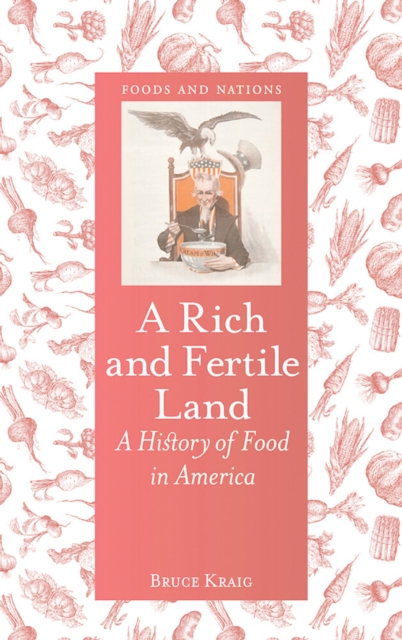
A rich and fertile land : a history of food in America
The small ears of corn once grown by Native Americans have now become row upon row of cornflakes on supermarket shelves. The immense seas of grass and herds of animals that supported indigenous people have turned into industrial agricultural operations with regular rows of soybeans, corn, and wheat that feed the world. But how did this happen and why? In A Rich and Fertile Land, Bruce Kraig investigates the history of food in America, uncovering where it comes from and how it has changed over time. From the first Native Americans to modern industrial farmers, Kraig takes us on a journey to reveal how people have shaped the North American continent and its climate based on the foods they craved and the crops and animals that they raised. He analyzes the ideas that Americans have about themselves and the world around them, and how these ideas have been shaped by interactions with their environments. He details the impact of technical innovation and industrialization, which have in turn created modern American food systems. Drawing upon recent evidence from the fields of science, archaeology, and technology, A Rich and Fertile Land is a unique and valuable history of the geography, climate, and food of the United States.
eBook

Midwest Maize
Food historian Cynthia Clampitt pens the epic story of what happened when Mesoamerican farmers bred a nondescript grass into a staff of life so prolific, so protean, that it represents nothing less than one of humankind's greatest achievements. Blending history with expert reportage, she traces the disparate threads that have woven corn into the fabric of our diet, politics, economy, science, and cuisine. At the same time she explores its future as a source of energy and the foundation of seemingly limitless green technologies. The result is a bourbon-to-biofuels portrait of the astonishing plant that sustains the world.
eBook

Glycemic responses to maize flour stiff porridges prepared using local recipes in Malawi
Glycemic index is defined as the incremental area under the blood glucose response curve of a 50 g carbohydrate portion of a test food expressed as a percent of the response to the same amount of carbohydrate from a standard food taken by the same subject. This study investigated glycemic index of maize stiff porridges consumed as staple food in Malawi and a large majority of other countries in sub‐Saharan Africa to identify areas for improvement in consumer diets. Stiff porridges were prepared using flour from whole maize, maize grits, and fermented maize grits. The porridges were served to 11 healthy volunteers for 3 weeks, with two serving sessions a week. Glucose was served as a reference food during weekly serving sessions. Results from descriptive analysis revealed that glycemic responses varied across subjects and porridge types. Porridge prepared from fermented maize grits had moderate glycemic index of 65.49 and was comparable in nutrient composition and sensory characteristics with the other test porridges. Glycemic indices of the porridges prepared from whole maize flour and grits were high at 94.06 and 109.64, respectively, attributed to the effect of traditional maize flour processing, preparation, and cooking methods used. The study also calculated glyaemic load of the porridges and drew recommendations to inform diet planning and modifications for healthy and diabetic individuals. This study investigated glycemic index of maize stiff porridges consumed as staple food in Malawi and a large majority of other countries in sub‐Saharan Africa to identify areas for improvement in consumer diets. Results from descriptive analysis showed that glycemic responses varied across subjects and porridge types. Porridge prepared from fermented maize grits was recommended for the diabetics and general population, having shown moderate glycemic index of 74.90 and comparable nutrient composition and sensory attributes with the other test porridges.
Journal Article