
Catalogue Search | MBRL


Are you sure you want to remove the book from the shelf?

{{itemTitle}}
14
result(s) for
"Czech language Grammaticalization."
Sort by:

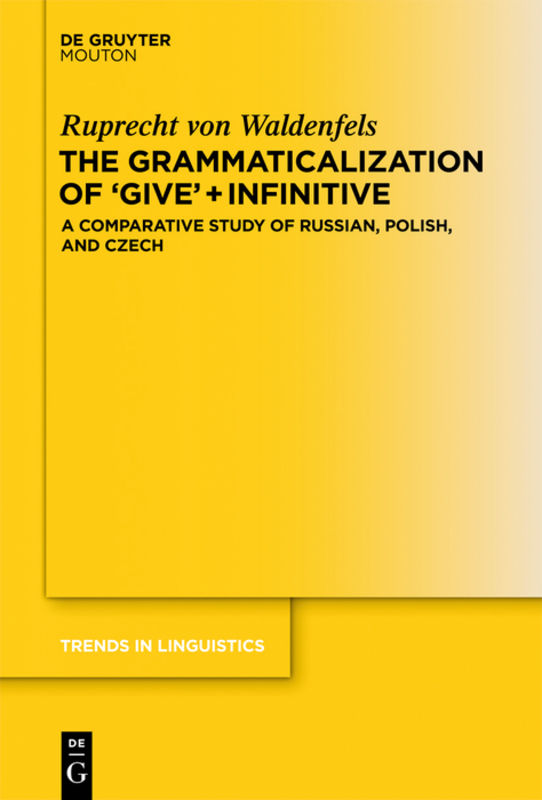
The Grammaticalization of 'Give' + Infinitive
Verbs denoting 'to give' have developed grammatical meanings in many languages of the world. The present study analyses the grammaticalization of give in causative and modal constructions in the closely related Slavic languages Russian, Polish and Czech.
Adopting a corpus driven approach, it takes departure from a detailed analysis of the use of these constructions in large reference corpora. This synchronic approach is supplemented by an analysis of the use of these constructions in Old Church Slavonic and by diachronic corpus-based accounts of the developments in Czech and Polish.
The study provides thorough descriptions of the syntax and semantics of causative constructions, ranging from permissive (letting someone do something) and reflexive permissive (letting something be done to oneself) to factitive causative (having something done by someone). It traces the development and synchronic status of modals that have developed out of reflexive permissives in Polish and Czech. General issues discussed in the study include polarity sensitivity in causatives, types of causee coding, the emergence of non-agreeing diathesis structures in Polish and the role of language contact with German.
eBook

The Grammaticalization of Numeral ‘One’ in Slavic: From Quantification to (Non-) Referentiality
The article presents a corpus-based investigation of the distribution and interpretation of ‘one’ + N combination in six Slavic languages (Russian, Ukrainian, Czech, Serbian, Macedonian, and Bulgarian). The study aims at determining whether there is an ongoing process of grammaticalization of the numeral ‘one’ in Slavic, and, if so, at what stage of grammaticalization is each language situated in the synchrony. In order to categorize the relevant uses of ‘one’ a system of semantic annotation is devised. The results of the study show different degree of grammaticalization of ‘one’ in the languages under study, with Russian and Ukrainian being in the beginning of the path (with occasional referential uses attested), Czech and Serbian being in between (with a significant frequency of referential uses), and Bulgarian and Macedonian being the most advanced on the scale (with a few non-referential uses). None of the languages has a fully grammaticalized indefinite article.
Journal Article

Revisiting the information structure of English verbo-nominal prepositional phrases in predication
LINGUISTICA PRAGENSIA 2025 (35) 2 Revisiting the information structure of English prepositional phrases in predication Irena Headlandová Kalischová – Martin Adam (Masaryk University, Brno) FULL TEXT ABSTRACT (en) The theory of functional sentence perspective (FSP) is centred on communicative dynamism and its distribution among communicative units, i.e. individual sentence elements (Firbas, 1996; 1999). When a context-dependent subject is further specified by more dynamic elements, the sentence follows the Quality Scale; conversely, if a context-independent subject is the most dynamic element, it follows the Presentation Scale. This corpus-based study, building on Adam & Headlandová Kalischová (2009), examines English sentences with prepositional predications of the pattern BE + PREPOSITIONAL PHRASE (specifically, be at fault, be at large, be in full swing, be in place, be on guard, be on display). Unlike the 2009 study, which categorized these structures based on semantic interpretation and paraphrasing potential, the present analysis explores their textual, syntactic, and information-structure characteristics irrespective of typological classification. The aim is to determine whether, and under what circumstances, these predicates express existence or appearance on the scene. The findings suggest that the FSP status of verbo-nominal prepositional structures is best understood as a continuum, ranging from predominantly presentational to primarily qualitative, rather than a strict binary categorization. KEYWORDS (en) FSP, lexical semantics, prepositional, presentation, quality, scale, verbo-nominal DOI https://doi.org/10.14712/18059635.2025.2.3 REFERENCES Adam, M. (2013). Presentation sentences (syntax, semantics and FSP). Brno: Masaryk University. Adam, M. (2019). Presentational capacity of English transitive verbs: On some semantic and FSP aspects of SEIZE. Linguistica Pragensia, 29(2), 178–191. http://dx.doi.org/10.14712/18059635.2019.2.4 Adam, M., & Headlandová Kalischová, I. (2022). FSP status of English verbo-nominal structures Be + Prepositional Phrase. Linguistica Pragensia, 32(2), 214–234. https://doi.org/10.14712/18059635.2022.2.3 Bolinger, D. L. (1952). Linear modification. Publication of the Modern Language Association of America, 67, 1117–1144. Bouveret, M., & Fillmore, C. (2008). Matching verbo-nominal constructions in FrameNet with lexical functions in MTT. In E. Bernal & J. A. DeCesaris (Eds.), Proceedings of the Euralex (pp. 297–308). Barcelona: Universitat Pompeu Fabra. Büring, D. (2012). Semantics, intonation, and information structure. In G. Ramchand & C. Reiss (Eds.), The Oxford Handbook of Linguistic Interfaces (pp. 445–474). Oxford: Oxford Academic. https://doi.org/10.1093/oxfordhb/9780199247455.013.0015 Cambridge Dictionary. (n.d.). Be at fault. In Cambridge Dictionary. Retrieved March 18, 2024, from https://dictionary.cambridge.org/dictionary/english/be-at-fault Cambridge Dictionary. (n.d.). Be at large. In Cambridge Dictionary. Retrieved March 18, 2024, from https://dictionary.cambridge.org/dictionary/english/be-at-large Cambridge Dictionary. (n.d.). Guard. In Cambridge Dictionary. Retrieved March 18, 2024, from https://dictionary.cambridge.org/dictionary/english/guard Cambridge Dictionary. (n.d.). In place. In Cambridge Dictionary. Retrieved March 18, 2024, from https://dictionary.cambridge.org/dictionary/english/in-place Chafe, W. (1994). Discourse, consciousness, and time: The flow and displacement of conscious experience in speaking and writing. Chicago/London: The University of Chicago Press. Chamonikolasová, J. (2010). Communicative dynamism and prosodic prominence of English and Czech pronouns. In M. Procházka, P. Šaldová & M. Malá (Eds.), The Prague School and Theories of Structure (pp. 143–159). Göttingen: V&R Unipress. Chamonikolasová, J., & Adam, M. (2005). The presentation scale in the theory of functional sentence perspective. In J. Čermák, A. Klégr, M. Malá & P. Šaldová (Eds.), Patterns: A Festschrift for Libuše Dušková (pp. 59–69). Prague: Faculty of Arts, Charles University. Chamonikolasová, J., Adam, M., Headlandová Kalischová, I., Drápela, M., & Stehlíková, L. (2015). Creating a system of annotation for FSP. Linguistica Pragensia, 25(1), 9–18. Davidse, K., Njende, N. M., & O’Grady, G. (2023). Specificational and presentational there-clefts: Redefining the field of clefts. Cham: Palgrave Macmillan. https://doi.org/10.1007/978-3-031-32270-9 Dušková, L. (1999). Basic distribution of communicative dynamism vs. nonlinear indication of functional sentence perspective. Travaux du Cercle Linguistique de Prague, 3, 249–262. Dušková, L. (2008). Vztahy mezi sémantikou a aktuálním členěním z pohledu anglistických členů Pražského lingvistického kroužku [The relations between semantics and functional sentence perspective as seen by Anglicist members of the Prague Linguistic Circle]. Slovo a slovesnost, 69(1–2), 67–77. Dušková, L. (2012). Mluvnice současné angličtiny na pozadí češtiny [A Grammar of Contemporary English with Reference to Czech]. Prague: Academia. Dušková, L. (2015). From Syntax to Text: The Janus Face of Functional Sentence Perspective. Prague: Karolinum Press. Dušková, L. (2020). Dual semantics of intransitive verbs: Lexical semantics vs. presentative meaning. In V. Kloudová, M. Šemelík, A. Racochová & T. Koptík (Eds.), Spielräume der modernen linguistischen Forschung (pp. 25–54). Prague: Karolinum. Erteschik-Shir, N. (2007). Information Structure: The Syntax-Discourse Interface. Oxford: Oxford University Press. https://doi.org/10.1093/oso/9780199262588.001.0001 Firbas, J. (1964). On defining the theme in functional sentence analysis. Travaux Linguistiques de Prague, 1, 267–280. Firbas, J. (1975). On ‘existence/appearance on the scene’ in functional sentence perspective. Prague Studies in English, 16, 45–70. Firbas, J. (1992). Functional sentence perspective in written and spoken communication. Cambridge: Cambridge University Press. Firbas, J. (1995). On the thematic and the rhematic layers of a text. In B. Wårwick, S.-K. Tanskanen & R. Hiltunen (Eds.), Organization in Discourse: Proceedings from the Turku Conference, Anglicana Turkuensia 14 (pp. 59–72). Turku: University of Turku. Farlex. (n.d.). The Free Dictionary. Retrieved March 18, 2024, from https://www.thefreedictionary.com/ Hornby, A. S., & Turnbull, J. (2010). Oxford Advanced Learner’s Dictionary of Current English (8th ed.). Oxford: Oxford University Press. Huddleston, R., & Pullum, G. K. (2002). The Cambridge Grammar of the English Language. Cambridge: Cambridge University Press. Lambrecht, K. (1994). Information Structure and Sentence Form: Topic, Focus, and the Mental Representations of Discourse Referents. Cambridge: Cambridge University Press. https://doi.org/10.1017/CBO9780511620607 Quirk, R., et al. (1985). A Comprehensive Grammar of the English Language. London: Longman. Sketch Engine. (n.d.). Sketch Engine [Corpus analysis tool]. Retrieved May 8, 2024, from https://ske.f.muni.cz/ Svoboda, A. (2005). Firbasian semantic scales and comparative studies. In J. Čermák, A. Klégr, M. Malá & P. Šaldová (Eds.), Patterns. A Festschrift for Libuše Dušková (pp. 217–229). Prague: Faculty of Arts, Charles University. USLegal. (n.d.). Damages at large. In USLegal. Retrieved May 22, 2024, from https://definitions.uslegal.com/ Vachek, J. (1994). A functional syntax of modern English. Brno: Masaryk University. Van Rompaey, T., Davidse, K., & Petré, P. (2015). Lexicalization and grammaticalization: The case of the verbo-nominal expressions be on the/one’s way/road. Functions of Language, 22(2), 232–263.
Journal Article

Studi italiani sull'aspetto verbale slavo
The aim of this article is to present the Italian studies on Slavic verbal aspect published between the years 1990-2020. Issues analyzed in this survey include (but are not limited to) the meanings of the perfective and imperfective aspects, actionality, the role of prefixes and suffixes in the grammaticalization of aspect, the interaction between aspect and other verbal categories, and the pragmatic uses of aspect. Moreover, the diachronic and typological perspectives are considered as well as the acquisitional perspective. Verbal aspect is explored in a group of Slavic languages, including Russian, Czech, Polish, Bulgarian, Serbian, Croatian, Slovenian, and Resian. It is argued that further research on verbal aspect in other Slavic languages can shed a new light on this issue.
Journal Article

A Typological Discussion of the Predicates Expressing Possessive Meaning “to Have” in Taiwan Mandarin and Czech — a Learner Corpus-Based Study
The main purpose of this research paper is to investigate predicates expressing the possessive meaning “to have” in Taiwan Mandarin and Czech. In Taiwan Mandarin, the word you has the semantic meaning of “to have” and “to exist” (Huang, 1987; Her, 1991). Mít in Czech, however, has three main usages (Daneš, 1987; Karlík — Nekula — Rusínová, 1995; 1996; Čechová, 2000; Cvrček, 2010): it is used as a modal, an auxiliary or a possessive verb. According to the language data collected from Taiwanese students who study Czech, these students often use mít in Czech to express not only possession but also existence, or they incorrectly use it as an auxiliary — in other words — their knowledge of you in Taiwan Mandarin seems to interfere (Brown, 2007) with their usage of mít in Czech. In this paper, firstly, relevant literature dealing with the usages of you in Taiwan Mandarin and mít in Czech will be introduced; secondly, there will follow a discussion of the language data collected from the NCCU foreign language learner corpus; thirdly, the grammaticalization theory (Heine, 1997) will be applied to investigate Taiwan Mandarin you and Czech mít, which shall offer a number of explanations regarding the observable typological diversity across these two languages. In spite of the fact that there are similar research papers related to the expression of possessive meaning in these two languages, this paper assumes that the cross-linguistic typological discussion shall bring more insight into the characteristics of these two languages. Furthermore, apart from advancing the typological discussion of these two languages, it is expected that this paper will also aid the preparation of related textbooks and teaching materials.
Journal Article

The Varying Role of po- in the Grammaticalization of Slavic Aspectual Systems: Sequences of Events, Delimitives, and German Language Contact
This article presents a comparative analysis of three interrelated phenomena: the use of imperfective verbs in sequences of events in Czech, Slovak, Sorbian, Slovene, and BCS; the use of po- delimitatives in sequences of events in East Slavic, Polish, and Bulgarian; the semantic nature of the prefix po- in the individual Slavic languages. The use of imperfective verbs in sequences of events in the western languages and the use of po- delimitatives in the eastern languages are two alternative ways of aspectually coding atelic predicates in narratives. The article makes two main arguments in this connection. The first is that the use of imperfective verbs in sequences of events in the western languages has been retained (and perhaps strengthened) due to German language contact, whereas the use of po- delimitatives for such atelic predicates represents an innovation in those languages that did not undergo significant amounts of such German language contact. The second is that the lack of the development of po- into an important perfectivizing prefix in the western languages is likewise due in part to German language contact, as po- was at various times used to calque German be- in its surface-contact and transitive meanings as well as ver- in its meaning of change of state; such calques contributed to the stabilization of po- as a lexical prefix in the western languages. The retarding effect of German language contact on the western languages whereby imperfective verbs remained acceptable in sequences of events, and po- did not become a major perfectivizing prefix, is analyzed as the result of a process of \"replica preservation,\" as opposed to the more commonly discussed process of \"replica change\" described by Heine and Kuteva (2005). Adapted from the source document
Journal Article

Kongruenzbrüche in slovakischen possessiven Resultativa (Evidenz aus dem Slovakischen Nationalkorpus)
Possessive resultative constructions containing a HAVE-verb and a past passive participle have been used in West Slavic languages for centuries without showing a rapid grammaticalisation into a perfect (cf. evidence from Polish and Czech). The same holds for Slovak, where examples can be found at least from the 17th century on without rapidly changing on the grammaticalisation chain. At the same time, Krupa demonstrated in 1960 a loss of congruence between object and past passive participle in possessive resultatives in colloquial Slovak distinguishing different types. Loss of congruence is often considered to be an important grammaticalisation step for emerging participial perfects. A sought in the Slovak National Corpus brought some evidence for such constructions in journalistic texts and from the Internet (the same types as used by Krupa), but their frequency is very low so far.
Journal Article
Aspectual Opposition and Aspectual Correlation in Slovak
This investigation of the scope and types of aspectual pairs in Slovak is motivated by the lack of a thorough monograph on aspect in Slovak linguistics, by the lack of a uniform approach to the essential questions of aspect in existing Czech and Slovak studies, and by the differing treatments of aspectual correlations in major dictionaries.
In the introduction we discuss the nature of aspect as a categorial (word-class) component in the meaning of verbs. Aspect is the grammaticalization of the subcategorial semantic feature “manner of flow of an action in time” and is closely connected with a second subcategorial semantic feature - “manner of distribution of an action in space” which finds its expression in the lexico-grammatical category of intention.
In the first part of this study we present a concise overview of opinions concerning the nature of the category of aspect in regard to the formal means of its expression: the universal dimension of aspect is represented by aspectual opposition covering all verbs, and the paradigmatic dimension of aspect is represented by aspectual correlation, i.e., aspect pairs.
Here we touch on the problem of the consideration of aspect as a lexico-grammatical category or a purely morphological category and the problem of the place of prefixation in aspect formation (the acceptance or rejection of prefixation as a means of forming aspectual pairs).
In the second part of the study we focus attention on the analysis of criteria for dividing aspectual pairs, whereby these criteria generate five approaches: A. a formal criterion: imperfectivizing suffixation; B. categorial-semantic criteria (in conceptualizations that also allow prefixal aspect formation): 1) gradual transition (
/opravovať [to repair perfective/imperfective], krotiť/
[to restrain imperfective/perfective]) as the core of the aspectual correlation, 2) + acceptance of causative semelfactives (bodať/
to pierce imperfective/perfective, kopať/
to kick imperfective/perfective) as a type of momentaneous transition, 3) + acceptance of quantitative discursives expressing an intrinsic portion of an atelic process (kašľať/
to cough imperfective/perfective, zvoniť/
to ring imperfective/perfective, triasť/
to shake imperfective/perfective), and 4) aspectual correlation as part of a system of several aspectually relevant oppositions, or derivationally perceived aspectual clusters.
The final part of the article is devoted to the question of the formal presentation of aspectual pairs. Here we analyze the problem of considering an aspectual pair as two forms of a single lexeme (the result of form modification, aspect formation) in contrast to considering the members of an aspectual pair as independent lexemes (the result of derivation).
Journal Article
GRAMMATICALIZATION AND VERBAL STRUCTURES (THE CASE OF ANALYTIC PERFECT)
The understanding of the grammaticalization process used today is quite diverse; nevertheless it presents a great step forward in contemporary linguistics and offers almost universal criteria for its description. The grammaticalization of the analytic verbal structures and especially of Perfect tense was first observed by the pioneers of the modern grammaticalization theory (A. Meillet, J. Kuryłowicz) and had since become the subject of systematic investigation. One of the constituents of the European linguistic area (ELA) is
the ability to form analytical verbal constructions and verbal tenses – in the case of the Perfects predominantly as a bi-auxiliary habere/esse type, or as a mono-auxiliary habere type and esse type. The West Slavic habere Perfect constructions in Czech with their three main types show, thanks to the extensive data well documented by the Czech National Corpus, some rather unique innovations, as e.g. the shift from the object type agreement of the n-/t-participle to a subject-type agreement.
Journal Article