
Catalogue Search | MBRL


Are you sure you want to remove the book from the shelf?

{{itemTitle}}
7,584
result(s) for
"DESIGN / Reference."
Sort by:

The Aesthetics of Imagination in Design
In The Aesthetics of Imagination in Design, Mads Folkmann investigates design in both material and immaterial terms. Design objects, Folkmann argues, will always be dual phenomena -- material and immaterial, sensual and conceptual, actual and possible. Drawing on formal theories of aesthetics and the phenomenology of imagination, he seeks to answer fundamental questions about what design is and how it works that are often ignored in academic research. Folkmann considers three conditions in design: the possible, the aesthetic, and the imagination. Imagination is a central formative power behind the creation and the life of design objects; aesthetics describes the sensual, conceptual, and contextual codes through which design objects communicate; the concept of the possible -- the enabling of new uses, conceptions, and perceptions -- lies behind imagination and aesthetics. The possible, Folkmann argues, is contained as a structure of meaning within the objects of design, which act as part of our interface with the world. Taking a largely phenomenological perspective that reflects both continental and American pragmatist approaches, Folkmann also makes use of discourses that range from practice-focused accounts of design methodology to cultural studies. Throughout, he offers concrete examples to illustrate theoretical points. Folkmann's philosophically informed account shows design -- in all its manifestations, from physical products to principles of organization -- to be an essential medium for the articulation and transformation of culture.
eBook

Graphic design + architecture : a 20th century history : a guide to type, image, symbol, and visual storytelling in the modern world
This innovative, comprehensive work closely examines the relationship between typography, image, symbolism, and the built environment.
eBook

Design And Truth
\"If good design tells the truth,\" writes Robert Grudin in this path-breaking book on esthetics and authority, \"poor design tells a lie, a lie usually related . . . to the getting or abusing of power.\"
From the ornate cathedrals of Renaissance Europe to the much-maligned Ford Edsel of the late 1950s, all products of human design communicate much more than their mere intended functions. Design holds both psychological and moral power over us, and these forces may be manipulated, however subtly, to surprising effect. In an argument that touches upon subjects as seemingly unrelated as the Japanese tea ceremony, Italian mannerist painting, and Thomas Jefferson's Monticello plantation, Grudin turns his attention to the role of design in our daily lives, focusing especially on how political and economic powers impress themselves on us through the built environment.
Although architects and designers will find valuable insights here, Grudin's intended audience is not exclusively the trained expert but all those who use designs and live within them every day.
eBook

The Design Way
Humans did not discover fire--they designed it. Design is not defined by software programs, blueprints, or font choice. When we create new things--technologies, organizations, processes, systems, environments, ways of thinking--we engage in design. With this expansive view of design as their premise, in The Design Way, Harold Nelson and Erik Stolterman make the case for design as its own culture of inquiry and action. They offer not a recipe for design practice or theorizing but a formulation of design culture's fundamental core of ideas. These ideas--which form \"the design way\"--are applicable to an infinite variety of design domains, from such traditional fields as architecture and graphic design to such nontraditional design areas as organizational, educational, interaction, and health care design. Nelson and Stolterman present design culture in terms of foundations (first principles), fundamentals (core concepts), and metaphysics, and then discuss these issues from both learner's and practitioner's perspectives. The text of this second edition is accompanied by new detailed images, \"schemas\" that visualize, conceptualize, and structure the authors' understanding of design inquiry. This text itself has been revised and expanded throughout, in part in response to reader feedback.
eBook

Comparing the Building Code Sawn Lumber’s Wet Service Factors (CM) with Four Commercial Wood Species Laboratory Tests
Indonesian Wooden Building Code (SNI 7973-2013) has adopted the National Design Specification (NDS) for Wood Construction since 2013. A periodic harmonization of the building-code-designated values (i.e., reference design values and adjustment factors) with the experimental data of commercial wood species is necessary. This study aimed to compare the building code’s wet service factors (CM) with the laboratory test of some commercial wood species. Since wood is weaker when its moisture content is high, the wet service factor (CM) must adjust the sawn lumber reference design values if the building serves in wet or aquatic environments. Four commercial wood species, namely pine (Pinus merkusii), agathis (Agathis dammara), red meranti (Shorea leprosula), and mahogany (Swietenia mahagoni), were subjected to mechanical property tests. To calculate the empirical CM values, the mechanical properties tests were conducted on air-dry and wet wood. Instead of testing the full-sized timber, which contains the growth characteristics and defects, this study chose clear-wood specimens to resemble the boundary condition of the ceteris paribus (other things being equal). The wet (water-saturated) specimens were immersed in water for 65 days, and the test was carried out when the specimen was still immersed. The test arrangement imitated the submerged wood as the worst-case scenario of the wet environment where the construction serves, rather than green or partially immersed timber. As many as 40 specimens were tested to compare each mechanical property’s wet service factor; thus, this study reported 200 specimens’ laboratory test results. The empirical CM values to adjust the modulus of elasticity, modulus of rupture, shear strength parallel-to-grain, tensile strength parallel-to-grain, and maximum crushing strength (CM = 0.59, 0.76, 0.65, 0.73, and 0.67, respectively) were significantly lower than SNI 7973-2013 designated values (CM = 0.9, 0.85, 0.97, 1, and 0.8, respectively). The empirical CM for the compression stress perpendicular-to-grain at the proportional limit and that at the 0.04″ deformation (CM = 0.66) were slightly lower than the designated values (CM = 0.67), although they were not significantly different. This study resulted in lower empirical CM values than the designated ones, which found that the building code lacked conservativeness. The lacked conservativeness is mainly attributed to the building code’s recent choices, e.g., (1) the wet service environment basis is the green timber rather than the fully water-saturated one, and (2) the ratio of near minimum (5% lower) distribution value is chosen as the CM value rather than the average of wet timber’s mechanical property divided by the air-dry one. This study proposes changing both recent choices to alternative ones to develop more safe and reliable designated CM values.
Journal Article
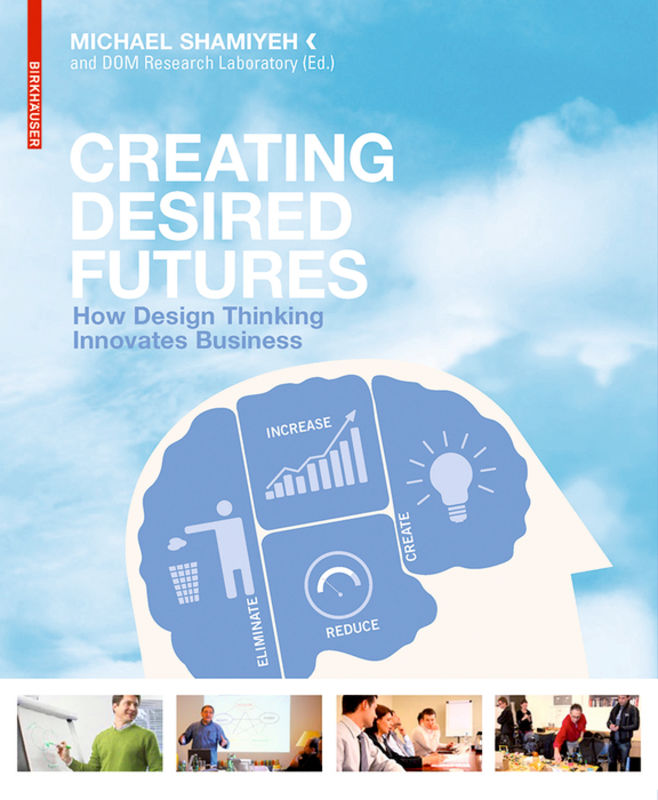
Creating Desired Futures
Today's society is making great leaps in its effort to obtain ever more and ever more specific know-how in various specialties, with the consequence that the structures of today's companies are become increasingly complex. This in turn leads to problems at the points of interface, which calls for a comprehensive approach to solutions.Creating Desired Futures defines design a creative, analytical method to develop and explore alternative solutions to complex problems, and it shows that design is particularly well suited to the business world's current need for innovative strategies. In twenty-four essays by designers, architects, and representatives of large companies such as Nike and Shell, the book shows how such a design-based approach can help define, assess, and solve problems for companies. It presents not only specific strategies from actual practice but also innovative approaches from the world of corporate consulting. Essays by researchers and teachers discuss theoretical aspects of the subject \"Design Thinking.\" Michael Shamiyeh is a practicing architect with his own firm (Shamiyeh Associates) and also founder and direction of the DOM (Design-Organisation-Media) Research Laboratory at the Kunstuniversität Linz. He works on the relevance of creative, analytical approaches in architectural thinking to solve complex problems in the area of Strategic Business Thinking and Innovation. Shamiyeh has received numerous awards, including the Innovation Prize (2008) of the Austrian Federal Ministry for Science and Research and well as the Future Award (ZuP, 2003) and the Award for Entrepreneurship (2000), both awarded by the Austrian government.
eBook

Separate-channel analysis of two-channel microarrays: recovering inter-spot information
Background
Two-channel (or two-color) microarrays are cost-effective platforms for comparative analysis of gene expression. They are traditionally analysed in terms of the log-ratios (M-values) of the two channel intensities at each spot, but this analysis does not use all the information available in the separate channel observations. Mixed models have been proposed to analyse intensities from the two channels as separate observations, but such models can be complex to use and the gain in efficiency over the log-ratio analysis is difficult to quantify. Mixed models yield test statistics for the null distributions can be specified only approximately, and some approaches do not borrow strength between genes.
Results
This article reformulates the mixed model to clarify the relationship with the traditional log-ratio analysis, to facilitate information borrowing between genes, and to obtain an exact distributional theory for the resulting test statistics. The mixed model is transformed to operate on the M-values and A-values (average log-expression for each spot) instead of on the log-expression values. The log-ratio analysis is shown to ignore information contained in the A-values. The relative efficiency of the log-ratio analysis is shown to depend on the size of the intraspot correlation. A new separate channel analysis method is proposed that assumes a constant intra-spot correlation coefficient across all genes. This approach permits the mixed model to be transformed into an ordinary linear model, allowing the data analysis to use a well-understood empirical Bayes analysis pipeline for linear modeling of microarray data. This yields statistically powerful test statistics that have an exact distributional theory. The log-ratio, mixed model and common correlation methods are compared using three case studies. The results show that separate channel analyses that borrow strength between genes are more powerful than log-ratio analyses. The common correlation analysis is the most powerful of all.
Conclusions
The common correlation method proposed in this article for separate-channel analysis of two-channel microarray data is no more difficult to apply in practice than the traditional log-ratio analysis. It provides an intuitive and powerful means to conduct analyses and make comparisons that might otherwise not be possible.
Journal Article

Coarse-grained reconfiguration: dataflow-based power management
Power reduction in modern embedded systems design is a challenging issue exacerbated by the complexity and heterogeneity of their architecture. In the field of Reconfigurable Video Coding (RVC), to challenge these issues and cut-down time to market, dataflow-based techniques have been adopted. In particular, to master management and composability of dynamically reconfigurable systems, the authors have developed the multi-dataflow composer. Nevertheless, despite the RVC offers several different tools, in its reference design framework power management is still an open issue. To make some steps forward towards filling this gap, in this study, they address power management for coarse-grained reconfigurable systems combining structural and dynamic strategies, both to be applied at the dataflow level.
Journal Article

Experimental Designs for Array Comparative Genomic Hybridization Technology
Array comparative genomic hybridization (aCGH) technology is commonly used to estimate genome-wide copy-number variation and to evaluate associations between copy number and disease. Although aCGH technology is well developed and there are numerous algorithms available for estimating copy number, little attention has been paid to the important issue of the statistical experimental design. Herein, we review classical statistical experimental designs and discuss their relevance to aCGH technology as well as their importance for downstream statistical analyses. Furthermore, we provide experimental design guidance for various study objectives.
Journal Article
