
Catalogue Search | MBRL


Are you sure you want to remove the book from the shelf?

{{itemTitle}}
8
result(s) for
"DeMille, Cecil B. 1881-1959 Criticism and interpretation."
Sort by:

Cecil B. Demille : the art of the Hollywood epic
More than any other filmmaker in the history of the medium, Cecil B. DeMille mastered the art of the spectacle. This volume combines Vieira's texts on the historical events, and Presley's insights on her grandfather's films.
Book
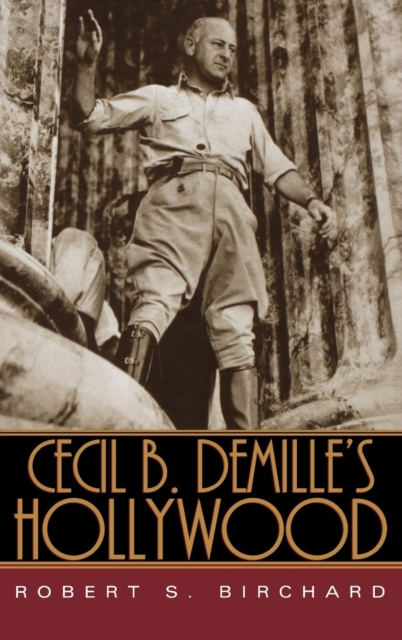
Cecil B. DeMille's Hollywood
\" \"\"Far and away the best film book published so far this year.\"\"--National Board of Review Cecil B. DeMille was the most successful filmmaker in early Hollywood history. Cecil B. DeMille's Hollywood is a detailed and definitive chronicle of the screen work that changed the course of film history and a fascinating look at how movies were actually made in Hollywood's Golden Age. Drawing extensively on DeMille's personal archives and other primary sources, Robert S. Birchard offers a revealing portrait of DeMille the filmmaker that goes behind studio gates and beyond DeMille's legendary persona. In his forty-five-year career DeMille's box-office record was unsurpassed, and his swaggering style established the public image for movie directors. DeMille had a profound impact on the way movies tell stories and brought greater attention to the elements of decor, lighting, and cinematography. Best remembered today for screen spectacles such as The Ten Commandments and Samson and Delilah, DeMille also created Westerns, realistic \"chamber dramas,\" and a series of daring and highly influential social comedies. He set the standard for Hollywood filmmakers and demanded absolute devotion to his creative vision from his writers, artists, actors, and technicians.
eBook


Representations of Nineteenth Century Mormonism in A Mormon Maid: A Cinematic Analysis
During the first quarter of the 20th century there was a trend in Hollywood to make films about Mormons. Practices such as polygamy created just the kind of sensationalism that attracted filmmakers (even Thomas Edison contributed with his 1902 film A Trip to Salt Lake).Many of these were B-pictures, but the 1917 film A Mormon Maid stands out because it was produced by a major production company (Paramount) and was backed by top director Cecil B. DeMille. It is often given passing reference, but very little genuine scholarship has been done on the film. A hundred years after its release, A Mormon Maid is remembered in name only. This paper is an in-depth analysis of the text as a reflection of and influence on the way the Mormon faith was perceived in the early twentieth century.
Journal Article

A New Eroticism or Merely a New Woman? Cecil B. DeMille's Adaptation of Alice Duer Miller's \Manslaughter\
The car accident that results in the death of the policeman whom she has previously bribed to ignore an earlier traffic violation arises from Lydia's haste to flee from an encounter with the sexually masterful Dan O'Bannon, and, the reader may surmise, may result from her rejection of all kinds of male authority, descending in a line from father; to O'Bannon, who is both suitor and district attorney; to Officer Drummond, whose task it is to interfere repeatedly in Lydia's pleasure in driving, which she is described as doing competently. In 1929, Stuart Chase noted that \"automobiling\" was more popular among girls than it was among boys,4 a popularity explained by the car's ability to remove young women from the supervision of their preceptors and render them as mobile as their male peers, offering them a kind of machine-assisted equality in the public sphere. While Miller clearly doubts that equality is a goal that women may reasonably expect to reach, since even Lydia is reluctantly aware that society is ordered in such a way that \"she herself was not the final judge of the rate at which she should drive,\" she remains interested in the question.28 Thus if O'Bannon's car is indeed the site of an important romantic passage with Lydia in the novel, the effect of the car there is often to flatten gender differences; a female driver is the equal of a male driver, and should, the novel suggests, suffer the same penalties when the law is violated. While Miller was herself in a taxi that injured a motorcyclist in 1918, the germ of Manslaughter appears to be the 1919 Edith Mortimer case, involving a well-bred young Long Island woman who killed a man while maneuvering at speed around an obstacle.39 Mortimer, unlike Lydia, was acquitted, although the prosecution (like O'Bannon) was particularly incensed at the class privilege on display, insisting that an acquittal would drive the disaffected workingman into the arms of Bolshevism.40 Given this spur to the creation of the narrative, I would argue that Miller explores two sets of illegitimate privileges associated with her heroine, those derived from wealth and those derived from gender. Because Lydia has always expected both class and gender to excuse her offenses, prison becomes the ideal means of replacing self-will with self-possession, an attitude that the feminist in Miller presumably endorsed by suggesting that privilege derived from gender is as offensive as privilege derived from wealth.
Journal Article
The Construction of Samson's Three Lovers in Cecil B. DeMille's Technicolor Testament, Samson and Delilah (1949)
Epic showman Cecil B. DeMille cofounded Hollywood and became a master of the American biblical epic who constructed his Judeo-Christian characters with great care; yet, his artistic efforts were frequently ignored, devalued, or dismissed. Thus, he is in need of reputation restoration alongside highlighting the pedagogic value of a pop culture approach to religion studies. Consequently, the critical literature was selectively reviewed and Samson and Delilah (1949) closely examined utilizing humanist film criticism as the guiding analytical lens to explicate the construction of Samson's three lovers, namely: (1) Delilah (Hedy Lamarr), (2) Semadar (Angela Lansbury) and (3) Miriam (Olive Deering). It was concluded that DeMille was a far defter biblical filmmaker than hitherto appreciated. Further research into DeMille studies, biblical epics and the emerging interdisciplinary field of religion-and-film is highly warranted, warmly recommended and already long overdue. [PUBLICATION ABSTRACT]
Journal Article

\The most dangerous anti-semitic photoplay in filmdom\: American Jews and The King of Kings
Examines the relationship between the American Jewish community and the motion picture industry in the 20th century. Analyzes the 1927 blockbuster film \"The King of Kings\" directed by Cecil B. DeMille. Considers anti-Semitic sentiment prior to World War II in the United States. Informs that DeMille's film spurred the creation of the first official relationship between an American Jewish organization, the Independent Order of B'nai B'rith, and the Motion Picture Producers and Distributors Association (MPPDA), as well as a promise that the MPPDA would not allow production of films which denigrated the Jews in any way. Remarks on the popular response to this film and the controversy that ensued.
Journal Article
