
Catalogue Search | MBRL


Are you sure you want to remove the book from the shelf?

{{itemTitle}}
633
result(s) for
"Direction in language."
Sort by:


Modification of indicating verbs in British Sign Language: A corpus-based study
Indicating verbs can be directed toward locations in space associated with their arguments. The primary debate about these verbs is whether this directionality is akin to grammatical agreement or whether it represents a fusion of both morphemic and gestural elements. To move the debate forward, more empirical evidence is needed. We consider linguistic and social factors in 1,436 indicating-verb tokens from the BSL Corpus. Results reveal that modification is not obligatory and that patient modification is conditioned by several factors, such as constructed action. We argue that our results provide some support for the claim that indicating verbs represent a fusion of morphemic and gestural elements.
Journal Article
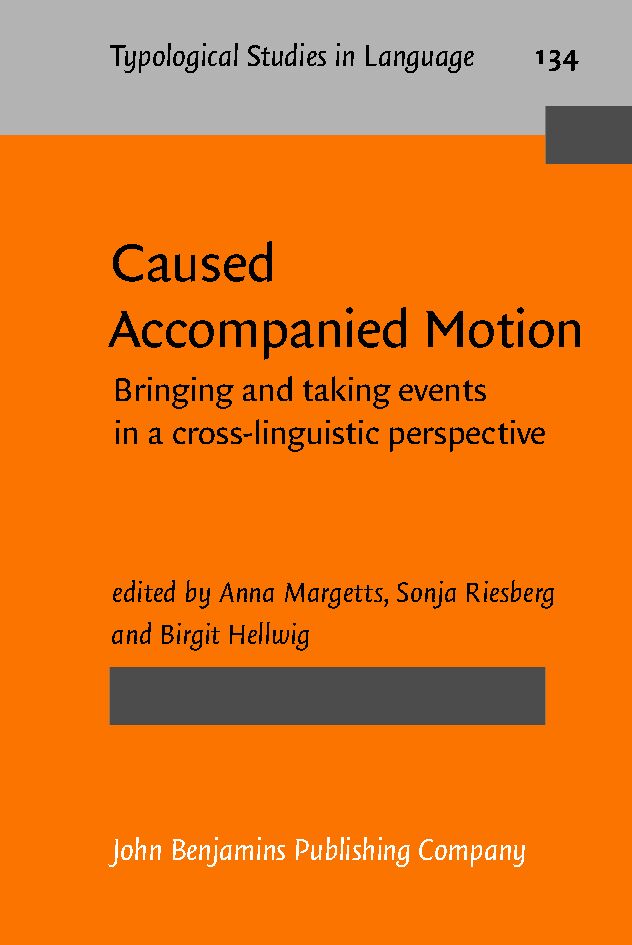
Caused accompanied motion : bringing and taking events in a cross-linguistic perspective
This volume investigates the linguistic expression of directed caused accompanied motion events, including verbal concepts like BRING and TAKE. Contributions explore how speakers conceptualise and describe these events across areally, genetically, and typologically diverse languages of the Americas, Austronesia and Papua. The chapters investigate such events on the basis of spoken language corpora of endangered, underdescribed languages and in this way the volume showcases the importance of documentary linguistics for linguistic typology. The semantic domain of directed caused accompanied motion shows considerable crosslinguistic variation in how meaning components are conflated within single lexemes or distributed across morphemes or clauses. The volume presents a typology of common patterns and constraints in the linguistic expression of these events. The study of crosslinguistic event encoding provided in this volume contributes to our understanding of the nature, extent and limits of linguistic and cognitive diversity.
eBook
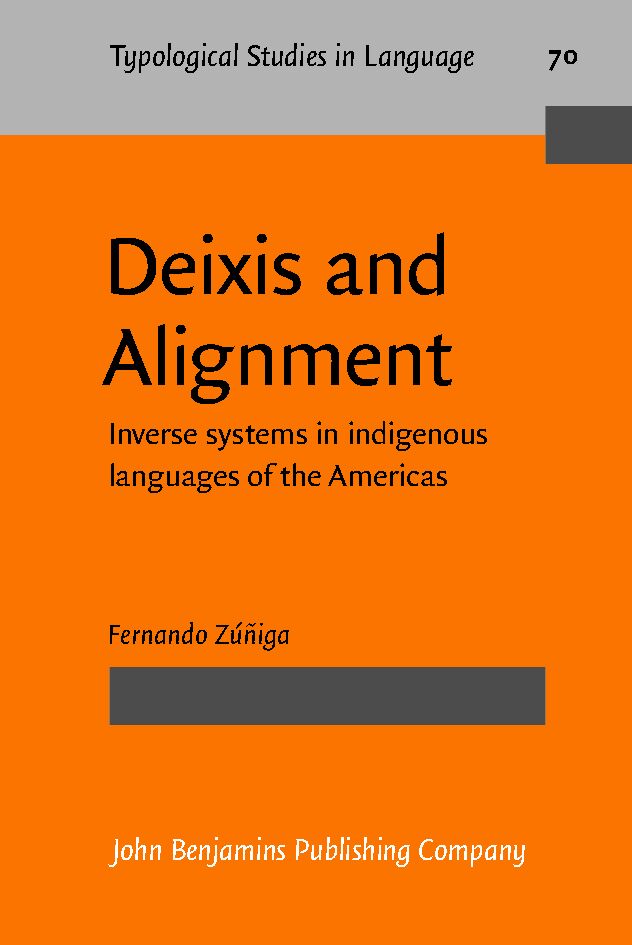
Deixis and alignment : inverse systems in indigenous languages of the Americas
This book proposes a notion of inverse that differs from two widespread positions found in descriptive and typological studies (one of them restrictive and structure-oriented, the other broad and function-centered). This third stance put forward here takes both grammar and pragmatic functions into account, but it also relates the opposition between direct and inverse verbs and clauses to an opposition between deictic values, thereby achieving two advantageous goals: it meaningfully circumvents one of the usual analytic dilemmas, namely whether a given construction is passive or inverse, and it refines our understanding of the cross-linguistic typology of inversion. This framework is applied to the description of the morphosyntax of eleven Amerindian languages (Algonquian: Plains Cree, Miami-Illinois, Ojibwa; Kutenai; Sahaptian: Sahaptin, Nez Perce; Kiowa-Tanoan: Arizona Tewa, PicurÃs, Southern Tiwa, Kiowa; Mapudungun).
eBook
Motion, direction and location in languages : in honor of Zygmunt Frajzyngier
This book contributes to an area of study that is of interest to linguists of all backgrounds. Typological in nature this volume presents data analysis from the major language families of Africa as well as Sino-Tibetan, Austronesian, Japanese, Indo-European, Siouan and Penutian. The 16 contributors to the volume share a commitment to examining the language phenomena pertaining to the volume's theme with a fresh eye. While most of the papers make reference to existing theoretical frameworks, each also makes a novel and sometimes surprising contribution to the body of knowledge and theory concerning motional, directional and locational predicates, complements, morphology, adpositions and other phenomena. This collection of articles suitably complements courses on comparative and diachronic linguistics, semantics, syntax, typology, or field methods.
eBook
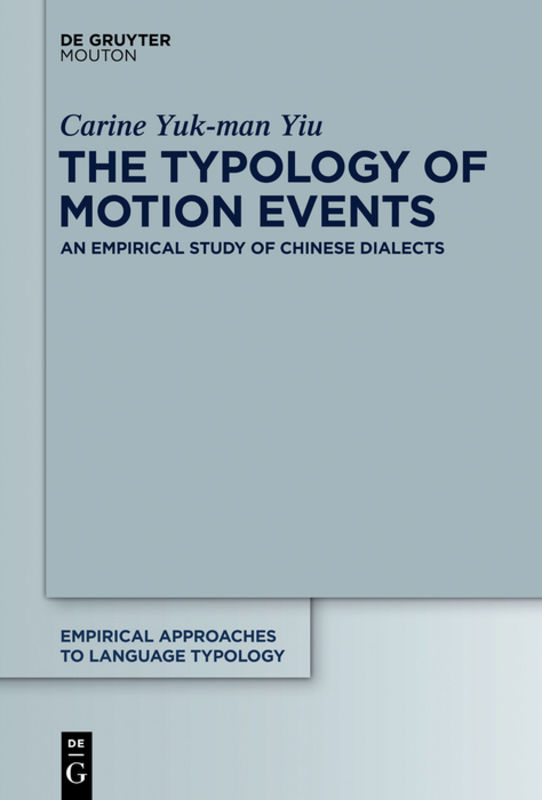
The Typology of Motion Events
This comprehensive study concentrates particularly on the use of a closed set of motion verbs in five of the major dialects, including Mandarin, Wú, Hakka, Min and Cantonese. The author shows that these dialects form a continuum with some exhibiting more characteristics of a verb-framed language than the others. The phenomenon reflects the various stages of typological transformation and grammaticalization that the dialects have undergone.
eBook

Research on university‐based Spanish heritage language programs in the United States: The state of affairs in 2022
Research on Spanish heritage language (SHL) education has grown exponentially in the last two decades. The most recent nationwide study on SHL programs in US postsecondary institutions was conducted a decade ago. To continue this line of research, the primary aim of this study is to provide an update about the current state of SHL course offerings at 4‐year universities in the United States. SHL programs can promote academic success for Latinx students who see their language and culture asserted. In turn, valuing their heritage language skills and supporting their language development can help Latinx students expand their multilingual abilities for use with their families and communities, as well as in professional contexts. Results reveal that the last decade (2012–2022) witnessed tremendous increase in the availability of SHL programs, although some of the challenges reported in prior research still remain nationwide. The Challenge Research on Spanish heritage language (SHL) education has grown exponentially in the past two decades, underscoring the benefits of SHL programs. However, the impact of this research on the spread of SHL programs is unknown. The main question that guides the present study is, given the surge of the Latinx student population in higher education and the mounting evidence supporting SHL education, what is the current state of university‐based SHL programs?
Journal Article
Towards growth for Spanish heritage programs in the United States: Key markers of success
Spanish heritage language (SHL) programs are multiplying in the United States, but our understanding of what constitutes effective practices for administering such programs remains quite limited. The aim of this study is to identify successful SHL programs in postsecondary institutions nationwide and examine key characteristics that appear to be contributing to their success. A two‐part survey study was conducted for which 98 responses were received from 19 different states (80 for the first survey and 18 for the second). By means of a contrastive content analysis, results from 12 program participants (seven in the successful group and five in the unsuccessful group) where analyzed to determine key markers of success. The results pointed to four programmatic markers and four curricular markers. As Spanish or world languages departments undertake the task of building or redesigning their heritage courses, this study may help inform decisions on how to allocate resources and set priorities in order to enhance their chances of success. The Challenge As heritage language programs multiply across the United States, what do we know about effective programmatic practices? What are successful programs doing? This study identifies successful heritage programs and compares them with unsuccessful ones in postsecondary institutions nationwide to reveal key characteristics that appear to be contributing to their success.
Journal Article
Supporting the Professional Development of Foreign Language Graduate Students: A Focus on Course Development and Program Direction
The 2007 Modern Language Association report spurred research regarding the professional development of foreign language graduate students. This article first reviews existing proposals for the professional development of graduate students, then addresses the relevance of helping graduate students to develop the knowledge and skills that are needed to direct undergraduate language programs, describes a course on this topic, and reports the results of end‐of‐semester course evaluations completed by students.
Journal Article

Translational research on early language development: Current challenges and future directions
There is a pressing need for the early and accurate identification of
young children at risk for language and other developmental disabilities
and the provision of timely, age-appropriate intervention, as mandated by
Part C of the Individuals with Disabilities Education Act. Research has
shown that early intervention is effective for many language impaired
children in different etiological groups, and can reduce the functional
impact of persistent disorders on children and their families. Yet, the
accurate identification of infants and toddlers at risk for language
impairment remains elusive, especially for late-talking children without
obvious genetic or neurological conditions. In this paper, the need for
translational research on basic processes in early language development in
typical and atypical populations and the contextual factors that affect
them are discussed, along with current challenges and future directions
for its successful implementation. Implications of this research for
clinical evidence-based practice are also considered.Partial support during the writing of this paper was provided
by NIH Grant RO1HD044068. I am grateful to Dante Cicchetti for his
thoughtful feedback on a prior version of this paper.
Journal Article