
Catalogue Search | MBRL


Are you sure you want to remove the book from the shelf?

{{itemTitle}}
141
result(s) for
"Discrimination Juvenile literature."
Sort by:

Dealing with discrimination
Discusses discrimination on both the general and individual levels and provides advice on dealing with and ending it.
Book


Developing English Language Arts Teacher Candidates’ Social Perspective Taking
Teachers' social and cultural perspectives may differ greatly from those of their students and families. [...]SPT may be useful in helping teachers cultivate more well-rounded and informed cultural perspectives that acknowledge issues such as race and gender that permeate the lives and realities of diverse students. While literature \"focuses on the possible, inviting its readers to wonder about themselves,\" literature also encourages \"readers to put themselves in the place of people of many different kinds and to take on their experiences\" (Nussbaum, 1995, p. 5). [...]reading \"can have transformative influences on readers\" (Mar et al., 2011, p. 829). Young Adult Literature as a \"Transformative Experience\" Literature as a transformational experience has been explored by English teacher educators when preparing future teachers to consider new perspectives and to examine their own biases, particularly related to the young adults they will be teaching (Donovan & Weber, 2021; Falter & Kerkhoff, 2018; Glenn, 2012; Haddix & Price-Dennis, 2013; Lewis & Petrone, 2010; Petrone & Lewis, 2012). In their study of 12 TCs who read young adult literature with representations of disability, Donovan and Weber found that TCs drew on their own backgrounds and personal experiences rather than on critical perspectives that might disrupt harmful representations or bias. [...]additional research can contribute to how teacher educators can incorporate young adult literature so that TCs can perhaps alter established, familiar thought patterns and embrace different methods of considering the world around them.
Journal Article

A kids book about AI bias
This is a book about AI (artificial intelligence) bias. AI consumes lots of information and uses that data to predict patterns. But when the information has biases, or prejudices, the predicted patterns can perpetuate injustice. If AI technology doesn't work fairly for everyone, it's not helpful AI. We can make a difference when we use our voices to advocate for fair, just technologies.
CHILDBOOK

Queering the Question
This research uses survey marginalia to differentiate the housing and child welfare experiences of youth identifying as gender non-conforming from their peers identifying as cisgender LGB. Marginalia references the unexpected responses people provide by writing in instrument margins or not complying with research tools. Findings indicate that data-cleaning and discrete questions about identity can erase youth identifying as gender queer or gender fluid from sampling as data noise, prompting an underreported incidence of risk. The inclusion of marginalia surfaces youth who are otherwise miscategorized or eliminated from sampling and alters the findings on trajectories from foster care to homelessness, experiences with violence, and incidence of harassment within social services. The paper presents an alternative method of including these youth in measurement bringing visibility to the intersection of housing insecurity, child welfare, and gender identity.
Journal Article

A greater goal : the epic battle for equal pay in women's soccer-and beyond
\"A history of the more than 250 women who have played for the U.S. National Soccer Team and their battle for equal pay\"-- Provided by publisher.
Book
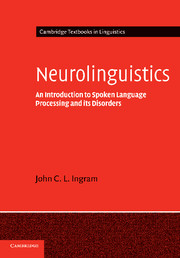
Neurolinguistics
What biological factors make human communication possible? How do we process and understand language? How does brain damage affect these mechanisms, and what can this tell us about how language is organized in the brain? The field of neurolinguistics seeks to answer these questions, which are crucial to linguistics, psychology and speech pathology alike. This textbook, first published in 2007, introduces the central topics in neurolinguistics: speech recognition, word and sentence structure, meaning, and discourse - in both 'normal' speakers and those with language disorders. It moves on to provide a balanced discussion of key areas of debate such as modularity and the 'language areas' of the brain, 'connectionist' versus 'symbolic' modelling of language processing, and the nature of linguistic and mental representations. Making accessible over half a century of scientific and linguistic research, and containing extensive study questions, it will be welcomed by all those interested in the relationship between language and the brain.
eBook

The gender pay gap : equal work, unequal pay
Despite increasing awareness, the gender pay gap has yet to close. In 2018, women still earned about eighty cents for every dollar men did, and that number changes when factoring in a woman's education level, profession, and ethnicity. These articles explore the discussion surrounding the gender pay gap, and highlight how our understanding of it has evolved in the past decade. Beginning with Obama's signing of the Lilly Ledbetter Fair Pay Act in his first weeks as president and leading to some of the complicated economics of paid family leave, these articles explore the factors that create a gender pay gap and point to possible solutions.
Book

Racial Disparities in the Punishment of Youth: A Theoretical and Empirical Assessment of the Literature
Findings from research on racial disparities in juvenile justice outcomes are mixed and the causes of minority overrepresentation in juvenile justice remain unclear. This study systematically examines the relationship between theories of disparity in juvenile justice, methodological characteristics of studies, and findings regarding the effects of race in the existing empirical literature. The results indicate that several theoretically derived methodological features of studies predict whether or not studies report that race matters. Race effects are more prevalent among studies that examine earlier stages in the juvenile justice process or that examine cumulative measures of dispositional severity, and among studies that compare outcomes for white youth to those for black youth. Studies that control for prior offending are significantly less likely to find direct race effects. Race effects are not contingent upon whether or not studies control for differences in the seriousness of offending. These findings offer support for a structural-processual perspective on the role of race in juvenile justice, and suggest that disproportionately punitive treatment is more clearly associated with being black than with being \"non-white.\"
Journal Article