
Catalogue Search | MBRL


Are you sure you want to remove the book from the shelf?

{{itemTitle}}
68
result(s) for
"Divina commedia"
Sort by:


Dante and Islam
Dante put Muhammad in one of the lowest circles of Hell. At the same time, the medieval Christian poet placed several Islamic philosophers much more honorably in Limbo. Furthermore, it has long been suggested that for much of the basic framework of the Divine Comedy Dante was indebted to apocryphal traditions about a \"night journey\" taken by Muhammad. Dante scholars have increasingly returned to the question of Islam to explore the often surprising encounters among religious traditions that the Middle Ages afforded. This collection of essays works through what was known of the Qur'an and of Islamic philosophy and science in Dante's day and explores the bases for Dante's images of Muhammad and Ali. It further compels us to look at key instances of engagement among Muslims, Jews, and Christians.
eBook

Botticelli's secret : the lost drawings and the rediscovery of the Renaissance
\"\"Brilliantly conceived and executed, Botticelli's Secret is a riveting search for buried treasure.\" -Stephen Greenblatt, author of The Swerve. Some five hundred years ago, Sandro Botticelli, a painter of humble origin, created works of unearthly beauty. A star of Florence's art world, he was commissioned by a member of the city's powerful Medici family to execute a near-impossible project: to illustrate all one hundred cantos of The Divine Comedy by Dante Alighieri, the ultimate visual homage to that \"divine\" poet. This sparked a gripping encounter between poet and artist, between the religious and the secular, between the earthly and the evanescent, recorded in exquisite drawings by Botticelli that now enchant audiences worldwide. Yet after a lifetime of creating masterpieces including Primavera and The Birth of Venus, Botticelli declined into poverty and obscurity. His Dante project remained unfinished. Then the drawings vanished for over four hundred years. The once famous Botticelli himself was forgotten. The nineteenth-century rediscovery of Botticelli's Dante drawings brought scholars and art lovers to their knees: this work embodied everything the Renaissance had come to mean. From Botticelli's metaphorical rise from the dead in Victorian England to the emergence of eagle-eyed connoisseurs like Bernard Berenson and Herbert Horne in the early twentieth century, and even the rescue of precious art during World War II and the fall of the Berlin Wall in 1989, the posthumous story of Botticelli's Dante drawings is, if anything, even more dramatic than their creation. A combination of artistic detective story and rich intellectual history, Botticelli's Secret shows not only how the Renaissance came to life, but also how Botticelli's art helped bring it about-and, most important, why we need the Renaissance and all that it stands for today\"-- Provided by publisher.
BOOK
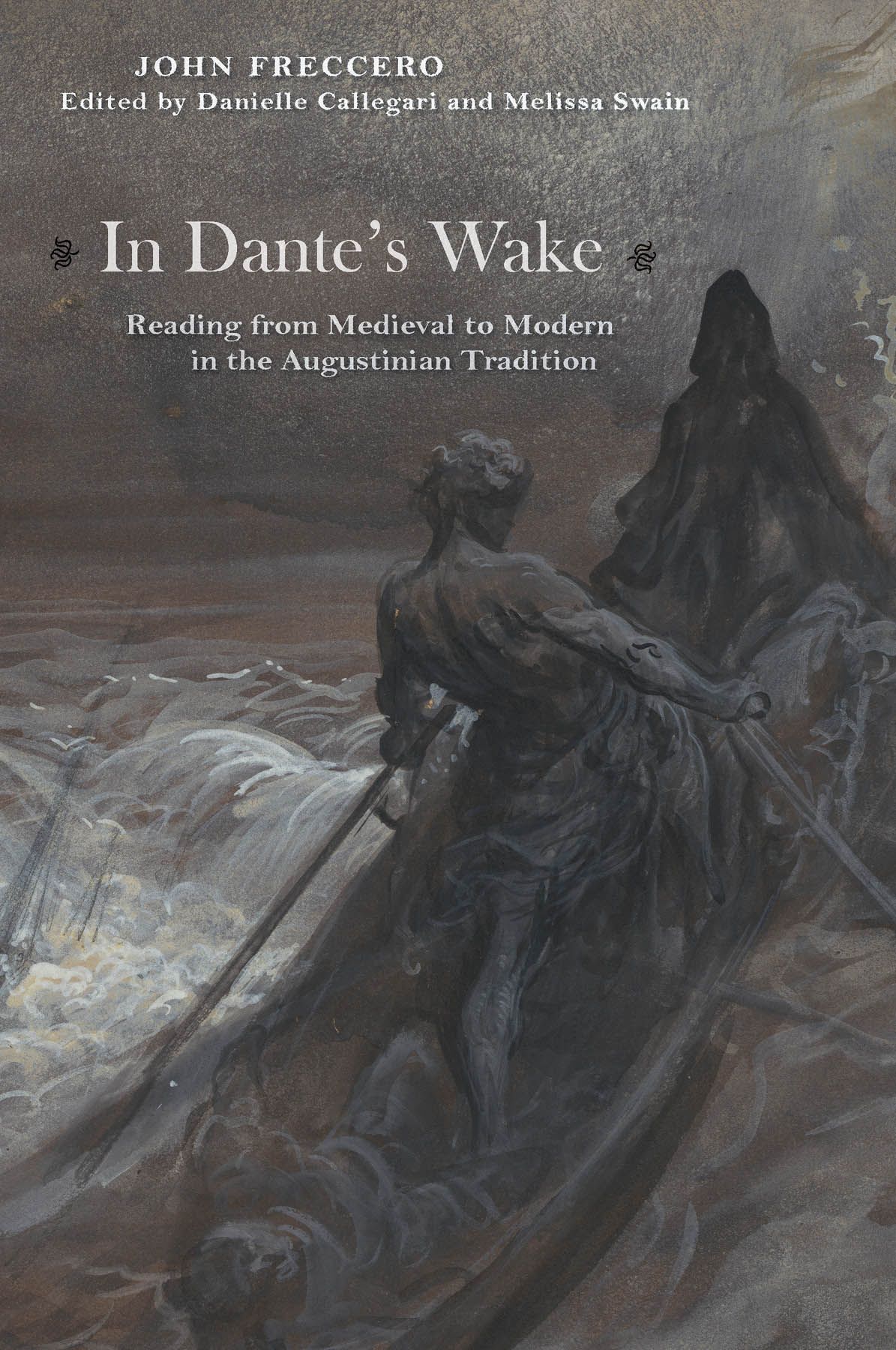
In Dante's Wake: Reading from Medieval to Modern in the Augustinian Tradition
Waking to find himself shipwrecked on a strange shore before a dark wood, the pilgrim of the Divine Comedy realizes he must set his sights higher and guide his ship to a radically different port. Starting on the sand of that very shore with Dante, John Freccero begins retracing the famous voyage recounted by the poet nearly 700 years ago. Freccero follows pilgrim and poet through the Comedy and then beyond, inviting readers both uninitiated and accomplished to join him in navigating this complex medieval masterpiece and its influence on later literature. Perfectly impenetrable in its poetry and unabashedly ambitious in its content, the Divine Comedy is the cosmos collapsed on itself, heavy with dense matter and impossible to expand. Yet Dante's great triumph is seen in the tiny, subtle fragments that make up the seamless whole, pieces that the poet painstakingly sewed together to form a work that insinuates itself into the reader and inspires the work of the next author. Freccero magnifies the most infinitesimal elements of that intricate construction to identify self-similar parts, revealing the full breadth of the great poem. Using this same technique, Freccero then turns to later giants of literature- Petrarch, Machiavelli, Donne, Joyce, and Svevo-demonstrating how these authors absorbed these smallest parts and reproduced Dante in their own work. In the process, he confronts questions of faith, friendship, gender, politics, poetry, and sexuality, so that traveling with Freccero, the reader will both cross unknown territory and reimagine familiar faces, swimming always in Dante's wake.
eBook
The metaphysics of Dante's Comedy
Dante's metaphysics — his understanding of reality — is very different from our own. To present Dante's ideas about the cosmos, or God, or salvation, or history, or poetry within the context of post-Enlightenment presuppositions, as is usually done, is thus to capture only imperfectly the essence of those ideas. This book argues that the recovery of Dante's metaphysics is essential if we are to resolve what has been called “the central problem in the interpretation of the Comedy. ”That problem is what to make of the Comedy's claim to the “status of revelation, vision, or experiential record — as something more than imaginative literature.” This book offers a sustained treatment of the metaphysical picture that grounds and motivates the Comedy, and of the relation between those metaphysics and Dante's poetics. The book carries this out through an examination of three notoriously complex cantos of the Paradiso, read against the background of the Neoplatonic and Aristotelian tradition from which they arise.
eBook

Dante's Idea of Friendship
In the ancient world, friendship was a virtue of great philosophical importance. Aristotle wrote extensively about it, as did Cicero. Their conception of friendship as a relationship based on reason and virtue was transformed by Christianity into a connection based on the mutual love of an individual and God.In Dante's Idea of Friendship, Filippa Modesto offers sharp readings of the Commedia, Vita Nuova, and Convivio that demonstrate Dante's interest in that theme. Drawing on a lucid and wide-ranging examination of the literature on friendship, she shows how he weaved together the contradictory classical and the Christian concepts of friendship into a harmonious synthesis in which friendship became a handmaiden to salvation and happiness. A fresh, perceptive interpretation of Dante's works, Dante's Idea of Friendship will engage medievalists, classicists, and scholars of friendship throughout the ages.
eBook

Dante Canonized and Discarded. Some Remarks on the Reception of the Divina Commedia in the Stalin Era
During the late nineteenth and early twentieth centuries, in the academic and literary circles of tsarist Russia Dante’s Divina Commedia was considered as a religious poem. The theological background underlying the work incurred ecclesiastical censorship, which made it challenging to publish its translations during Nicolay i’s and Alexander ii’s reigns. The mystic motifs and religious imagery found therein became later particularly popular with Silver Age authors. The reception of the Divina Commedia as a Christian text remained unchallenged in the early post-revolutionary Russian intellectual milieu; notably, the publishing house “Vsemirnaja Literatura” (“World Literature”) was not able to justify the preparation of a new translation on ideological grounds. Until the early 1930s, in Soviet literature Dante Alighieri was a controversial figure within the subfield of literary translation; yet in 1946, Michail Lozinskij’s translation of the Divina Commedia was awarded the Stalin Prize 1st class, which for the very first time was granted to a work of translation. The aim of this article is threefold: first it attempts to demonstrate the ways by which, beginning in the 1930s, Dante gradually came to occupy an important place in some printed media in the Soviet Union; second it investigates the circumstances under which a translation of the Divina Commedia was published, and lastly it emphasises that the religious content of Dante’s poem – once appealing to pre-revolutionary writers – was eventually disregarded. The present research, which relies on documents from public and private archives, also traces the history of the preparation of the commentaries that in the 1930s and 1950s accompanied the Russian translations of the Divina Commedia; I shall argue that the editors Dmitrij Min and Michail Lozinskij adopted an approach that was to a certain extent similar to ecclesiastical censorship in tsarist Russia.
Journal Article

La dittologia da Quintiliano a Dante: strategie e prospettive semantiche nella Commedia
In the first part of the article, the itinerary of binomials will be briefly illustrated from their first attestations in the classical context up to the forms that they took in the Latin and Romance production of medieval writers like the Stilnovist poets and Dante. In the Divina Commedia, the figure is used with unprecedented versatility, also in relation to the synonymous component. In the second part we will briefly present the different binomial typologies and the corresponding expressive outcomes, with particular reference to the configurations of synonymous links, whose peculiarities frequently open up new semantic perspectives.
Journal Article

Virgil the Blind Guide
Virgil the Blind Guide examines the repetition of certain linguistic configurations that have remained hidden because the meanings of the words involved do not relate to Virgil’s competence as guide. Uncovering tropes that have yet to be studied, Howard allows us to see new junctures in the poet’s travels, while highlighting Virgil’s impotence and diminishing his authority as regards other poets, guides, and the demons of Hell’s lower gate. The concealed route revealed by Dante’s figurative signposts establishes Virgil’s traits as foundational to the poem and allows for new perspectives and understandings of this critical character. Using this distinctive strategy, Virgil the Blind Guide helps us to piece together the complex puzzle that is Dante’s pagan guide and suggests new ways of understanding important characters that are applicable to a broad range of poetry and prose.
eBook
Dante's Pluralism and the Islamic Philosophy of Religion
This book explores the Islamic roots of the Western values of tolerance and religious pluralism, and considers Dante from the perspective of the Arab-Islamic philosophical tradition. It examines the relations between Islamic and Western thought, the historical origins of Western values, and the tradition of tolerance in classical Islamic thought.
eBook