
Catalogue Search | MBRL


Are you sure you want to remove the book from the shelf?

{{itemTitle}}
43,846
result(s) for
"Durable"
Sort by:

The eco hero handbook : simple solutions to tackle eco-anxiety
\"Looking behind the slogans and exploring the myths, The Eco Hero Handbook is a clear and balanced exploration in to the major eco-debates, enabling you to make decisions based on facts. As we face a global environmental crisis, The Eco Hero Handbook addresses all your eco-anxieties and dilemmas to empower you to become part of the solution. Looking behind the slogans and exploring the myths, this handy guide offers a clear and balanced exploration of the major eco-debates, enabling you to make decisions based on facts. Featuring practical steps for positive action in all areas of your life, find solutions to all your environment-related challenges, including: How can I keep my house clean but low impact? How can I reduce my overall energy use in the home? How can I protect my plants without using chemicals? Which transport choices will help cut carbon emissions? Is it okay to eat any meat? Organised by area of life (home, out and about, work, food and activism), each issue is paired with a practical solution and the evidence to back it up. From recycling to eating sustainably, ethical fashion to being an eco-conscious tourist, this book is the essential guide to the little changes that will make a big difference\"--Publisher's description.
BOOK
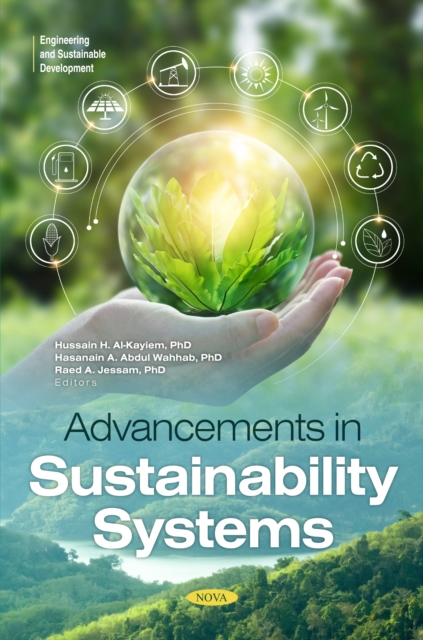
Advancements in Sustainability Systems
Sustainability is a complex concept as it has two opposite faces. It may be positive or may be negative sustainability as it regards to poverty, illness, diseases, terrorism, drug addiction, human trafficking, global warming, colonization, slavery, and many other kinds of harmful matters to the safety, happiness and prosperity of communities and people. People think only of positive sustainability, which leads to development, and security for mankind. The United Nations, through UNDP identified seventeen positive Sustainable Development Goals (SDGs) that are purposely steering communities toward a better future. This book is structured to discuss some of the developers and their efforts, and it compiles their findings to provide useful data, strategies, and materials for positive sustainability. The book is split into ten chapters, each one discussing a separate sustainability topic. Three chapters deal with new urban planning and development. Three chapters present state-of-the-art solar systems. Three chapters cover the topic of human health, and one chapter discusses advanced 5G communication.
eBook

Not the end of the world : how we can be the first generation to build a sustainable planet
In this bold, radically hopeful book, a data scientist, drawing on the latest research, practical guidance and eye-opening graphics, gives us the tools for understanding our current environmental crisis and making lifestyle changes that actually have an impact.
Book

Slowed canonical progress in large fields of science
In many academic fields, the number of papers published each year has increased significantly over time. Policy measures aim to increase the quantity of scientists, research funding, and scientific output, which is measured by the number of papers produced. These quantitative metrics determine the career trajectories of scholars and evaluations of academic departments, institutions, and nations. Whether and how these increases in the numbers of scientists and papers translate into advances in knowledge is unclear, however. Here, we first lay out a theoretical argument for why too many papers published each year in a field can lead to stagnation rather than advance. The deluge of new papers may deprive reviewers and readers the cognitive slack required to fully recognize and understand novel ideas. Competition among many new ideas may prevent the gradual accumulation of focused attention on a promising new idea. Then, we show data supporting the predictions of this theory. When the number of papers published per year in a scientific field grows large, citations flow disproportionately to already well-cited papers; the list of most-cited papers ossifies; new papers are unlikely to ever become highly cited, and when they do, it is not through a gradual, cumulative process of attention gathering; and newly published papers become unlikely to disrupt existing work. These findings suggest that the progress of large scientific fields may be slowed, trapped in existing canon. Policy measures shifting how scientific work is produced, disseminated, consumed, and rewarded may be called for to push fields into new, more fertile areas of study.
Journal Article

Reducing greenhouse gas emissions from livestock production
Reducing greenhouse gas emissions from livestock production provides authoraitative reviews on measure GHG emissions from livestock as well as the range of methods that can be applied to reduce emissions, ranging from breeding to animal health and manure management. The collection also reviews nutritional approaches such as improving forage quality and the use of plant bioactive compounds and other feed supplements to limit emissions by modifying the rumen environment.
BOOK

Impact of the TEAM Wheels eHealth manual wheelchair training program: Study protocol for a randomized controlled trial
Variable, and typically inadequate, delivery of skills training following manual wheelchair (MWC) provision has a detrimental impact on user mobility and participation. Traditional in-person delivery of training by rehabilitation therapists has diminished due to cost, travel time, and most recently social distancing restrictions due to COVID-19. Effective alternative training approaches include eHealth home training applications and interactive peer-led training using experienced and proficient MWC users. An innovative TEAM Wheels program integrates app-based self-training and teleconference peer-led training using a computer tablet platform.
This protocol outlines implementation and evaluation of the TEAM Wheels training program in a randomized control trial using a wait-list control group.
The study will be implemented in a community setting in three Canadian cities.
Individuals ≥ 18 years of age within one year of transitioning to use of a MWC.
Using a computer tablet, participants engage in three peer-led teleconference training sessions and 75-150 minutes of weekly practice using a video-based training application over 4 weeks. Peer trainers individualize the participants' training plans and monitor their tablet-based training activity online. Control group participants also receive the intervention following a 1-month wait-list period and data collection.
Outcomes assessing participation; skill capacity and performance; self-efficacy; mobility; and quality of life will be measured at baseline and post-treatment, and at 6-month follow-up for the treatment group.
We anticipate that TEAM Wheels will be successfully carried out at all sites and participants will demonstrate statistically significant improvement in the outcome measures compared with the control group.
Journal Article

Sustainable architecture
Reveals the different connections between the planning and construction phases of a project, which reflect the joint efforts of architects, designers and builders to transform an industry that plays a key role in environmental conservation processes.
Book

The Role of Sales Agents in Information Disclosure: Evidence from a Field Experiment
With a large nationwide retailer, we run a natural field experiment to measure the effects of energy use information disclosure, customer rebates, and sales agent incentives on demand for energy-efficient durable goods. Although a combination of large rebates plus sales incentives substantially increases market share, information and sales incentives alone each have zero statistical effect and explain at most a small fraction of the low baseline market share. Sales agents strategically comply only partially with the experiment, targeting information to more interested consumers but not discussing energy efficiency with the disinterested majority. These results suggest that seller-provided information is not a major barrier to energy-efficiency investments at current prices in this context.
Data, as supplemental material, are available at
http://dx.doi.org/10.1287/mnsc.2015.2327
.
This paper was accepted by John List, behavioral economics
.
Journal Article


Predictive Maintenance in Building Facilities: A Machine Learning-Based Approach
The operation and maintenance of buildings has seen several advances in recent years. Multiple information and communication technology (ICT) solutions have been introduced to better manage building maintenance. However, maintenance practices in buildings remain less efficient and lead to significant energy waste. In this paper, a predictive maintenance framework based on machine learning techniques is proposed. This framework aims to provide guidelines to implement predictive maintenance for building installations. The framework is organised into five steps: data collection, data processing, model development, fault notification and model improvement. A sport facility was selected as a case study in this work to demonstrate the framework. Data were collected from different heating ventilation and air conditioning (HVAC) installations using Internet of Things (IoT) devices and a building automation system (BAS). Then, a deep learning model was used to predict failures. The case study showed the potential of this framework to predict failures. However, multiple obstacles and barriers were observed related to data availability and feedback collection. The overall results of this paper can help to provide guidelines for scientists and practitioners to implement predictive maintenance approaches in buildings.
Journal Article