
Catalogue Search | MBRL


Are you sure you want to remove the book from the shelf?

{{itemTitle}}
18,495
result(s) for
"Economics Psychological aspects."
Sort by:


Identity Economics
Identity Economicsprovides an important and compelling new way to understand human behavior, revealing how our identities--and not just economic incentives--influence our decisions. In 1995, economist Rachel Kranton wrote future Nobel Prize-winner George Akerlof a letter insisting that his most recent paper was wrong. Identity, she argued, was the missing element that would help to explain why people--facing the same economic circumstances--would make different choices. This was the beginning of a fourteen-year collaboration--and ofIdentity Economics.
The authors explain how our conception of who we are and who we want to be may shape our economic lives more than any other factor, affecting how hard we work, and how we learn, spend, and save. Identity economics is a new way to understand people's decisions--at work, at school, and at home. With it, we can better appreciate why incentives like stock options work or don't; why some schools succeed and others don't; why some cities and towns don't invest in their futures--and much, much more.
Identity Economicsbridges a critical gap in the social sciences. It brings identity and norms to economics. People's notions of what is proper, and what is forbidden, and for whom, are fundamental to how hard they work, and how they learn, spend, and save. Thus people's identity--their conception of who they are, and of who they choose to be--may be the most important factor affecting their economic lives. And the limits placed by society on people's identity can also be crucial determinants of their economic well-being.
eBook


Realizing Capital: Financial and Psychic Economies in Victorian Form
During a tumultuous period when financial speculation began rapidly to outpace industrial production and consumption, Victorian financial journalists commonly explained the instability of finance by criticizing its inherent artifice drawing persistent attention to what they called \"fictitious capital.\" In a shift that naturalized this artifice, this critique of fictitious capital virtually disappeared by the 1860s, being replaced by notions of fickle investor psychology and mental equilibrium encapsulated in the fascinating metaphor of \"psychic economy.\" In close rhetorical readings of financial journalism, political economy, and the works of Dickens, Eliot, and Trollope, Kornbluh examines the psychological framing of economics, one of the nineteenth century's most enduring legacies, reminding us that the current dominant paradigm for understanding financial crisis has a history of its own. She shows how novels illuminate this displacement and ironize ideological metaphors linking psychology and economics, thus demonstrating literature's unique facility for evaluating ideas in process. Inheritors of this novelistic project, Marx and Freud each advance a critique of psychic economy that refuses to naturalize capitalism.
eBook

Freakonomics : a rogue economist explores the hidden side of everything
Asking provocative and profound questions about human motivation and contemporary living and reaching some astonishing conclusions, 'Freakonomics' will make you see the familiar world through a completely original lens.
Book

Beautiful Game Theory
A wealth of research in recent decades has seen the economic approach to human behavior extended over many areas previously considered to belong to sociology, political science, law, and other fields. Research has also shown that economics can provide insight into many aspects of sports, including soccer.Beautiful Game Theoryis the first book that uses soccer to test economic theories and document novel human behavior.
In this brilliant and entertaining book, Ignacio Palacios-Huerta illuminates economics through the world's most popular sport. He offers unique and often startling insights into game theory and microeconomics, covering topics such as mixed strategies, discrimination, incentives, and human preferences. He also looks at finance, experimental economics, behavioral economics, and neuroeconomics. Soccer provides rich data sets and environments that shed light on universal economic principles in interesting and useful ways.
Essential reading for students, researchers, and sports enthusiasts,Beautiful Game Theory is the first book to showwhat soccer can do for economics.
eBook

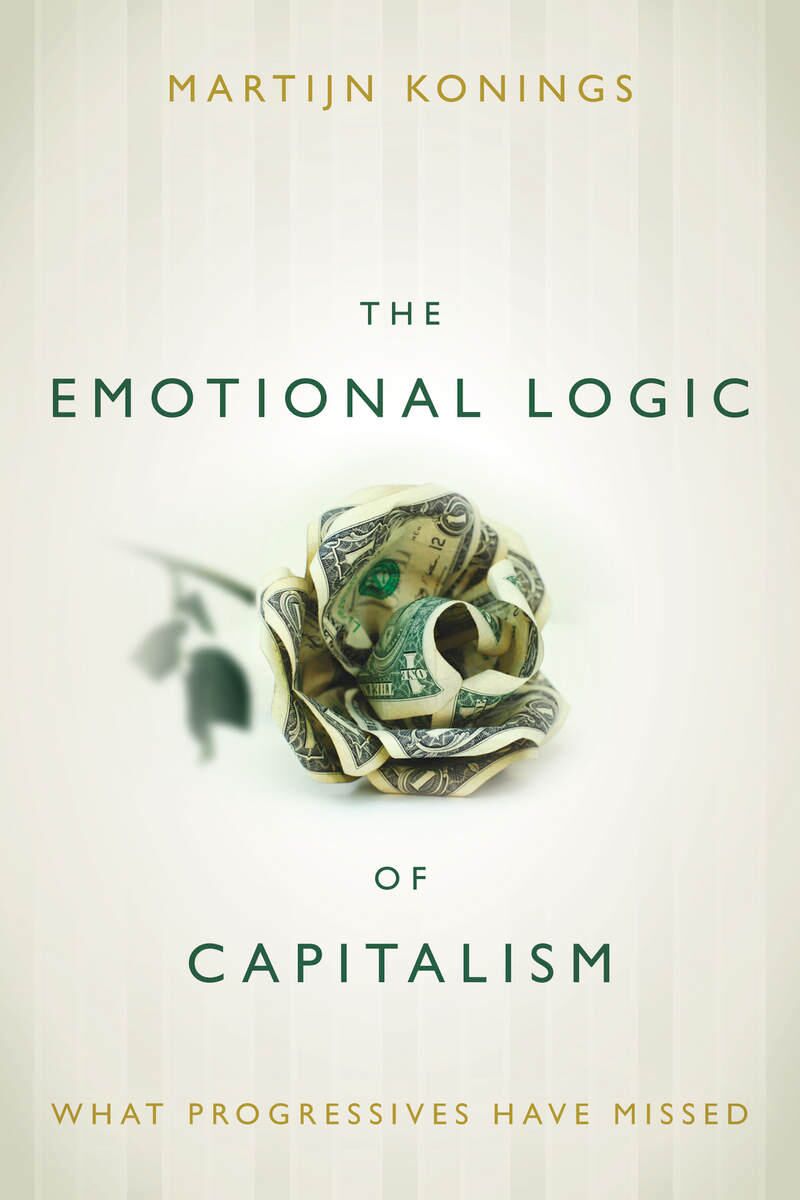
The emotional logic of capitalism : what progressives have missed
The capitalist market, progressives bemoan, is a cold monster: it disrupts social bonds, erodes emotional attachments, and imposes an abstract utilitarian rationality. But what if such hallowed critiques are completely misleading? This book argues that the production of new sources of faith and enchantment is crucial to the dynamics of the capitalist economy. Distinctively secular patterns of attraction and attachment give modern institutions a binding force that was not available to more traditional forms of rule. Elaborating his alternative approach through an engagement with the semiotics of money and the genealogy of economy, Martijn Konings uncovers capitalism's emotional and theological content in order to understand the paradoxical sources of cohesion and legitimacy that it commands. In developing this perspective, he draws on pragmatist thought to rework and revitalize the Marxist critique of capitalism.
eBook

Misbehaving : the making of behavioral economics
\"Traditional economics assumes rational actors. Early in his research, Thaler realized these Spock-like automatons were nothing like real people. Whether buying a clock radio, selling basketball tickets, or applying for a mortgage, we all succumb to biases and make decisions that deviate from the standards of rationality assumed by economists. In other words, we misbehave. More importantly, our misbehavior has serious consequences. Dismissed at first by economists as an amusing sideshow, the study of human miscalculations and their effects on markets now drives efforts to make better decisions in our lives, our businesses, and our governments\"--Amazon.com.
Book

Measuring Happiness
Can money buy happiness? Is income a reliable measure for life satisfaction? In the West after World War II, happiness seemed inextricably connected to prosperity. Beginning in the 1960s, however, other values began to gain ground: peace, political participation, civil rights, environmentalism. \"Happiness economics\" -- a somewhat incongruous-sounding branch of what has been called \"the dismal science\" -- has taken up the puzzle of what makes people happy, conducting elaborate surveys in which people are asked to quantify their satisfaction with \"life in general.\" In this book, three economists explore the happiness-prosperity connection, investigating how economists measure life satisfaction and well-being.The authors examine the evolution of happiness research, considering the famous \"Easterlin Paradox,\" which found that people's average life satisfaction didn't seem to depend on their income. But they question whether happiness research can measure what needs to be measured. They argue that we should not assess people's well-being on a \"happiness scale,\" because that necessarily obscures true social progress. Instead, rising income should be understood as increasing opportunities and alleviating scarcity. Economic growth helps societies to sustain freedom and to finance social welfare programs. In this respect, high income may not buy happiness with life in general, but it gives individuals the opportunity to be healthier, better educated, better clothed, and better fed, to live longer, and to live well.
eBook