
Catalogue Search | MBRL


Are you sure you want to remove the book from the shelf?

{{itemTitle}}
146,431
result(s) for
"Educational evaluation"
Sort by:


Exemplars of Assessment in Higher Education
Co-published with \"While assessment may feel to constituents like an activity of accountability simply for accreditors, it is most appropriate to approach assessment as an activity of accountability for students. Assessment results that improve institutional effectiveness, heighten student learning, and better align resources serve to make institutions stronger for the benefit of their students, and those results also serve the institution or program well during the holistic evaluation required through accreditation.\" - from the foreword by Heather Perfetti, President of the Middle States Commission on Higher EducationColleges and universities struggle to understand precisely what is being asked for by accreditors, and this book answers that question by sharing examples of success reported by schools specifically recommended by accreditors. This compendium gathers examples of assessment practice in twenty-four higher education institutions: twenty-three in the U.S. and one in Australia. All institutions represented in this book were suggested by their accreditor as having an effective assessment approach in one or more of the following assessment focused areas: assessment in the disciplines, co-curricular, course/program/institutional assessment, equity and inclusion, general education, online learning, program review, scholarship of teaching and learning, student learning, or technology. These examples recommended by accrediting agencies makes this a unique contribution to the assessment literature. The book is organized in four parts. Part One is focused on student learning and assessment and includes ten chapters. The primary focus for Part Two is student learning assessment from a disciplinary perspective and includes four chapters. Part Three has a faculty engagement and assessment focus, and Part Four includes four chapters on institutional effectiveness and assessment, with a focus on strategic planning.This book is a publication of the Association for the
eBook


Real-time student assessment : meeting the imperative for improved time to degree, closing the opportunity gap, and assuring student competencies for 21st century needs
This book challenges institutions and their programs to prioritize the use of chronological assessment results to benefit enrolled students in comparison with the more common practice of prolonged assessment cycles that generally benefit future students.
eBook

Student growth measures in policy and practice : intended and unintended consequences of high-stakes teacher evaluations when theoretical models meet school realities : educator responses to student growth measures in an incentive pay program
This book examines the intersection of policy and practice in the use of student growth measures (SGMs) for high-stakes purpose as per such educator evaluation systems. The book also focuses on examinations of educators perceptions of and reactions to the use of SGMs; ethical implications pertaining to the use of SGMs; contextual challenges when implementing SGMs; and legal implications of SGM use. The use of student test score data has been the cornerstone of the recent transfiguration of educator evaluation systems in forty-two states and the District of Columbia. Three leading voices on SGMs - Sean Corcoran, Henry Braun, and David Berliner - also serve as section and concluding commentators.
Book
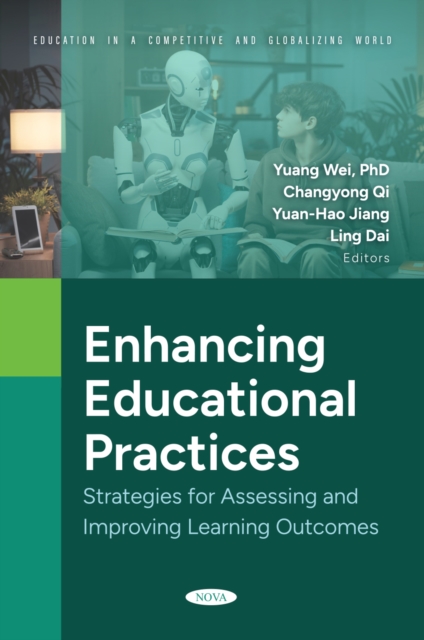
Enhancing educational practices:: strategies for assessing and improving learning outcomes
\"The effective assessment of learning outcomes serves as the cornerstone of educational guidance while improving learning outcomes stands as the central objective of effective teaching. As intelligent technology continues to advance, the field of education must endeavor to develop increasingly personalized, effective, and human-centric approaches to assessing and enhancing learning outcomes. To realize this vision, this book seeks to identify educational realities, dismantle educational barriers using advanced technology, and speculate on future trajectories. Throughout this book, readers will delve into cutting-edge research about the assessment and enhancement of learning outcomes, explore the latest educational technologies for this purpose, and gain a more comprehensive understanding of future research directions. Let us collectively contribute to shaping the future of AI for education\"--.
eBook

Monitoring the quality of education in schools : examples of feedback into systems from developed and emerging economies
The monitoring of quality has been part of the educational landscape for many decades. Originally the need to monitor arose as part of an economic process whereby policy makers wanted to discern the return on investment in education. This bottom line thinking, while still prominent, has receded into the background in light of global changes and the emergence of a global economy. Now in addition to the question \"what is the return on investment?\", the more important question is \"are the students in schools ready to participate in the economy of a 21st century society?\". This is underpinned by the inquiry into what knowledge and competencies are required for students to participate meaningfully in nation-building. This inquiry can only be undertaken by means of monitoring, evaluating where the students are and what is required so that students reach their potential. In an ever-changing technologically-oriented world the manner in which competencies and knowledge are identified and how these need to be measured and identified is important. In this book, the theory and practice of underpinning the monitoring of the quality of education is described. This is followed by a number of practical examples, in the form of country case studies, on how theory plays out in practice. The book further provides common themes across developed and developing emerging economies underscoring the need for approaches which are locally relevant but internationally transferable. Publisher.
Book
Data Rules
Data Rules provides much-needed clarity on how instructional leaders can effectively leverage data.
It's no secret that using data can be a key driver of teacher growth and student achievement. The only real question is how. Coaching expert Jim Knight and professor Michael Faggella-Luby distill decades of research into an accessible, proven approach that explains
- Why data is important for transforming teaching.
- A framework of 10 easy-to-apply rules for effective data use.
- Best practices to communicate and discuss data.
- How to analyze data for student engagement and achievement.
- How to analyze data for instructional practice.
To help schools achieve sustained improvement, this book also connects its data rules to the Impact Cycle, Knight's field-tested model for coaching teachers based on research from the Instructional Coaching Group (ICG). Equipped with the right tools, any instructional leader or coach will be able to realize the full potential of data, move the needle on classroom instruction, and improve student outcomes.
This book is a copublication of ASCD and One Fine Bird Press.
eBook


Critical Race Spatial Analysis
This book addresses these questions and explores the use of critical spatial analysis to uncover the dimensions of entrenched and systemic racial inequities in educational settings and identify ways to redress them. It demonstrates the analytical and communicative power of mapping and its potential for identifying and dismantling racial injustice in education and its possibilities for future research.
eBook