
Catalogue Search | MBRL


Are you sure you want to remove the book from the shelf?

{{itemTitle}}
2,555
result(s) for
"Electric lighting Design."
Sort by:

Urban lighting for people : evidence-based lighting design for the built environment
Lighting has the power to illuminate and enhance our experience within the built environment. The light that enables people to travel around their neighbourhood or their city; the light which they see themselves and their neighbourhood under. Research into the effects of urban lighting on behaviour, environmental psychology and social interaction is developing at a rapid rate. Yet, despite the affect it has on our daily lives, the practical application of this research is a relatively untapped resource. 0This book explores the needs and experiences of people at night and how these can be addressed by public lighting. It will give readers the confidence to develop more sophisticated lighting plans and add value to their projects. Case studies provide in-depth analysis of real-life projects and will help the reader to understand lighting designers' own experiences, including post-installation observations. Written in an accessible style by an array of experts, this is an essential book for practitioners, academics and students alike, that will enable you to put the research in to practice and develop better lighting for better places.
Book
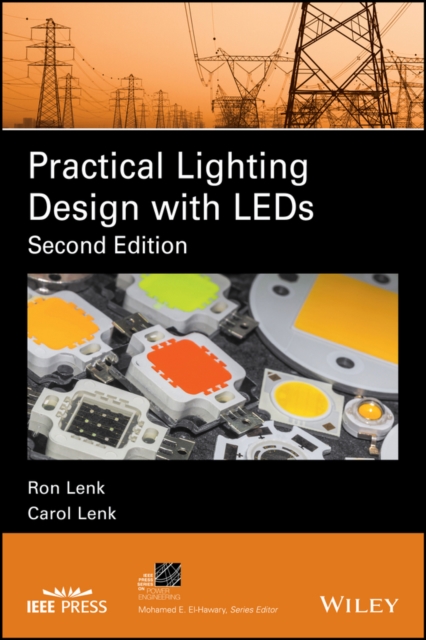
Practical Lighting Design with LEDs
<p>The second edition of <i>Practical Lighting Design with LEDs</i> has been revised and updated to provide the most current information for developing light-emitting diodes products. The authors, noted authorities in the field, offer a review of the most relevant topics including optical performance, materials, thermal design, and modeling and measurement. Comprehensive in scope, the text covers all the information needed to design LEDs into end products.</p> <p>The user-friendly text also contains numerous drawings and schematics that show how things such as measurements are actually made, and show how circuits actually work. Designed to be practical, the text includes a myriad of notes and illustrative examples that give pointers and how-to guides on many of the book's topics. In addition, the book's equations are used only for practical calculations, and are kept at the level of high-school algebra. This thoroughly expanded second edition offers: <ul><li>New chapters on the design of an LED flashlight, USB light, automotive taillight, and LED light bulbs</li> <li>Dozens of new illustrations</li> <li>Coverage of the nitty-gritty, day-to-day engineering and systems used to design and build complete LED systems</li> <li>An exploration of the cutting-edge technology of LEDs</li></ul> <p><i>Practical Lighting Design with LEDs, Second Edition</i> helps engineers and managers meet the demand for the surge in usage for products using light-emitting diodes with a practical guide that takes them through the relevant fields of light, electronic and thermal design.
eBook


Manipulation of ionized impurity scattering for achieving high thermoelectric performance in n-type Mg₃Sb₂-based materials
Achieving higher carrier mobility plays a pivotal role for obtaining potentially high thermoelectric performance. In principle, the carrier mobility is governed by the band structure as well as by the carrier scattering mechanism. Here, we demonstrate that by manipulating the carrier scattering mechanism in n-type Mg₃Sb₂-based materials, a substantial improvement in carrier mobility, and hence the power factor, can be achieved. In this work, Fe, Co, Hf, and Ta are doped on the Mg site of Mg3.2Sb1.5Bi0.49Te0.01, where the ionized impurity scattering crosses over to mixed ionized impurity and acoustic phonon scattering. A significant improvement in Hall mobility from ∼16 to ∼81 cm²·V−1·s−1 is obtained, thus leading to a notably enhanced power factor of ∼13 μW·cm−1·K−2 from ∼5 μW·cm−1·K−2. A simultaneous reduction in thermal conductivity is also achieved. Collectively, a figure of merit (ZT) of ∼1.7 is obtained at 773 K in Mg3.1Co0.1Sb1.5Bi0.49Te0.01. The concept of manipulating the carrier scattering mechanism to improve the mobility should also be applicable to other material systems.
Journal Article

High thermoelectric performance by resonant dopant indium in nanostructured SnTe
From an environmental perspective, lead-free SnTe would be preferable for solid-state waste heat recovery if its thermoelectric figure-of-merit could be brought close to that of the lead-containing chalcogenides. In this work, we studied the thermoelectric properties of nanostructured SnTe with different dopants, and found indium-doped SnTe showed extraordinarily large Seebeck coefficients that cannot be explained properly by the conventional two-valence band model. We attributed this enhancement of Seebeck coefficients to resonant levels created by the indium impurities inside the valence band, supported by the first-principles simulations. This, together with the lower thermal conductivity resulting from the decreased grain size by ball milling and hot pressing, improved both the peak and average nondimensional figure-of-merit (ZT) significantly. A peak ZT of ∼1.1 was obtained in 0.25 atom % In-doped SnTe at about 873 K.
Journal Article
Achieving high power factor and output power density in p-type half-Heuslers Nb1-xTiₓFeSb
Improvements in thermoelectric material performance over the past two decades have largely been based on decreasing the phonon thermal conductivity. Enhancing the power factor has been less successful in comparison. In this work, a peak power factor of ∼106 μW·cm−1·K−2 is achieved by increasing the hot pressing temperature up to 1,373 K in the p-type half-Heusler Nb0.95Ti0.05FeSb. The high power factor subsequently yields a record output power density of ∼22 W·cm−2 based on a single-leg device operating at between 293 K and 868 K. Such a high-output power density can be beneficial for large-scale power generation applications.
Journal Article

Experimental observation of Weyl points
The massless solutions to the Dirac equation are described by the so-called Weyl Hamiltonian. The Weyl equation requires a particle to have linear dispersion in all three dimensions while being doubly degenerate at a single momentum point. These Weyl points are topological monopoles of quantized Berry flux exhibiting numerous unusual properties. We performed angle-resolved microwave transmission measurements through a double-gyroid photonic crystal with inversion-breaking where Weyl points have been theoretically predicted to occur. The excited bulk states show two linear dispersion bands touching at four isolated points in the three-dimensional Brillouin zone, indicating the observation of Weyl points. This work paves the way to a variety of photonic topological phenomena in three dimensions.
Journal Article

High-performance flat-panel solar thermoelectric generators with high thermal concentration
The conversion of sunlight into electricity has been dominated by photovoltaic and solar thermal power generation. Photovoltaic cells are deployed widely, mostly as flat panels, whereas solar thermal electricity generation relying on optical concentrators and mechanical heat engines is only seen in large-scale power plants. Here we demonstrate a promising flat-panel solar thermal to electric power conversion technology based on the Seebeck effect and high thermal concentration, thus enabling wider applications. The developed solar thermoelectric generators (STEGs) achieved a peak efficiency of 4.6% under AM1.5G (1 kW m
−2
) conditions. The efficiency is 7–8 times higher than the previously reported best value for a flat-panel STEG, and is enabled by the use of high-performance nanostructured thermoelectric materials and spectrally-selective solar absorbers in an innovative design that exploits high thermal concentration in an evacuated environment. Our work opens up a promising new approach which has the potential to achieve cost-effective conversion of solar energy into electricity.
The conversion of sunlight into electricity has been dominated by photovoltaic and solar thermal power generation. A highly efficient solar to electric energy conversion device based on nanostructured thermoelectric materials and high solar concentration is now demonstrated. The results show potential for cost effective solar thermoelectric generation.
Journal Article

Toward high-energy-density, high-efficiency, and moderate-temperature chip-scale thermophotovoltaics
The challenging problem of ultra-high-energy-density, high-efficiency, and small-scale portable power generation is addressed here using a distinctive thermophotovoltaic energy conversion mechanism and chip-based system design, which we name the microthermophotovoltaic (μTPV) generator. The approach is predicted to be capable of up to 32% efficient heat-to-electricity conversion within a millimeter-scale form factor. Although considerable technological barriers need to be overcome to reach full performance, we have performed a robust experimental demonstration that validates the theoretical framework and the key system components. Even with a much-simplified μTPV system design with theoretical efficiency prediction of 2.7%, we experimentally demonstrate 2.5% efficiency. The μTPV experimental system that was built and tested comprises a silicon propane microcombustor, an integrated high-temperature photonic crystal selective thermal emitter, four 0.55-eV GaInAsSb thermophotovoltaic diodes, and an ultra-high-efficiency maximum power-point tracking power electronics converter. The system was demonstrated to operate up to 800 °C (silicon microcombustor temperature) with an input thermal power of 13.7 W, generating 344 mW of electric power over a 1-cm ² area.
Journal Article