
Catalogue Search | MBRL


Are you sure you want to remove the book from the shelf?

{{itemTitle}}
1,022
result(s) for
"English language Word order."
Sort by:

Multifactorial analysis in corpus linguistics : a study of particle placement
This book presents a new analysis of the word-order alternation of English transitive phrasal verbs (aka Particle Movement) from a cognitive-functional and psycholinguistic perspective. Its main objective, however, is a methodological one, namely to demonstrate the superiority of corpus-based, multifactorial and probabilistic approaches towards grammatical phenomena over traditional analyses based on acceptability judgements and minimal pair tests.
eBook
The English it-Cleft
This book examines the structure and function of the English it-cleft configuration from within the framework of construction grammar. It defends a straightforward extraposition-from-NP analysis (on which the cleft clause is a restrictive relative, modifying the initial it) and claims that all types of it-cleft involve nominal predication. Support for this analysis comes from three main areas: (a) the central role of definiteness in the creation of specificational meaning, (b) the existence and makeup of predicational (and proverbial) it-clefts, and (c) the early, historical it-cleft data. In addition, the book contains a sizeable diachronic component, drawing data from the Penn Parsed Corpora of Historical English and from the International Corpus of English - Great Britain. This investigation informs and advances what is an otherwise simple account of the English it-cleft, explaining how and why the configuration has developed an assortment of peculiar, construction-specific properties over time.
eBook
Element order in Old English and Old High German translations
This book is the first comprehensive corpus study of element order in Old English and Old High German, which brings to light numerous differences between these two closely related languages. The study's innovative approach relies on translated texts, which allows the authors to tackle the problem of the apparent incomparability of OE and OHG textual records and to identify the areas of OE and OHG syntax potentially influenced by the Latin source texts. This is especially important from the point of view of OE research, where Latin is rarely considered to be a significant variable. The book's profile and content is of direct interest to historical linguists working on OE and/or OHG (and Old Germanic languages in general), but it can also greatly benefit several other groups of researchers: scholars applying corpus methods to the study of dead languages, historical linguists generally, linguists researching element order as well as specialists in translation studies.
eBook

Word order change in acquisition and language contact : essays in honour of Ans van Kemenade
The case studies in this volume offer new insights into word order change. As is now becoming increasingly clear, word order variation rarely attracts social values in the way that phonological variants do.
eBook
The Discourse Function of Inversion in English
First published in 1997.This dissertation presents a discourse-functional account of English inversion, based on an empirical study of natural language data.The central finding is that inversion is subject to a pragmatic constraint on the information status of its constituents; specifically, the information represented by the preposed.
eBook
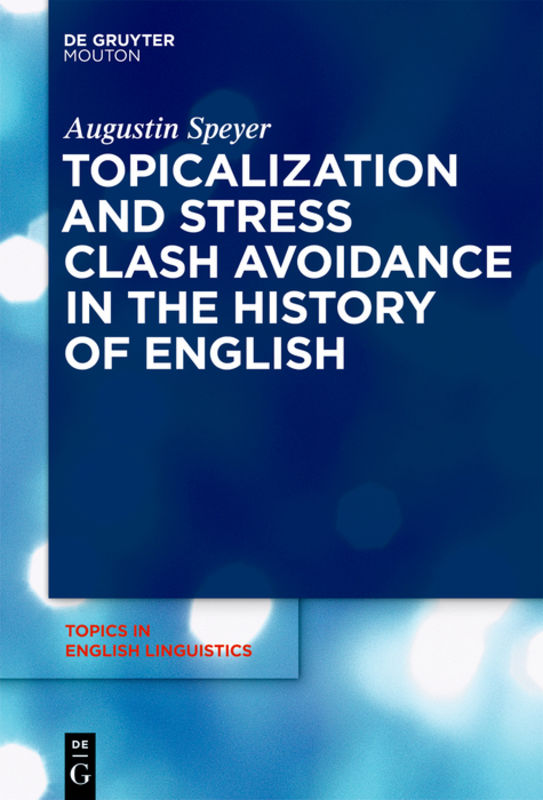
Topicalization and Stress Clash Avoidance in the History of English
The book is concerned with the interaction of syntax, information structure and prosody in the history of English, demonstrating this with a case study of object topicalization. The approach is data-oriented, using material from syntactically parsed digital corpora of Old, Middle and Early Modern English, which serve as a solid foundation for conclusions. The use of object topicalization underwent a sharp decline from Old English until today. In the present volume, a basic prosodic well-formedness condition, the Clash Avoidance Requirement, is identified as the main factor for this change. With the loss of V2-syntax, object topicalization led more easily to cases in which two focalized phrases, the topicalized object and the subject, are adjacent. The two focal accents on these phrases would produce a clash, thus violating the Clash Avoidance Requirement. In order to circumvent this, the use of topicalization in critical cases is avoided. The Clash Avoidance Requirement is highly relevant also today, as experimental data on English and German show. Further, the Clash Avoidance Requirement helps to explain the well-known syntactic structure of the left periphery in Old English. An analysis positing two subject positions is defended in the study. The variation of these subject positions is shown to depend not on pronominal vs. lexical status of the subject but on information structural properties.
eBook
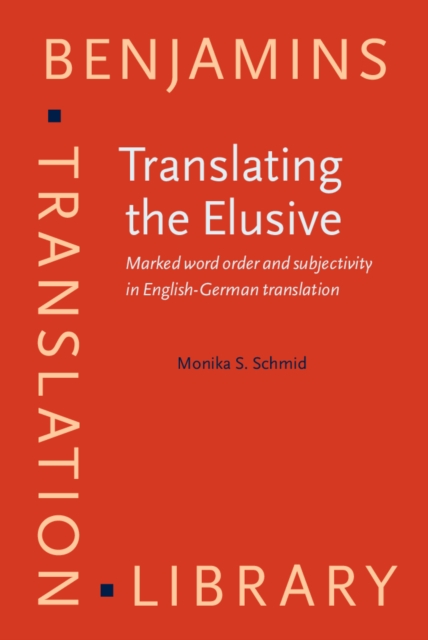
Translating the elusive : marked word order and subjectivity in English-German translation
This work presents an in-depth analysis of text- and speaker-based meaning of non-canonical word order in English and ways to preserve this in English-German translation. Among the sentence structures under discussion are subject-verb inversion, Left Dislocation, Topicalization as well as wh-cleft and it -cleft sentences. Various approaches to the description and analysis of the meaning potential of these structures are presented and discussed, among them theories of grammaticalization, subjectivity, empathy and information structure.English as a rigid word order language has quite different means of creating meaning by syntactic variation than a free word order language like German. Contrastive analyses of English and German have emphasized structural differences due to the fact that English uses word order to encode the assignment of grammatical roles, while in German this is achieved mainly by morphological means. For most 'marked' constructions in English a corresponding, structure-preserving translation does not lead to an ungrammatical or unacceptable German sentence. The temptation for the translator to preserve these structures is therefore great. A case study discusses more than 200 example sentences drawn from recent works of US-American fiction and offers possible strategies for their translation.
eBook
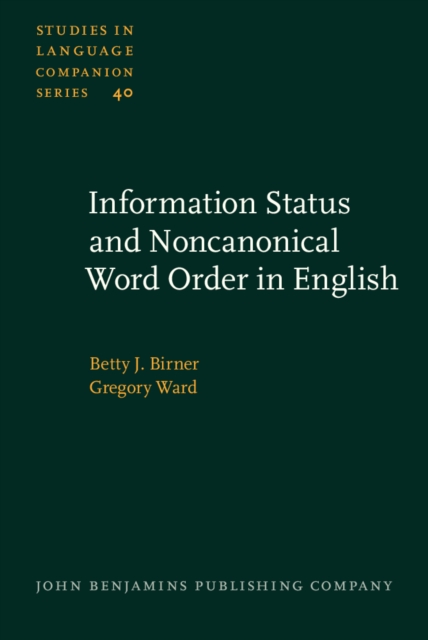
Information Status and Noncanonical Word Order in English
This work provides a comprehensive discourse-functional account of three classes of noncanonical constituent placement in English - preposing, postposing, and argument reversal - and shows how their interaction is accounted for in a principled and predictive way. In doing so, it details the variety of ways in which information can be 'given' or 'new' and shows how an understanding of this variety allows us to account for the distribution of these constructions in discourse. Moreover, the authors show that there exist broad and empirically verifiable functional correspondences within classes of syntactically similar constructions.Relying heavily on corpus data, the authors identify three interacting dimensions along which individual constructions may vary with respect to the pragmatic constraints to which they are sensitive: old vs. new information, relative vs. absolute familiarity, and discourse- vs. hearer-familiarity. They show that preposed position is reserved for information that is linked to the prior discourse by means of a contextually licensed partially-ordered set relationship; postposed position is reserved for information that is 'new' in one of a small number of distinct senses; and argument-reversing constructions require that the information represented by the preverbal constituent be at least as familiar within the discourse as that represented by the postverbal constituent. Within each of the three classes of constructions, individual constructions vary with respect to whether they are sensitive to familiarity within the discourse or (assumed) familiarity within the hearer's knowledge store. Thus, although the individual constructions in question are subject to distinct constraints, this work provides empirical evidence for the existence of strong correlations between sentence position and information status. The final chapter
presents crosslinguistic data showing that these correlations are not limited to English.
eBook
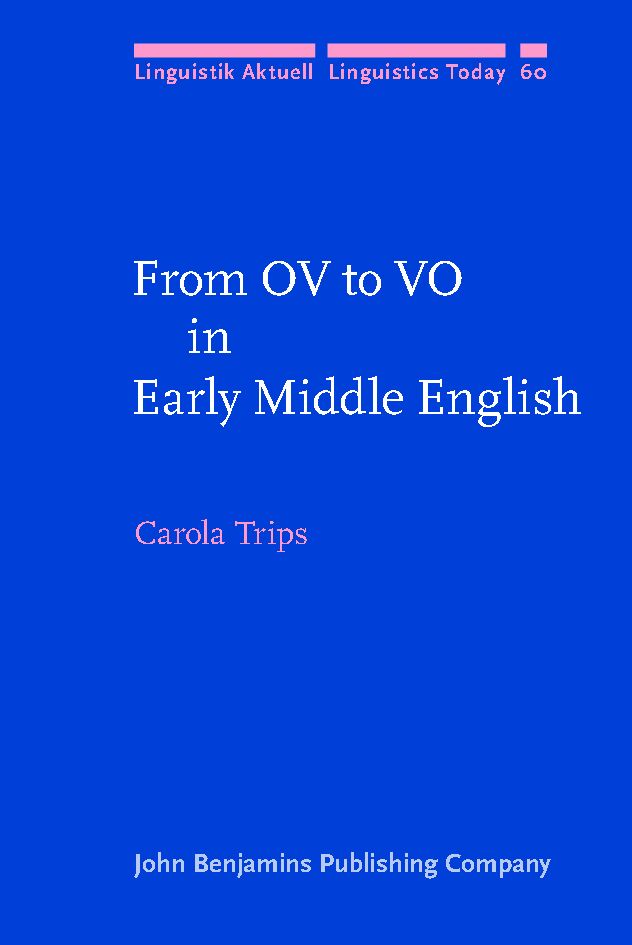
From OV to VO in Early Middle English
This monograph answers the question of why English changed from an OV to a VO language on the assumption that this change is due to intensive language contact with Scandinavian. It shows for the first time that the English language was much more heavily influenced by Scandinavian than assumed before, i.e., northern Early Middle English texts clearly show Scandinavian syntactic patterns like stylistic fronting that can only be found today in the Modern Scandinavian languages. Thus, it sheds new light on the force of language contact in that it shows that a language can be heavily influenced through contact with another language in such a way that it affects deeper levels of language. It further gives an introduction to working with the Penn-Helsinki-Parsed Corpus of Middle English II (PPCMEII). It discusses the texts included in the corpus, it describes the format of the texts, and it explains how to search the corpus with the tool called Corpus Search. The book targets researchers in diachronic syntax, comparative syntax and in general linguists working in the field of generative syntax. It can further be used as an introduction to working with the PPCMEII.
eBook