
Catalogue Search | MBRL


Are you sure you want to remove the book from the shelf?

{{itemTitle}}
224
result(s) for
"Financial crises Argentina."
Sort by:


Everyday revolutions
Daring and groundbreaking, Marina Sitrin explores how an economic crisis in Argentina spurred a people's rebellion, leading to new forms of social organization and providing an instructive example for activists the world over.
eBook
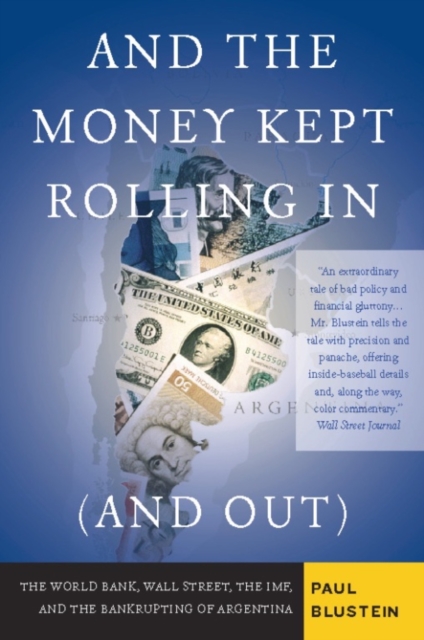
And the Money Kept Rolling in (and Out) Wall Street, the IMF, and the Bankrupting of Argentina
In the 1990s, few countries were more lionized than Argentina for its efforts to join the club of wealthy nations. Argentina's policies drew enthusiastic applause from the IMF, the World Bank and Wall Street. But the club has a disturbing propensity to turn its back on arrivistes and cast them out. That was what happened in 2001, when Argentina suffered one of the most spectacular crashes in modern history. With it came appalling social and political chaos, a collapse of the peso, and a wrenching downturn that threw millions into poverty and left nearly one-quarter of the workforce unemployed.Paul Blustein, whose book about the IMF,The Chastening, was called \"gripping, often frightening\" byThe Economistand lauded by theWall Street Journalas \"a superbly reported and skillfully woven story,\" now gets right inside Argentina's rise and fall in a dramatic account based on hundreds of interviews with top policymakers and financial market players as well as reams of internal documents. He shows how the IMF turned a blind eye to the vulnerabilities of its star pupil, and exposes the conduct of global financial market players in Argentina as redolent of the scandals - like those at Enron, WorldCom and Global Crossing - that rocked Wall Street in recent years. By going behind the scenes of Argentina's debacle, Blustein shows with unmistakable clarity how sadly elusive the path of hope and progress remains to the great bulk of humanity still mired in poverty and underdevelopment.
eBook


Banks During the Argentine Crisis: Were They All Hurt Equally? Did They All Behave Equally?
Intro -- Contents -- I. INTRODUCTION -- II. OVERVIEW OF THE ARGENTINE BANKS IN THE RUN-UP TO THE CRISIS -- III. DESCRIPTIVE LOOK AT ARGENTINE BANKS IN THE 1995-2001 PERIOD -- IV. ECONOMETRIC ANALYSIS -- V. CONCLUSIONS -- REFERENCES.
eBook

Are economic evaluations and health technology assessments increasingly demanded in times of rationing health services? The case of the Argentine financial crisis
Objectives: After 4 years of deepening recession, Argentina's economy plummeted after default in 2002. This crisis critically affected health expenditures and triggered acute rationing. Our objective was to explore health decision-makers' knowledge and attitudes about economic evaluations (EE) and whether health technology assessment (HTA) were increasingly used for decision making. Methods: A qualitative design based on semistructured interviews and focus groups was used to explore how decision makers belonging to different health sectors implement resource allocation decisions. Results: Informants were mostly unaware of EE. The most important criteria mentioned to adopt a treatment were evidence of effectiveness, social/stakeholder demand, or resource availability. Despite general positive attitudes about EE, knowledge was rather limited. Although cost considerations were widely accepted by purchasers and managers, clinicians argued about these issues as interfering with the doctor–patient relationship. Other important perceived barriers to HTA use were lack of confidence in the transferability of studies conducted in developed countries and institutional fragmentation of the Argentine healthcare system. The new macroeconomic context was cited as a justification of implicit rationing measures. Although explicit priority setting was implemented by many purchasers and managers, HTA was not used to improve technical and/or allocative efficiency. Conclusions: The crisis seems to be a strong incentive to extend the use of HTA in Argentina, provided decision makers are aware as well as involved in the generation of local studies.
Journal Article

Developing Country Debt and the World Economy
For dozens of developing countries, the financial upheavals of the 1980s have set back economic development by a decade or more. Poverty in those countries have intensified as they struggle under the burden of an enormous external debt. In 1988, more than six years after the onset of the crisis, almost all the debtor countries were still unable to borrow in the international capital markets on normal terms. Moreover, the world financial system has been disrupted by the prospect of widespread defaults on those debts. Because of the urgency of the present crisis, and because similar crises have recurred intermittently for at least 175 years, it is important to understand the fundamental features of the international macroeconomy and global financial markets that have contributed to this repeated instability. Developing Country Debt and the World Economy contains nontechnical versions of papers prepared under the auspices of the project on developing country debt, sponsored by the National Bureau of Economic Research. The project focuses on the middle-income developing countries, particularly those in Latin America and East Asia, although many lessons of the study should apply as well to other, poorer debtor countries. The contributors analyze the crisis from two perspectives, that of the international financial system as a whole and that of individual debtor countries. Studies of eight countries—Argentina, Bolivia, Brazil, Indonesia, Mexico, the Philippines, South Korea, and Turkey—explore the question of why some countries succumbed to serious financial crises while other did not. Each study was prepared by a team of two authors—a U.S.-based research and an economist from the country under study. An additional eight papers approach the problem of developing country debt from a global or \"systemic\" perspective. The topics they cover include the history of international sovereign lending and previous debt crises, the political factors that contribute to poor economic policies in many debtor nations, the role of commercial banks and the International Monetary Fund during the current crisis, the links between debt in developing countries and economic policies in the industrialized nations, and possible new approaches to the global management of the crisis
Book

Maturity, Indebtedness, and Default Risk
We advance quantitative-theoretic models of sovereign debt by proving the existence of a downward sloping equilibrium price function for long-term debt and implementing a novel method to accurately compute it. We show that incorporating long-term debt allows the model to match Argentina's average external debt-to-output ratio, average spread on external debt, the standard deviation of spreads, and simultaneously improve upon the model's ability to account for Argentina's other cyclical facts. We also investigated the welfare properties of maturity length and showed that if the possibility of self-fulfilling rollover crises is taken into account, long-term debt is superior to short-term debt.
Journal Article

Inequality and instability : a study of the world economy just before the Great Crisis
As Wall Street rose to dominate the U.S. economy, income and pay inequalities in America came to dance to the tune of the credit cycle. As the reach of financial markets extended across the globe, interest rates, debt, and debt crises became the dominant forces driving the rise of economic inequality almost everywhere. Thus the “super-bubble” that investor George Soros identified in rich countries for the two decades after 1980 was a super-crisis for the 99 percent—not just in the U.S. but the entire world. This book demonstrates that finance is the driveshaft that links inequality to economic instability. The book challenges those, mainly on the right, who see mysterious forces of technology behind rising inequality. And it also challenges those, mainly on the left, who have placed the blame narrowly on trade and outsourcing. Inequality and Instability presents straightforward evidence that the rise of inequality mirrors the stock market in the U.S. and the rise of finance and of free-market policies elsewhere. Starting from the premise that fresh argument requires fresh evidence, this book brings new data to bear, presenting information built up over fifteen years in easily understood charts and tables. By measuring inequality at the right geographic scale, the book shows that more equal societies systematically enjoy lower unemployment. It shows how this plays out inside Europe, between Europe and the United States, and in modern China. It explains that the dramatic rise of inequality in the U.S. in the 1990s reflected a finance-driven technology boom that concentrated incomes in just five counties, very remote from the experience of most Americans—which helps explain why the political reaction was so slow to come. That the reaction is occurring now, however, is beyond doubt. In the aftermath of the Great Financial Crisis, inequality has become, in America and the world over, the central issue.
eBook

WHAT HINDERS INVESTMENT IN THE AFTERMATH OF FINANCIAL CRISES: INSOLVENT FIRMS OR ILLIQUID BANKS?
We quantify the effects of lending and balance sheet channels on corporate investment during large devaluations. We find that if currency crises are accompanied by banking crises, domestic exporters holding unhedged foreign currency debt decrease investment while foreign exporters with better access to credit increase investment despite their unhedged foreign currency debt. We do not find such a differential effect under pure currency crises. Using firm-bank matched data during the global financial crisis, we show that both domestic and foreign-owned firms experienced a decline in bank credit from affected banks; however, foreign-owned firms substituted the lost credit.
Journal Article