
Catalogue Search | MBRL


Are you sure you want to remove the book from the shelf?

{{itemTitle}}
992
result(s) for
"Huxley, Julian"
Sort by:

The Ecology of Virginia Woolf's London Scene
Virginia Woolf's The London Scene essays, published in 1931–1932 in Good Housekeeping , showcase her engagement with the contemporary life sciences, as expressed by Arthur George Tansley, Julian Huxley, and H.G. and G.P. Wells, among others. While Woolf embraces certain aspects of contemporary ecology, namely observing species in their habitats and material interconnectedness—elements that inform her essay writing—the series displays reservations about the field's imperial androcentric foundation. Through the trope of birds, Woolf unsettles this patriarchal framework, positing more polyvocal, cooperative networks of human and non-human exchange to her female middlebrow readers. Rethinking \"nature,\" Woolf suggests, can destabilize social hierarchies and generate alternative political and economic futures.
Journal Article

UNESCO and the (One) World of Julian Huxley
This article investigates the idea of cosmopolitanism associated with internationalism and the origins of UNESCO at the end of World War II. In the first few years of UNESCO's operation, delegates and functionaries portrayed \"world citizenship\" as the path to permanent world peace and as a necessary step in the evolution of human society from tribes to nations, from national consciousness to \"one world.\" A key figure in that history was Julian Huxley, UNESCO's first director-general. This article argues that Huxley's conception of cosmopolitan internationalism provides an important link between the history of postwar international organizations and a long nineteenth-century vision of historical and political progress and of imperial policies and practices.
Journal Article
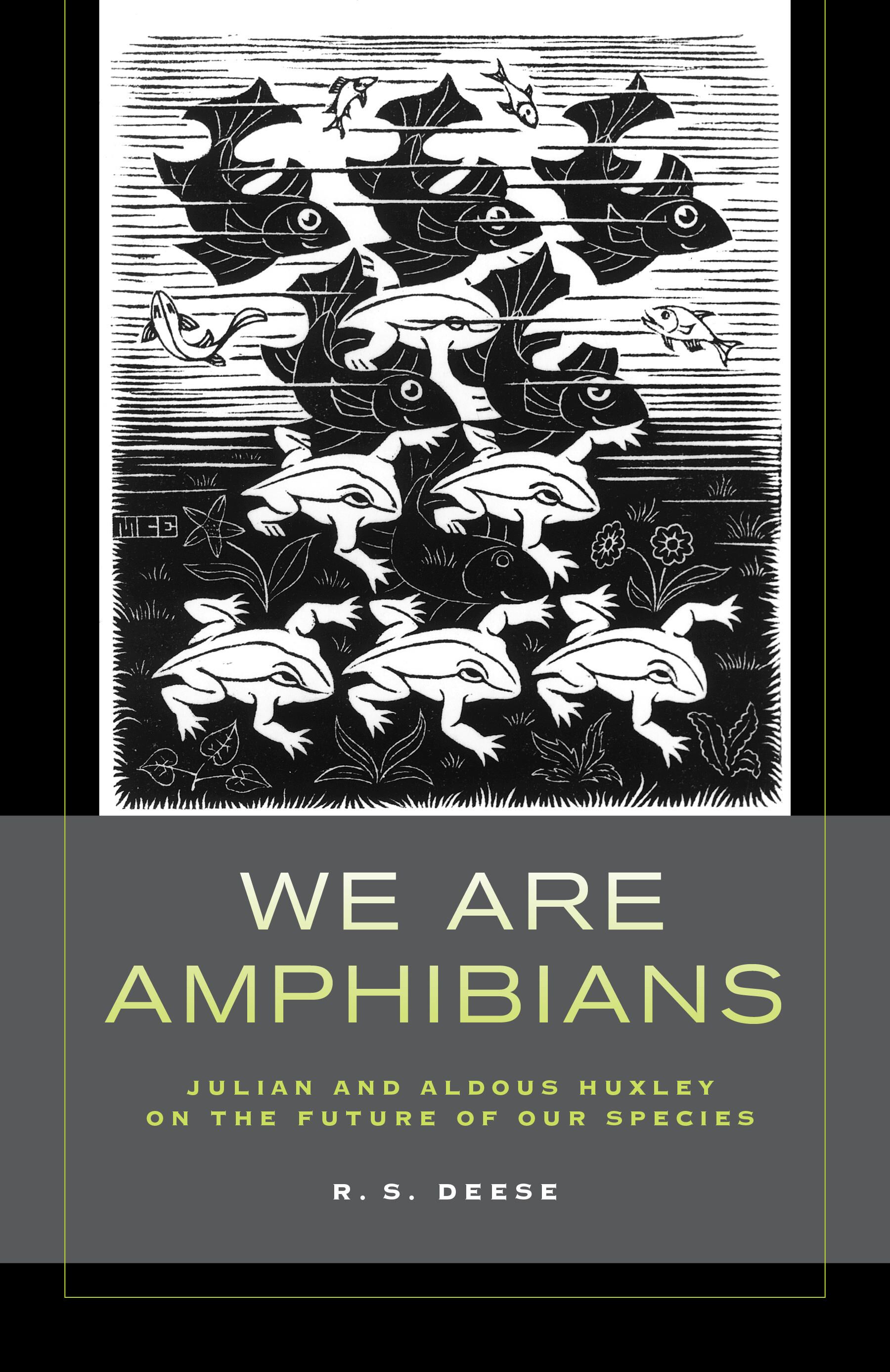
We are amphibians
We Are Amphibians tells the fascinating story of two brothers who changed the way we think about the future of our species. As a pioneering biologist and conservationist, Julian Huxley helped advance the \"modern synthesis\" in evolutionary biology and played a pivotal role in founding UNESCO and the World Wildlife Fund. His argument that we must accept responsibility for our future evolution as a species has attracted a growing number of scientists and intellectuals who embrace the concept of Transhumanism that he first outlined in the 1950s. Although Aldous Huxley is most widely known for his dystopian novel Brave New World, his writings on religion, ecology, and human consciousness were powerful catalysts for the environmental and human potential movements that grew rapidly in the second half of the twentieth century. While they often disagreed about the role of science and technology in human progress, Julian and Aldous Huxley both believed that the future of our species depends on a saner set of relations with each other and with our environment. Their common concern for ecology has given their ideas about the future of Homo sapiens an enduring resonance in the twenty-first century. The amphibian metaphor that both brothers used to describe humanity highlights not only the complexity and mutability of our species but also our ecologically precarious situation.
eBook

Aldous Huxley’s Ape and Essence and Clashing Discourses of Nature
This essay considers Aldous Huxley’s Ape and Essence in the light of late 1940s conservationism. The novel shares specific concerns with contemporary conservationist non-fiction, but embeds these within a fragmented, polyvocal novel. Doing so, it demonstrates how different schools of thought clash, each blind to underlying nature in some aspect.
Journal Article
Contesting the Moral High Ground
In mid-twentieth century Britain, four intellectuals - Julian Huxley, Bertrand Russell, Malcolm Muggeridge, and Barbara Ward - held sway over popular conceptions of morality. While Huxley and Russell championed ideas informed by agnosticism and atheism, Muggeridge and Ward were adherents to Christianity. In Contesting the Moral High Ground, Paul Phillips reveals how this fundamental dichotomy was representative of British society at the time, and how many of the ideologies promoted by these four moralists are still present today. As world-class public figures in an open forum of debate, Huxley, Russell, Muggeridge, and Ward all achieved considerable public attention, particularly during the turbulent 1960s. Phillips captures the rebellious spirit of the time, detailing how these thinkers exploited the popular media to disseminate ideas on prevailing social issues - from justice and world peace to protection of the environment. Phillips skilfully traces the foundations of their thought to their earlier careers and social movements of previous generations, and shows how many of their approaches were adopted by a host of present-day groups from the Christian Right and Left to the New Atheists and environmentalists. A significant contribution to British intellectual history, Contesting the Moral High Ground provides new insights into the moral philosophies of four of Britain's most influential minds in the twentieth century.
eBook

Education as an Evolutionary Phenomenon: Huxley, Waddington, and the Foundational Importance of Ethics
This essay sheds light on the “father of epigenetics,” Conrad Hal Waddington’s (1905–1975) tacit critique of one of the most prominent biologists of the twentieth century, Julian Huxley’s (1887–1975) theses concerning the evolutionary meaning and importance of learning and education for the human species. This topic has great significance today when it comes to educators both recognizing and being able to orient themselves in relation to the profound biological and evolutionary aspects of their role and purpose, and in determining their own ethos and modes of activity therein. Here, I highlight Waddington’s stance in relation to Julian Huxley’s thesis that education comprises humanity’s new “psycho-social,” or alternatively, “socio-genetic,” mode of biological inheritance parallel to, yet beyond, the “rawer” biological struggle for existence that most other living organisms are engaged in, namely, that involving natural selection acting on genes or genomes and the exigency of adapting successfully to the environment. According to Huxley, the gradual, yet cumulative, transmission of the knowledge and attainments of one generation to the next, over evolutionary time, via various modes of learning and education, has enabled the human species to have surpassed the capacities of all other organisms on the planet, such that it has become super-dominant.Waddington was in general agreement with Huxley’s thesis regarding the evolutionary significance of humanity’s learning and education here, as well as the latter’s notion that education is an epigenetic phenomenon, namely, comprising a distinct, yet interrelated inheritance system beyond that of genetic inheritance. However, Waddington tacitly disagreed with Huxley’s assertions that in light of such realizations, going forward: (1) humanity should exert the power of its selective agencies so as to take control of the biological processes of all life-forms on the planet; (2) formal education should be reformed into a function of evolutionary humanist ideology, eugenics, and transhumanism; (3) humanity ought to attempt to transcend its current capacities, as though there were a linear progression to some higher stage of biological development that is mechanistically calculable in advance. Waddington’s chief argument against Huxley is that this “socio-genetic” and/or epigenetic system of inheritance has part of its foundation in ethics and in the moral conduct of teacher and learner, and that Huxley’s inert vision of the future of education and of the role and conduct of educators therein are unethical. As such, for Waddington, Huxley’s view can be said to undermine the very inheritance system that has enabled humanity to reach its privileged place, rendering it unsustainable. From a Waddingtonian standpoint, Huxley’s stance is “biologically unwise” in that it undermines the teacher-learner relationship, given that it treats learners mechanistically, namely, as means only to the ends of evolutionary humanist and transhumanist ideology, rather than organismically, meaning as having selective agency and intrinsic worth (a notion that is grounded in the notion that living organisms are bearers of intrinsic purposiveness, as evidenced by the homeostatic, chronobiological, and autopoietic processes belonging to them which enable persistence in the face of entropy). On the contrary, Waddington calls for the cultivation of “biological wisdom” surrounding formal education (e.g., in relation to the aims of such education, its content, its curricula, the behaviour of educators, and the educational activities to be engaged in by learners), that would serve to strengthen the foundations of education qua humanity’s “psycho-social” inheritance system rather than to diminish or undermine it. Last, I associate the Waddingtonian notion of “biological wisdom” with the evolutionary-environmental ethic of “critical pan-selectionism.”
Journal Article

One World, Two Cultures? Alfred Zimmern, Julian Huxley and the Ideological Origins of UNESCO
Against the background of revival of interest in the 'two cultures' controversy of the 1960s, this article examines an earlier episode in the struggle between literary intellectuals and scientists for cultural leadership – the choice of a British candidate for the leadership of UNESCO. Why was Sir Alfred Zimmern, the obvious choice for the post of founding Director-General, not selected? This article argues that Zimmern was ousted as frontrunner because he had failed to gather the support of the burgeoning British scientific establishment, which had mounted its own successful agitation to have science included explicitly in the new organization's remit. It examines the actions and motivations of Ellen Wilkinson and John Maud, whose joint decision it was to replace the classicist Zimmern with the biologist Julian Huxley. It concludes that the main factor behind the replacement of Zimmern was his failure to bridge the two cultures of arts and science. Nevertheless, these events should not be viewed merely as a prologue to the two cultures debate as Huxley and Zimmern's attitudes to science and culture cannot easily be separated from their respective approaches to broader international political questions.
Journal Article


Huxleyan utopia or Huxleyan dystopia? “Scientific humanism”, Faure’s legacy and the ascendancy of neuroliberalism in education
In addition to the longstanding threat posed by narrow economism, faith in the possibility of peace and progress through democratic politics – central to the humanistic vision of the 1972 Faure report – today faces additional challenges. These challenges include the ascendancy of neurocentrism in the global policyscape. Whereas the effects of neoliberalism on education have been extensively critiqued, the implications of a newer, related ideological framework known as neuroliberalism remain under-theorised. Neuroliberalism combines neoliberal ideas concerning the role of markets in addressing social problems with beliefs about human nature ostensibly grounded in the behavioural, psychological and neurological sciences. This article critically examines a recent initiative of one of UNESCO’s Category 1 Institutes – the Mahatma Gandhi Institute of Education for Peace and Sustainable Development (MGIEP) – that seeks to mainstream neuroscience and digital technology within global educational policy. Comparing the visions of the 1972 Faure, the 1996 Delors and the 2021 Futures of Education reports with MGIEP’s International Science and Evidence Based Education Assessment (ISEEA), the authors analyse continuity and change in UNESCO’s attempts to articulate a vision of “scientific humanism” which advocates the use of science for the betterment of humanity. They argue that ISEEA’s overall recommendations – as represented in its Summary for Decision Makers (SDM) – reinforce a reductive, depoliticised vision of education which threatens to exacerbate educational inequality while enhancing the profits and power of Big Tech. These recommendations exemplify a neuroliberal turn in global education policy discourse, marking a stark departure from the central focus on ethics and democratic politics characteristic of UNESCO’s landmark education reports. Reanimating, in cruder form, visions of a scientifically-organised utopia of the kind that attracted UNESCO’s inaugural Director-General, Julian Huxley, ISEEA’s recommendations actually point towards the sort of dystopian “brave new world” of which his brother, Aldous Huxley, warned.
Journal Article