
Catalogue Search | MBRL


Are you sure you want to remove the book from the shelf?

{{itemTitle}}
41,049
result(s) for
"INVESTIGATING MAGISTRATE"
Sort by:

Barriers to Asset Recovery
It is estimated that the proceeds of crime, corruption and tax evasion represent between $1 trillion and $1.6 trillion per year, with half coming from developing countries. Proceeds are typically transferred abroad and hidden in foreign jurisdictions, thus requiring international cooperation. Various international conventions and agreements require international cooperation on this issue, in particular the United Nations Convention against Corruption; however, only $5 billion in stolen assets have been repatriated over the last 15 years. This enormous gap reveals that significant barriers continue to impede asset recovery despite the commitments taken by governments, civil society and the private sector. Drawing on the experience of practitioners with hands-on experience, the Stolen Asset Recovery (StAR) Initiative launched this study to identify the barriers to stolen asset recovery internationally, provide brief analysis of the impact of these barriers, and propose recommendations for overcoming these obstacles. This volume is intended to guide policy makers in their efforts to ensure necessary resources and the development of a plan, policy or strategy aimed at eradicating the barriers to asset recovery. In addition, this study proposes actions to be taken by the G20, international organizations, financial institutions, developmental agencies and civil society.
eBook
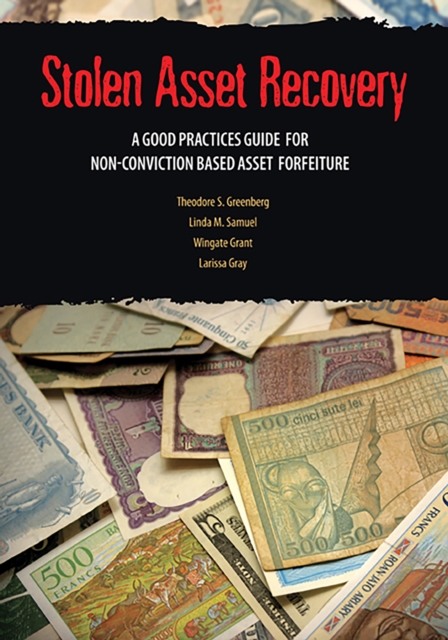
Stolen asset recovery : a good practices guide for non-conviction based asset forfeiture
A practical guide to recovering stolen assets and combating corruption. This guide provides a comprehensive overview of non-conviction based asset forfeiture, a powerful tool for recovering the proceeds of corruption, especially when assets are transferred abroad. It is designed for policy makers, legislators, prosecutors, investigators, and judges in countries considering or implementing these regimes. This guide identifies key concepts, legal frameworks, and best practices for effective asset recovery. It explores international treaties, asset tracing, and forfeiture procedures. Case studies and examples from various jurisdictions illustrate practical applications. It offers guidance on international cooperation, asset management, and balancing due process with effective enforcement. * Understand legal frameworks for asset forfeiture * Implement effective asset tracing and seizure strategies * Navigate international cooperation in asset recovery * Combat corruption and financial crime
eBook

Barriers to Asset Recovery : An Analysis of the Key Barriers and Recommendations for Action
Theft of public assets from developing countries is an immense problem with a staggering development impact. These thefts diverts valuable public resources from addressing the abject poverty and fragile infrastructure often present in such countries. Although the exact magnitude of the proceeds of corruption circulating in the global economy is impossible to ascertain, estimates demonstrate the severity and scale of the problem at $20 to $40 billion lost to developing countries each year. What this estimate does not capture are the societal costs of corruption and the devastating impact of such crimes on victim countries. Theft of assets by corrupt officials, often at the highest levels of government, weakens confidence in public institutions, damages the private investment climate, and divests needed funding available for core investment in such poverty alleviation measures as public health, education, and infrastructure. This study's key objective is to mobilize policy makers on the existing difficulties in stolen asset recovery actions and convince them to take action on the featured recommendations. Such action will enhance the capacity of practitioners to successfully recover stolen assets.
Los países en desarrollo pierden aproximadamente $ 20-40 mil millones cada año por causa de sobornos, malversación de fondos y otras prácticas corruptas. Sólo una mínima parte se recupera. Esta enorme brecha en la recuperación real de los activos robados apunta a la presencia de importantes barreras que impiden su recuperación. Con el fin de llenar este vacío, la Iniciativa para la Recuperación de Activos Robados (StAR) ha lanzado Barreras para la recuperación de Activos, un análisis exhaustivo de estos impedimentos y su impacto negativo. La cooperación internacional es fundamental. La Convención de las Naciones Unidas contra la Corrupción es una plataforma clave para fomentar este tipo de acción colectiva, como lo demuestran los compromisos asumidos por los gobiernos, la sociedad civil y el sector privado aun así, varias de las barreras identificadas no pueden superarse a través de la convención. Basándose en la experiencia de profesionales con experiencia práctica, este estudio tiene por objeto orientar a los responsables de formulación de políticas y promover recomendaciones prácticas destinadas a ayudar a las jurisdicciones en la elaboración de políticas efectivas para recuperar energéticamente los activos robados. El G-20, las organizaciones internacionales, instituciones financieras, agencias de desarrollo y la sociedad civil tienen un papel clave que desempeñar en asegurar un progreso concreto en la implementación de estas recomendaciones.
Le détournement des fonds publics représente un obstacle de plus en plus significatif au développement économique des pays émergents. En effet, la disparition de ces ressources publiques essentielles empêche de réduire la pauvreté et pérennise la fragilité des infrastructures de ces pays. S’il est impossible d’évaluer le montant exact des produits de la corruption dans le monde, les estimations témoignent de la gravité et de l’ampleur du problème. Chaque année, on considère que la corruption prive les pays en voie de développement de 20 à 40 milliards de dollars. Ces chiffres ne reflètent pas l’ensemble des coûts de la corruption, ni l’impact dévastateur de ces infractions sur les pays qui en sont victimes. Les détournements de fonds publics perpétrés par des agents publics corrompus, occupant souvent les plus hautes fonctions de l’Etat, sapent la confiance dans les institutions publiques, met à mal le climat nécessaire aux investissements privés, et empêche la mise en œuvre de mesures contre la pauvreté, notamment dans les domaines de la santé publique, de l’éducation et des infrastructures. Réalisée dans le cadre de l’initiative StAR (Stolen Asset Recovery), cette étude s’appuie sur l’expérience de praticiens du monde entier rompus au processus de recouvrement des avoirs, et sur des études effectuées indépendamment par des collaborateurs. Ainsi, une cinquantaine de praticiens originaires à la fois des Etats requérants et requis, traitant quotidiennement des dossiers de recouvrement d’avoirs, ont été consultés afin de passer en revue les conclusions de cette étude avant sa publication. Les obstacles sont classés en trois catégories distinctes qui feront chacune l’objet d’une section : les obstacles d’ordre général et les problèmes institutionnels ; les obstacles juridiques et exigences qui retardent l’entraide judiciaire et enfin, les obstacles opérationnels et les problèmes de communication.
Publication
Public wrongs, private actions
Corruption and thefts of public assets harm a diffuse set of victims, weakens confidence in public institutions, damages the private investment climate, and threatens the foundations of the society as a whole. In developing countries with scarce public resources, the cost of corruption is an impediment to development: developing countries lose between US
eBook

Combating Money Laundering and the Financing of Terrorism - A Comprehensive Training Guide : Workbook 7. Investigating Money Laundering and Terrorist Financing
\"Combating Money Laundering and the Financing of Terrorism: a Comprehensive Training Guide\" is one of the products of the capacity enhancement program on Anti-Money Laundering and Combating the Funding of Terrorism (AML/CFT), which has been co-funded by the Governments of Sweden, Japan, Denmark, and Canada. The program offers countries the tools, skills, and knowledge to build and strengthen their institutional, legal, and regulatory frameworks to successfully implement their national action plan on these efforts. This workbook includes seven training course modules: effects on economic development and international standards (module one); legal requirements to meet international standards (module two); regulatory and institutional requirements for AML/CFT (module three a ); compliance requirements for financial institutions (module three b); building an effective financial intelligence unit (module four); domestic (interagency) and international cooperation (module five); combating the financing of terrorism(module six); and investigating money laundering and terrorist financing (module seven).
Publication

Public Wrongs, Private Actions : Civil Lawsuits to Recover Stolen Assets
Corruption and thefts of public assets harm a diffuse set of victims, weakens confidence in public institutions, damages the private investment climate, and threatens the foundations of the society as a whole. In developing countries with scarce public resources, the cost of corruption is an impediment to development: developing countries lose between US$20 to US$40 billion each year through bribery, misappropriation of funds, and other corrupt practices. Corruption is by no means a \"victimless crime.\" This study aims to explore the standing of States and Government entities as victims and the possible recourse to private actions to redress public wrongs. States and Government entities may act as private litigants and bring civil suits to recover assets lost to corruption. The goal of this work is to promote knowledge and understanding as well as to increase the use of civil remedies and private lawsuits to recover stolen assets in the context of the United Nations Convention against Corruption (UNCAC) offences. The UNCAC, the global standard for the fight against corruption, does not contain a legal definition of corruption itself but lists an array of offences, including public and private sector bribery and the embezzlement of public and private sector funds. The study will mainly focus on these two types of corruption, namely bribery and embezzlement of funds. This study is not intended in any way to minimize the importance of criminal proceedings and confiscation in addressing acts of corruption. Rather, it will show that civil law remedies can effectively complement criminal penalties by attacking the economic base of corrupt activities both in the public and the private sectors. In fact, given the magnitude of the challenges, all avenues of asset recovery, be they criminal or civil, should be explored simultaneously in order to tackle corruption from each and every angle and achieve the goals of deterrence and enforcement. Hence, while criminal law expresses society's disapproval of the corrupt acts and aims at dissuasion, punishment, and confiscation of illicit proceeds, civil law focuses on victims' interests and aims at compensation and restitution. These procedures may occur sometimes in parallel, sometimes sequentially. An effective response to corruption very often requires concomitant use of both criminal and civil law remedies to achieve the desired result.
Publication

Stolen Asset Recovery : A Good Practices Guide for Non-conviction Based Asset Forfeiture
The guide is organized into three major parts: Part A first provides an overview of the problem of stolen assets and the problem of recovering the assets once they are transferred abroad. Second, it describes how the international community has taken steps to respond to the problem through United Nations Convention against Corruption (UNCAC) and the Stolen Asset Recovery (StAR) Initiative. UNCAC introduced a new framework to facilitate the tracing, freezing, seizing, forfeiture, and return of assets stolen through corrupt practices and hidden in foreign jurisdictions. The StAR Initiative developed an action plan to support the domestication and implementation of asset recovery provisions under UNCAC, to facilitate countries' efforts to recover stolen assets that have been hidden in foreign jurisdictions, and ultimately, to help deter such flows and eliminate safe havens for hiding corruption proceeds. Third and finally, Part A introduces non-conviction based (NCB) asset forfeiture as one of the critical tools to combat corruption, describing the situations when it is useful, how it differs from criminal forfeiture, its usefulness in civil and common law jurisdictions, and the support it has gained internationally. Part B contains the 36 key concepts. The concepts have been grouped together by topic area, including prime imperatives, definitions of assets and offenses subject to NCB asset forfeiture, measures for investigation and preservation of assets, procedural and evidentiary concepts, determining parties and ensuring proper notice, judgment proceedings, organizational considerations and asset management, and international cooperation and asset recovery. The concepts are illustrated through examples from cases and excerpts from different jurisdictions' NCB asset forfeiture legislation. Part C contains a number of special contributions written by individual practitioners. The contributions focus on the general practice of NCB asset forfeiture and international cooperation in specific jurisdictions, namely Colombia, Guernsey, Ireland, Kuwait, Switzerland, Thailand, and the United Kingdom. In addition, some contributions illustrate a selection of NCB asset forfeiture practices, such as asset management, delegating certain roles to the executive branch, and pursuing forfeiture based on illicit enrichment.
Le vol d’avoirs publics est un problème de développement de grande ampleur. On estime que le flux transfrontalier total provenant des activités criminelles, de la corruption et de la fraude fiscale, représente entre 1 et 1.6 trillion de dollars par an. Les dommages résultant de ces vols comprennent également la dégradation et la défiance envers les institutions publiques, l’affaiblissement du climat de confiance des investisseurs privés et la corruption des services sociaux en charges des programmes d’assistance de santé et d’éducation. Qu’ils soient publics ou privés, une fois transférés à l’étranger, ces fonds volés sont difficilement récupérables. Les pays en voie de développement se heurtent à de sérieux obstacles, liés à l’absence de lois sur la confiscation d’avoirs sans condamnation (CSC), de moyens d’investigations, de pouvoir judiciaire et de ressources financières inadéquates. La CSC est un outil primordial pour la restitution du produit et des moyens de la corruption. C’est un mécanisme juridique prévoyant la contrainte, la saisie et la confiscation d’avoirs volés, sans la nécessité d’une condamnation pénale. Un nombre croissant de systèmes législatifs nationaux ont institué des règles encadrant la CSC, et de tels cadres juridiques ont été recommandés par nombre d’organisations tant au niveau national que multilatéral. Cet intérêt croissant pour les lois sur la CSC rend nécessaire la mise au point d’un outil pratique pour les systèmes judiciaires envisageant de développer une telle réglementation. Ce livre est conçu comme un outil pratique pour aider les États à récupérer leurs avoirs volés. C’est le premier guide traitant de la confiscation de biens selon le principe des lois sans condamnation CSC et la première publication de synthèse dans le cadre de « l’Initiative pour la Restitution d’Avoirs Volés (StAR) ». Le guide identifie 36 concepts clés (légaux et opérationnels) que des lois sur la CSC devraient englober afin d’être efficaces dans la Restitution d’avoirs volés.
Publication

Representative Bureaucracy in Policing: Does It Increase Perceived Legitimacy?
Drawing on the theory of representative bureaucracy, specifically the theory of symbolic representation, we examine whether or not gender representativeness in a police department's domestic violence unit influences how citizens judge the agency's performance, trustworthiness, and fairness. To examine this question, we use an online survey experiment in which we vary the representation of female police officers in a hypothetical domestic violence unit as well as the agency's performance. Results suggest that gender representation does indeed influence the perceived job performance, trustworthiness, and fairness of the agency, as does the agency's performance. Thus, this study suggests that the symbolic representativeness of the police does causally influence how citizens view and judge a law enforcement agency, and thus in turn perhaps their willingness to cooperate in the coproduction of public safety outcomes.
Journal Article

Dna forensic data bank, facts and perception: The Italian experience
In 2016 the Italian National Dna database for forensic purposes finally went live. After seven years of “operational life”, numbers and results are still scarce. The aim of the study is to evaluate the actual knowledge and perceived usefulness of this investigative tool among a significant sample of Italian magistrates. The research was conducted through the administration of an anonymous structured questionnaire to magistrates belonging to the Court of Milano. The overall picture emerging from the questionnaire is a worrying lack of preparation regarding the functioning of the Dna database among judges and public prosecutors. This situation affects the performance of the instrument. The authors believe that a specific and compulsory training for magistrates should be introduced.
Journal Article

Life, Liberty, and Trade Secrets: Intellectual Property in the Criminal Justice System
The criminal justice system is becoming automated At every stage, from policing to evidence to parole, machine learning and other computer systems guide outcomes. Widespread debates over the pros and cons of these technologies have overlooked a crucial issue: ownership. Developers often claim that details about how their tools work are trade secrets and refuse to disclose that information to criminal defendants or their attorneys. The introduction of intellectual property claims into the criminal justice system raises undertheorized tensions between life, liberty, and property interests. This Article offers the first wide-ranging account of trade secret evidence in criminal cases and develops a framework to address the problems that result. In sharp contrast to the general view among trial courts, legislatures, and scholars alike, this Article argues that trade secrets should not be privileged in criminal proceedings. A criminal trade secret privilege is ahistorical, harmful to defendants, and unnecessary to protect the interests of the secret holder. Meanwhile, compared to substantive trade secret law, the privilege overprotects intellectual property. Further, privileging trade secrets in criminal proceedings fails to serve the theoretical purposes behind either trade secret law or privilege law. The trade secret inquiry sheds new light on how evidence rules do, and should, function differently in civil and criminal cases.
Journal Article