
Catalogue Search | MBRL


Are you sure you want to remove the book from the shelf?

{{itemTitle}}
12
result(s) for
"Identity (Psychology) Comic books, strips, etc."
Sort by:

Much ado about nothing
A comic book version of Shakespeare's comedy about mistaken identities, games, eavesdropping, and unrequited love.
BOOK

Learning by drawing: understanding the potential of comics-based courses in medical education through a qualitative study
In recent years, medical educators have increasingly incorporated comics into their teaching to promote humanism and empathy and to encourage reflective practice. However, it remains unclear how and to what extent comics-based courses effectively address persistent challenges in medical education, such as the need for more engaging, multimodal learning strategies and the cultivation of emotional intelligence alongside clinical competencies. The aim of this study is to investigate the experiences of students who have enrolled in courses on comics and medicine during medical school. Students in North America who had taken such a course during the previous 5 years were invited to participate in an interview about their experiences. 17 students from 10 different medical schools in North America were interviewed. To explore the students’ views on the value of such courses to their medical education, we used a constructivist grounded analytic approach, employing thematic analysis to understand and interpret our interview. Students reported that comics-based courses support key aspects of their medical training that traditional pedagogical approaches may overlook, such as fostering self-reflection, enhancing empathy, and encouraging creative engagement with complex medical narratives. Moreover, comics contributed to their individual and collective professional identity formation by providing a space for introspection and shared discourse.
Journal Article

Rickety Stitch and the gelatinous Goo
\"Meet Rickety Stitch ... a walking, talking, singing skeleton minstrel. He's the one skeleton in the dungeon who seems to have retained his soul, and he has no idea why. His only clue to his former identity is a song he hears snippets of in his dreams, an epic bard's tale about the Road to Epoli and the land of Eem. His sidekick and sole friend is Goo, a squishy blob of jelly that Rickety alone can understand. Together they set out in search of Rickety's past, with abundant humor and adventure galore.\"--Inside jacket flap of Book 1.
Book

Serial Selves
Autobiography is one of the most dynamic and quickly-growing genres in contemporary comics and graphic narratives.In Serial Selves , Frederik Byrn Køhlert examines the genre's potential for representing lives and perspectives that have been socially marginalized or excluded.
eBook
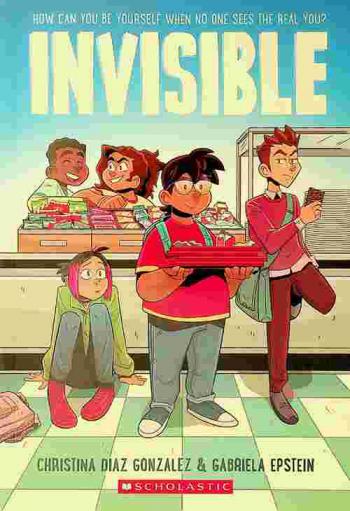
Invisible
\"Can five overlooked kids make one big difference? There's George: the brain, Sara: the loner, Dayara: the tough kid, Nico: the rich kid, and Miguel: the athlete. And they're stuck together when they're forced to complete their school's community service hours. Although they're sure they have nothing in common with one another, some people see them as all the same... just five Spanish-speaking kids. Then they meet someone who truly needs their help, and they must decide whether they are each willing to expose their own secrets to help... or if remaining invisible is the only way to survive middle school.\"-- Front jacket flap.
BOOK

Drawing National Boundaries in Barr’s Ba-Bru Comic Strip Advertising
Barr’s Irn-Bru (previously Iron Brew), Scotland’s best-known soft drink, was promoted by recurrent comic strip advertisements in Scottish newspapers from 1939 to 1970. ‘The Adventures of Ba-Bru’ featured an eponymous Indian character who was joined by a kilt-wearing companion known as Sandy. This article explores how what the firm presents as the longest-running promotional comic strip in history has helped shape the construction of Scottishness in the drink’s advertising. The exotic nature of the central Ba-Bru figure provides a counterpoint to manifestations of local particularism but also grounds the drink’s discourse on Scottishness in a wider imperial and unionist context. The comic strips also generate examples of intermedial transfer that underline the impact of quotidian consumption habits in a national identity shaped by popular culture.
Journal Article

Hilo : the boy who crashed to Earth
When a mysterious boy falls from the sky, friends D.J. and Gina must discover the secrets of his identity and help him save the world.
Book

DISAPPOINTED BELIEVERS?
Frimme hersh’s question marks stand out in ‘A Contract with God’ (1978; Fig. 1). Written in a unique font, these markings intertwine English punctuation with Hebrew lettering, and articulate faith, anger, expectation and disappointment. These question marks are both text and image, end sentences but also look for answers from a God found wanting: ‘Then is not GOD ALSO, so obligated??’ (Eisner 2006: 5). In this essay I will consider how American graphic novelists explore their complex relationships with God and Judaism through their semi-autobiographical comics. Focusing on Will Eisner’s ‘A Contract with God’¹ I will also examine Miss Lasko-Gross’s
Book Chapter

In limbo
Ever since Deborah (Jung-Jin) Lee emigrated from South Korea to the United States, she's felt her otherness. For a while, her English wasn't perfect. Her teachers can't pronounce her Korean name. Her face and her eyes--especially her eyes--feel wrong. In high school, everything gets harder. Friendships change and end, she falls behind in classes, and fights with her mom escalate. Caught in limbo, with nowhere safe to go, Deb finds her mental health plummeting, resulting in a suicide attempt. But Deb is resilient and slowly heals with the help of art and self-care, guiding her to a deeper understanding of her heritage and herself.
Book

Huda F cares?
This summer's exercise in Fahmy family sisterly bonding involves a trip to Disney World--which seems like it is headed for disaster when Huda gets into a fight with a boy making fun of her hijab.
Book