
Catalogue Search | MBRL


Are you sure you want to remove the book from the shelf?

{{itemTitle}}
28,686
result(s) for
"Import policy"
Sort by:

Imported Intermediate Inputs and Domestic Product Growth: Evidence from India
New goods play a central role in many trade and growth models. We use detailed trade and firm-level data from India to investigate the relationship between declines in trade costs, imports of intermediate inputs, and domestic firm product scope. We estimate substantial gains from trade through access to new imported inputs. Moreover, we find that lower input tariffs account on average for 31% of the new products introduced by domestic firms. This effect is driven to a large extent by increased firm access to new input varieties that were unavailable prior to the trade liberalization.
Journal Article

The Direction of Farming Policy Toward Food Resilience in Indonesia
Objective: This research aims to analyze the direction of farming policy toward food resilience through subsidy program and maintaining the existence of farmers. Theoretical Framework: As an agrarian state, Indonesia has majority populations living in rural areas with farming being livelihood and rice being main food staple. Therefore, the availability of food material is a very crucial problem. Method: The research methods used was survey on dry-land farmers, secondary data, and documentation of newspaper clipping. Result: The result shows: 1) the farming policy is inhibited by the ever reduced land, 2) subsidy granting has not solved the farmers’ problem yet, the difficulty of finding fertilizer during harvest season and lowered prices during harvest season, and 3) the governmental policy through importing rice does not solve the root of problem in achieving food resilience by making the farmers not prosperous. Implication of Research: The policy is made by government through improving domestic production and importing rice to secure the rice reserve in Perum BULOG. Conclusion: The problems inhibiting the production of food staple are the reduced farming land, the increased population number, and the natural factor. On the other hand, the price of rice goes down during harvest season and import during low season always occurs repeatedly. A commitment of farming policy direction partial to the farmers is required, from upstream to downstream.
Journal Article

Self-Enforcing Trade Agreements: Evidence from Time-Varying Trade Policy
The Bagwell and Staiger (1990) theory of cooperative trade agreements predicts new tariffs (i) increase with imports, (ii) increase with the inverse of the sum of the import demand and export supply elasticities, and (iii) decrease with the variance of imports. We find US import policy during 1997–2006 to be consistent with this theory. A one standard deviation increase in import growth, the inverse of the sum of the import demand and export supply elasticity, and the standard deviation of import growth changes the probability that the US imposes an antidumping tariff by 35 percent, by 88 percent, and by –76 percent, respectively.
Journal Article
Optimal Tariffs and Market Power: The Evidence
We find that prior to World Trade Organization membership, countries set import tariffs 9 percentage points higher on inelastically supplied imports relative to those supplied elastically. The magnitude of this effect is similar to the size of average tariffs in these countries, and market power explains more of the tariff variation than a commonly used political economy variable. Moreover, US trade restrictions not covered by the WTO are significantly higher on goods where the United States has more market power. We find strong evidence that these importers have market power and use it in setting noncooperative trade policy.
Journal Article

Income determination of rice traders and how they perceived the rice import policy in Indonesia: an economic and ecological impacts
Rice is the principal source of carbohydrates for most people in Indonesia. Over time, the government implemented some measures, including importing rice, to meet the population’s daily need for rice. Traders have a vital role in the marketing chain before the community finally purchases and consumes local and imported rice. The welfare of rice traders must be considered, which becomes the basis for researching the factors determining the tradersʼ incomes. Besides, this study aimed to observe the tradersʼ perception of the rice import policy. The sampling method was conveniently executed, utilizing a sample of forty rice traders from four regions on Indonesia’s Java Island. Interviews were carried out using a questionnaire to collect the data. The results show that the respondentʼs age and rice stock influenced the traderʼs income. Most rice traders agreed that the import policy increased rice availability, decreased rice prices, and reduced competition among traders. Although most traders confirmed that imports were still needed, the government must control and oversee the execution to maximize economic benefits and reduce negative environmental impacts.
Journal Article


Review of Smart Grid and Nascent Energy Policies: Pakistan as a Case Study
Smart grid plays a vital role in energy management systems. It helps to mitigate the demand side management of electricity by managing the microgrid. In the modern era, the concept of hybrid microgrids emerged which helps the smart grid management of electricity. Additionally, the Internet of Things (IoT) technology is used to integrate the hybrid microgrid. Thus, various policies and topologies are employed to perform the task meticulously. Pakistan being an energy deficient country has recently introduced some new policies such as Energy Wheeling Policy (EWP), Energy Import Policy (EIP), and Net Metering/Distributed Generation Policy (NMP) to manage the electricity demand effectively. In addition, the Energy Efficiency and Conservation Act (EECA) has also been introduced. In this paper, we present the overview and impact of these policies in the context of the local energy market and modern information and communication mechanisms proposed for smart grids. These new policies primarily focus on energy demand–supply for various types of consumers such as the demand for bulk energy for industrial ventures and the distributed production by consumers. The EWP deals with obtaining power from remote areas within the country to ease the energy situation in populated load centers and the EIP highlights energy import guidelines from foreign countries. The NMP deals with the integration of renewable energy resources and EECA is more focused on the measures and standardization for energy efficiency and conservation. The benefits and challenges related to EWP, NMP, and EIP have also been discussed concerning the present energy crisis in Pakistan. The generalized lessons learned and comparison of a few aspects of these policies with some other countries are also presented.
Journal Article
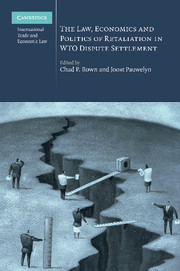
The Law, Economics and Politics of Retaliation in WTO Dispute Settlement
The WTO allows its members to retaliate in the face of continued non-compliance. After more than ten years' operation and ten arbitration disputes, this volume assesses the law, economics and politics of trade sanctions in WTO dispute settlement. Including more than thirty contributions from leading academics, trade diplomats and practitioners, it offers a thorough analysis of the legal rules on permissible WTO retaliation as well as an assessment of the economic rationale and calculations behind the mechanism. In addition, it provides first hand experiences of those countries that have obtained WTO authorisation to retaliate, ranging from the United States and the EC to Mexico and Antigua. In this assessment, the question of how to make the system work also for small countries is paramount. Finally, the volume spells out lessons that could be learned from related fields such as remedies for non-compliance in investment arbitration and competition or anti-trust regimes.
eBook

Integrating invasion and disease in the risk assessment of live bird trade
Aim International trade in plants and animals generates significant economic benefits. It also leads to substantial unintended impacts when introduced species become invasive, causing environmental disturbance or transmitting diseases that affect people, livestock, other wildlife or the environment. Policy responses are usually only implemented after these species become established and damages are already incurred. International agreements to control trade are likewise usually based on selection of species with known impacts. We aim to further develop quantitative invasive species risk assessment for bird imports and extend the tool to explicitly address disease threats. Location United States of America. Methods We use a two-step approach for rapid risk assessment based on the expected biological risks due to both the environmental and health impact of a potentially invasive wildlife species in trade. We assess establishment probability based on a model informed by historical observations and then construct a model of emerging infectious disease threat based on economic and ecological characteristics of the exporting country. Results We illustrate how our rapid assessment tool can be used to identify high-priority species for regulation based on a combination of the threat they pose for becoming established and vectoring emerging infectious diseases. Main conclusions Our approach can be executed for a species in a matter of days and is nested in an economic decision-making framework for determining whether the biological risk is justified by trade benefits.
Journal Article

A trade-based method for modelling supply markets in consequential LCA exemplified with Portland cement and bananas
PurposeThis study proposes a method based on the analysis of trade networks over time for modelling the marginal supply of products in consequential life cycle assessment (LCA). It aims at increasing the geographical granularity of markets, accuracy of transport distances and modes and material losses during transit by creating country-specific markets, instead of region-based supply-origin markets as currently proposed by ecoinvent. It leads to a better consideration of the environmental weight of trade following a change in demand on a local market and may serve as an inspirational basis for future releases of consequential life cycle inventory (LCI) databases.MethodsThe method uses ecoinvent v.3.3 as a support LCI database and two distinct traded products: bananas and grey Portland cement. Each country involved in the trade of a said product has a corresponding market created in the LCI database. The behavior of market to a marginal change in internal demand is modelled after its marginal trading preferences: it can either affect local production, imports, exports or a mix of the first two. Markets are linked to one another based on the linear regression analysis of their historical trade relations. The inventories that follow an increase in demand of 1000 kg of bananas and grey Portland cement are calculated for each market involved in their trade and are environmentally characterized and compared to the generic region-based market datasets provided by ecoinvent to assess the gains in accuracy through a higher geographical granularity. Furthermore, the characterized inventories of the markets for bananas are compared to a parallel scenario where transport distances are kept to a minimum using the shortest path method. It isolates the environmental burden associated to the utility maximization of the demand.Results and discussionWhen comparing the characterized impacts of country-specific markets with the generic ecoinvent market datasets, disparities in results appear. They highlight the importance of transport induced by demand displacement and losses of material during transport, both being the consequences of the extent a given market decides to be supplied directly from producing markets at the margin. These are aspects that may go unaccounted for when using generic regional markets. Second, optimizing transport distances for each market decreases the environmental impacts for most categories by more than 70%.ConclusionsThis study shows there is a need for modelling and understanding market relations to more accurately define the role of trade, supply chain efficiency and import policies in LCA.
Journal Article