
Catalogue Search | MBRL


Are you sure you want to remove the book from the shelf?

{{itemTitle}}
2,352
result(s) for
"Induction (Logic)"
Sort by:

Pure inductive logic
\"Pure inductive logic is the study of rational probability treated as a branch of mathematical logic. This monograph, the first devoted to this approach, brings together the key results from the past seventy years plus the main contributions of the authors and their collaborators over the last decade to present a comprehensive account of the discipline within a single unified context.\" -- Provided by publisher.
Book
The Material Theory of Induction
The fundamental burden of a theory of inductive inference is to
determine which are the good inductive inferences or relations of
inductive support and why it is that they are so. The traditional
approach is modeled on that taken in accounts of deductive
inference. It seeks universally applicable schemas or rules or a
single formal device, such as the probability calculus. After
millennia of halting efforts, none of these approaches has been
unequivocally successful and debates between approaches
persist.
The Material Theory of Induction identifies the source
of these enduring problems in the assumption taken at the outset:
that inductive inference can be accommodated by a single formal
account with universal applicability. Instead, it argues that that
there is no single, universally applicable formal account. Rather,
each domain has an inductive logic native to it.The content of that
logic and where it can be applied are determined by the facts
prevailing in that domain.
Paying close attention to how inductive inference is conducted
in science and copiously illustrated with real-world examples,
The Material Theory of Induction will initiate a new
tradition in the analysis of inductive inference.
eBook

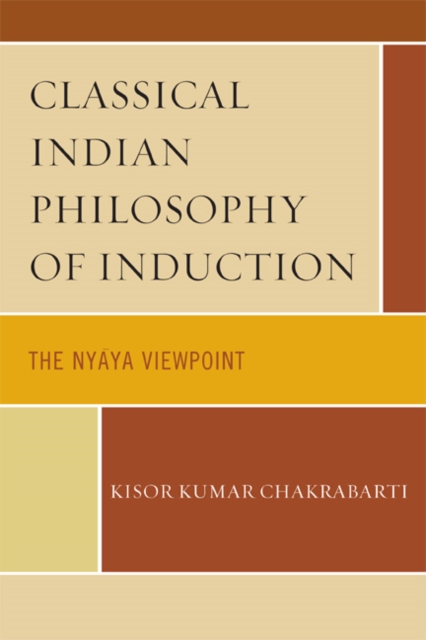
Classical Indian philosophy of induction
Induction is a basic method of scientific and philosophical inquiry. The work seeks to show against the skeptical tide that the method is secure and reliable. The problem of induction has been a hotly debated issue in modern and contemporary philosophy since David Hume. However, long before the modern era Indian philosophers have addressed this problem for about two thousand years. This work examines some major Indian viewpoints including those of Jayarasi (7th century), Dharmakirti (7th century), Prabhakara (8th century), Udayana (11th century) and Prabhacandra (14th century). It also discusses some influential contemporary positions including those of Russell, Strawson, Popper, Reichenbach, Carnap, Goodman and Quine. The main focus is on the Nyaya view developed by Gangesa (13th century). A substantial part of the work is devoted to annotated translation of selected chapters from Gangesa's work dealing with the problem of induction with copious references to the later Nyaya philosophers including Raghunatha (15th century), Mathuranatha (16th century), Jagadisa (17th century) and Gadadhara (17th century). An annotated translation of selections from Sriharsa (12th century) of the Vedanta school, Prabhacandra of the Jaina school and Dharmakirti of the Buddhist school is also included. A solution is presented to the classical problem of induction and the Grue paradox based on the Nyaya perspective. The solution includes an argument from counterfactual reasoning, arguments in defense of causality, analyses of circularity and logical economy, arguments for objective universals and an argument from belief-behavior contradiction.
eBook


The Large-Scale Structure of Inductive Inference
The Large-Scale Structure of Inductive Inference investigates the relations of inductive support on the large scale, among the totality of facts comprising a science or science in general. These relations form a massively entangled, non-hierarchical structure which is discovered by making hypotheses provisionally that are later supported by facts drawn from the entirety of the science. What results is a benignly circular, self-supporting inductive structure in which universal rules are not employed, the classical Humean problem cannot be formulated and analogous regress arguments fail. The earlier volume, The Material Theory of Induction, proposed that individual inductive inferences are warranted not by universal rules but by facts particular to each context. This book now investigates how the totality of these inductive inferences interact in a mature science. Each fact that warrants an individual inductive inference is in turn supported inductively by other facts. Numerous case studies in the history of science support, and illustrate further, those claims. This is a novel, thoroughly researched, and sustained remedy to the enduring failures of formal approaches to inductive inference. With The Large-Scale Structure of Inductive Inference, author John D. Norton presents a novel, thoroughly researched, and sustained remedy to the enduring failures of formal approaches of inductive inference.
eBook

Thinking off your feet : how empirical psychology vindicates armchair philosophy
In an original defense of armchair philosophy, Michael Strevens seeks to restore philosophy to its traditional position as an essential part of the quest for knowledge, by reshaping debates about the nature of philosophical thinking. His approach explores experimental philosophy's methodological implications and the cognitive science of concepts.-- Provided by publisher
Book
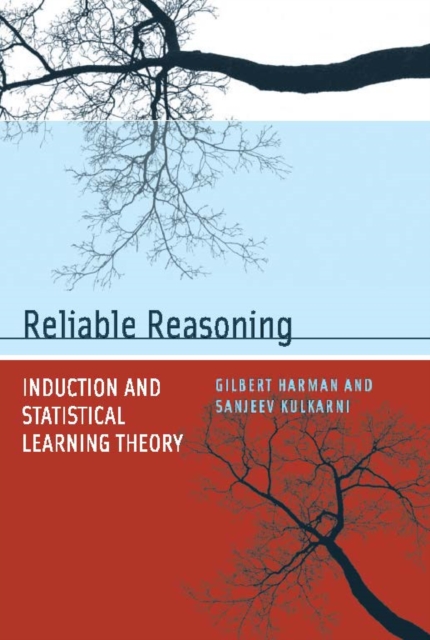
Reliable Reasoning
The implications for philosophy and cognitive science of developments in statistical learning theory.
In Reliable Reasoning, Gilbert Harman and Sanjeev Kulkarni—a philosopher and an engineer—argue that philosophy and cognitive science can benefit from statistical learning theory (SLT), the theory that lies behind recent advances in machine learning. The philosophical problem of induction, for example, is in part about the reliability of inductive reasoning, where the reliability of a method is measured by its statistically expected percentage of errors—a central topic in SLT.
After discussing philosophical attempts to evade the problem of induction, Harman and Kulkarni provide an admirably clear account of the basic framework of SLT and its implications for inductive reasoning. They explain the Vapnik-Chervonenkis (VC) dimension of a set of hypotheses and distinguish two kinds of inductive reasoning. The authors discuss various topics in machine learning, including nearest-neighbor methods, neural networks, and support vector machines. Finally, they describe transductive reasoning and suggest possible new models of human reasoning suggested by developments in SLT.
eBook

Redesign and validation of a computer programming course using Inductive Teaching Method
Inductive Teaching Method (ITM) promotes effective learning in technological education (Felder & Silverman, 1988). Students prefer ITM more as it makes the subject easily understandable (Goltermann, 2011). The ITM motivates the students to actively participate in class activities and therefore could be considered a better approach to teach computer programming. There has been little research on implementing ITM in computer science courses despite its potential to improve effective learning. In this research, an existing computer programming lab course is taught using a traditional Deductive Teaching Method (DTM). The course is redesigned and taught by adopting the ITM instead. Furthermore, a comprehensive plan has been devised to deliver the course content in computer labs. The course was evaluated in an experiment consisting of 81 undergraduate students. The students in the Experimental Group (EG) (N = 45) were taught using the redesigned ITM course, whereas the students in the Control Group (CG) (N = 36) were taught using the DTM course. The performance of both groups was compared in terms of the marks obtained by them. A pre-test conducted to compare pre-course mathematical and analytical abilities showed that CG was better in analytical reasoning with no significant differences in mathematical abilities. Three post-tests were used to evaluate the groups theoretical and practical competence in programming and showed EG improved performance with large, medium, and small effect sizes as compared to CG. The results of this research could help computer programming educators to implement inductive strategies that could improve the learning of the computer programming.
Journal Article