
Catalogue Search | MBRL


Are you sure you want to remove the book from the shelf?

{{itemTitle}}
148
result(s) for
"Interconnected electric utility systems."
Sort by:


Voltage-Sourced Converters in Power Systems
Presents Fundamentals of Modeling, Analysis, and Control of Electric Power Converters for Power System ApplicationsElectronic (static) power conversion has gained widespread acceptance in power systems applications; electronic power converters are increasingly employed for power conversion and conditioning, compensation, and active filtering. This book presents the fundamentals for analysis and control of a specific class of high-power electronic converters—the three-phase voltage-sourced converter (VSC). Voltage-Sourced Converters in Power Systems provides a necessary and unprecedented link between the principles of operation and the applications of voltage-sourced converters. The book: Describes various functions that the VSC can perform in electric power systems Covers a wide range of applications of the VSC in electric power systems—including wind power conversion systems Adopts a systematic approach to the modeling and control design problems Illustrates the control design procedures and expected performance based on a comprehensive set of examples and digital computer time-domain simulation studiesThis comprehensive text presents effective techniques for mathematical modeling and control design, and helps readers understand the procedures and analysis steps. Detailed simulation case studies are included to highlight the salient points and verify the designs. Voltage-Sourced Converters in Power Systems is an ideal reference for senior undergraduate and graduate students in power engineering programs, practicing engineers who deal with grid integration and operation of distributed energy resource units, design engineers, and researchers in the area of electric power generation, transmission, distribution, and utilization.
eBook


Security load frequency control model of interconnected power system based on deception attack
The interconnected power system connects the power grids of different regions through transmission lines, achieving power interconnection and resource sharing. However, data is transmitted through open power networks and is more susceptible to network attacks. To improve the stability of interconnected power systems under deception attacks, three scenarios of system security load frequency control were studied. Based on the construction of a dynamic model of load frequency control, an event-triggered strategy was used to reduce the communication frequency between nodes, resulting in a reduction in the amount of network transmission data. A sliding mode controller was constructed to solve the problem of event-triggered sliding mode security load frequency control. Elastic event-triggered sliding mode load frequency control for interconnected power systems under mixed attacks. The simulation results showed that using the load frequency control model triggered by events, the load frequency deviation of the interconnected power system can be stabilized at around 12 seconds, effectively saving the cost of network resources. Under the regulation of the load frequency control model based on sliding mode control, the interconnected power system stabilized in 10 seconds, reducing the load of network transmission. The elastic event-triggered sliding mode load frequency control model can ensure stable transmission of power data under various attacks and has good anti-interference performance. The results of this study have played an important role in achieving the stability of power resource supply. Compared with previous studies on individual power systems, this study solves the attack problem of interconnected power systems and considers the frequency control problem of system security loads under mixed attacks, enabling the system to recover stability faster.
Journal Article

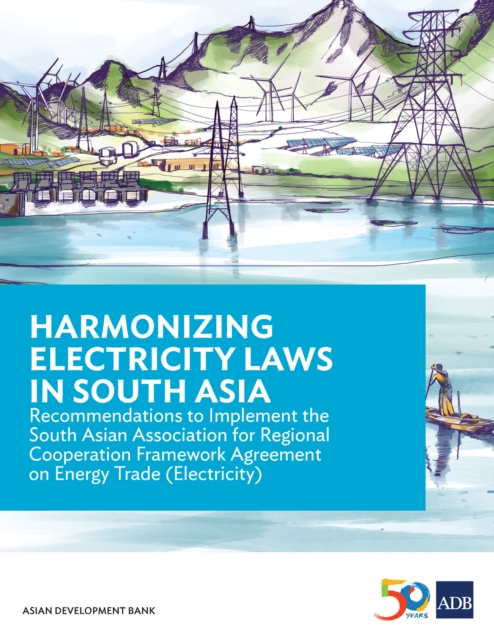
Harmonizing Electricity Laws in South Asia
South Asia, home to nearly one-sixth of the global population, is one of the poorest regions in the world. Access to electricity in the region is low and the South Asian Association for Regional Cooperation (SAARC) member countries face acute electricity shortages, adversely impacting their socioeconomic development. Yet the region is endowed with hydropower potential, coal reserves, natural gas reserves, large renewable energy resources, and petroleum reserves. These can be harnessed to become key drivers of the region's growth—and energy trade has the potential to capitalize on this asset. This report culminates the work of ADB and SAARCLAW on regional energy trade. It identifies the legal, regulatory, technical, and commercial requirements for energy trade; and what each country needs to do to make the framework agreement a reality. The recommendations provide an easy reference for policy makers and energy stakeholders in the region. It is hoped that this report's recommendations, derived from the work of national consultants and regional and international experts, will contribute to the fulfillment of the framework agreement.
eBook

Green energy : sustainable electricity supply with low environmental impact
Defines the future of the world's electricity supply system, exploring the key issues associated with global warming, and which energy systems are best suited to reducing it. --from publisher description.
Book

A Robust Artificial Bee Colony-Based Load Frequency Control for Hydro-Thermal Interconnected Power System
The presented work examines load frequency control (LFC) to develop the dynamic behavior of the power system under different load disturbances that have occurred in multi-interconnected power systems. An artificial bee colony (ABC) algorithm is proposed to design an optimal proportional integral derivative (PID) controller simulating the LFC installed in a hybrid hydro-thermal interconnected power system. The proposed approach incorporating ABC is employed to determine the optimal parameters of the controller during load disturbance applied on one area. The integral time absolute error (ITAE) of the frequency and exchange power violations is considered as the target to be minimized. Moreover, integral absolute error (IAE) and sum squared error (SSE) are calculated. To prove how the proposed model controller is effective, two-interconnected power systems are presented during a wide range of operating cases, and then the behavior of the proposed controller is compared to that of the designed via a chef-based optimization algorithm (CBOA), seagull optimization approach (SOA), and sine cosine approach. Regarding the 5% disturbance on the thermal plant, the ABC outperformed the other approaches hence achieving the best fitness value of 1.80936, IAE of 3.147938, and SSE of 0.1787486. On the other hand, during a 5% disturbance on the hydro plant, the ABC succeeded in getting ITAE, IAE, and SSE with values of 3.43291, 3.630509, and 0.5233815, respectively. The efficiency and prevalence of the proposed LFC-PID is confirmed by the achieved results.
Journal Article
Flexibility-Constrained Energy Storage System Placement for Flexible Interconnected Distribution Networks
Configuring energy storage systems (ESSs) in distribution networks is an effective way to alleviate issues induced by intermittent distributed generation such as transformer overloading and line congestion. However, flexibility has not been fully taken into account when placing ESSs. This paper proposes a novel ESS placement method for flexible interconnected distribution networks considering flexibility constraints. An ESS siting and sizing model is formulated aiming to minimize the life-cycle cost of ESSs along with the annual network loss cost, electricity purchasing cost from the upper-level power grid, photovoltaic (PV) curtailment cost, and ESS scheduling cost while fulfilling various security constraints. Flexible ramp-up/-down constraints of the system are added to improve the ability to adapt to random changes in both power supply and demand sides, while a fluctuation rate of net load constraints is also added for each bus to reduce the net load fluctuation. The nonconvex model is then converted into a second-order cone programming formulation, which can be solved in an efficient manner. The proposed method is evaluated on a modified 33-bus flexible distribution network. The simulation results show that better flexibility can be achieved with slightly increased ESS investment costs. However, a large ESS capacity is needed to reduce the net load fluctuation to low levels, especially when the PV capacity is large.
Journal Article
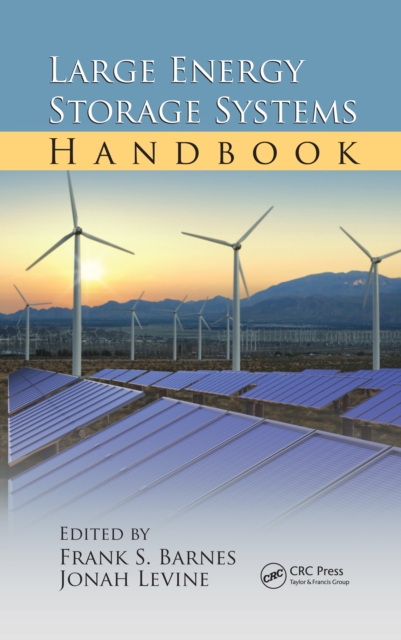
Large Energy Storage Systems Handbook
Reviewing several ways in which large amounts of energy can be stored so that it may be deployable by utilities, this handbook covers major topics including pumped hydroelectric systems, compressed air, and batteries. By considering the perspective of developers, planners, and legislators as well as engineers tasked with assessing and developing real energy storage systems, readers will find the information they need to make economic and practical decisions concerning renewable energy. Chapters on modeling for integration of wind and solar energy into the grid, hydrogen generation and storage, and thermal energy storage are included.
eBook