
Catalogue Search | MBRL


Are you sure you want to remove the book from the shelf?

{{itemTitle}}
7
result(s) for
"Islam and secularism -- Iran -- History -- 20th century"
Sort by:

A Guerrilla Odyssey
Emerging in the early 1970s, the Organization of Iranian People’s Fadai Guerrillas (OIPFG) became one of the most important secular leftist political organizations in Iran. Despite their lasting influence and the way in which their efforts helped shape the history of Iran for decades to come, little is known about the group. A Guerrilla Odyssey presents the first comprehensive examination of the rise and fall of the Fadai urban guerrilla movement in Iran. Drawing on exhaustive analyses of the published and unpublished works of the Fadai Guerrillas, as well as of archival material and interviews with activists, the author demonstrates historically and sociologically the conditions that surrounded the debut and demise of the urban guerrilla warfare that defined Iranian political life in the 1970s. Vahabzadeh offers a critique of various aspects of the Fadai’s theories of national liberation in an attempt to reconsider the painful relationship among modernization, secularism, and democracy in contemporary Iran. In addition, the author makes a compelling case explaining why older revolutionary social movements of the 1960s and 1970s have transformed into the new democratic social movements that emerged from the 1980s onward in the form of today’s women’s, student, and youth movements in Iran. A Guerilla Odyssey is a meticulously researched and engrossing narrative that promises to be a major contribution to the field of Iranian history.
eBook
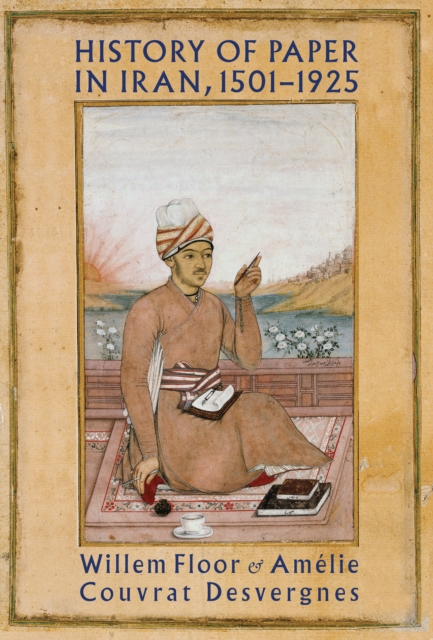
History of Paper in Iran, 1501–1925
The Chinese invented papermaking, which by the 8th century had reached the Muslim world in Samarkand and Baghdad, and Spain by the 11th century. Much later at the end of the 18th century onwards, modern, industrial papermaking was developed by the Europeans. The History of Paper in Iran, 1501 to 1925 sets out for the reader the types of paper made in Iran during the Safavid and Qajar periods and the crucial role imported paper played in the country. The Iranian government attempted to introduce modern European paper production technology, first by sending students abroad to learn about this technology and then by purchasing equipment to set up a paper industry. However, during the 19th century, domestic Iranian paper production came under increasing pressure from paper imports, and the government abandoned its efforts to modernize the domestic paper industry. The authors, renowned scholar Willem Floor in collaboration with Amélie Couvrat Desvergnes a museum conservator of artworks on paper and books, identify and illustrate the watermarks and/or countermarks of the various paper producers and provide examples of the diversity of quality, composition, and nature of the different types of paper used by various strata of the Iranian society. Also provided are detailed import data, showing which country exported paper to Iran, via which routes, as well as their changing market position over time. Finally, the various end uses of paper, from books and farmans to paintings, and diverse packing and utilitarian paper are examined and, where possible, quantified data are presented. This book will reward scholars and general readers alike.
eBook
Intellectual Discourse and the Politics of Modernization
In this thought-provoking study, Ali Mirsepassi explores the concept of modernity, exposing the Eurocentric prejudices and hostility to non-Western culture that have characterized its development. Focusing on the Iranian experience of modernity, he charts its political and intellectual history and develops a new interpretation of Islamic Fundamentalism through the detailed analysis of the ideas of key Islamic intellectuals. The author argues that the Iranian Revolution was not a simple clash between modernity and tradition but an attempt to accommodate modernity within a sense of authentic Islamic identity, culture and historical experience. He concludes by assessing the future of secularism and democracy in the Middle East in general, and in Iran in particular. A significant contribution to the literature on modernity, social change and Islamic Studies, this book will be essential reading for scholars and students of social theory and change, Middle Eastern Studies, Cultural Studies and many related areas.
eBook
Islamism and post-Islamism in Iran : an intellectual history
This book is a study of overlooked themes in Iran's contemporary political and intellectual history. It investigates the way Iranian Muslim intellectuals have discussed politics and democracy. As a history of Iranian Islamism and its transformation to post-Islamism, this work demonstrates that Muslim intellectuals have enriched the Iranian society epistemologically, aesthetically, ethically, and politically. This book examines the internal conflicts of the Islamist ideology as the intellectual underpinnings of the 1979 Revolution, its contribution to the formation of the post-revolutionary state, and the post-Islamist response to the democratic deficits of the post-revolutionary state. Seeking to overcome the shortcomings of historiographical approaches, this book demonstrates the intellectual and political agency of Muslim intellectuals from the 1960s to the present.
eBook

The Scum of Tabriz: Ahmad Kasravi and the Impulse to Reform Islam
Ahmad Kasravi (1890-1946), one of the most influential Iranian thinkers of the twentieth century, delivers a stinging criticism of Shi′ism and Islam in two works which have been almost completely ignored by secular scholars, despite their immense influence on the thought and writings of Ayatollah Khomeini, the leader of the Islamic revolution as well as Ali Shariati and Jalal Ale Ahmad, its ideological forebears. The article considers the paradoxical reception of Kasravi's Shi′ism (Shi′igari) and On Islam (Dar Piramun-i Islam): both their extraordinary impact on Islamic revivalists and their neglect by specialists in Iranian affairs and Islamic studies. The occlusion of Kasravi's impulse to reform, the reduction of his ambiguous position in the Iranian intellectual tradition, has functioned to all but foreclose discussions of Islamic reform among secular scholars, deforming the contemporary intellectual history of Iran and Shi′ism more broadly.
Journal Article

Passé soufi, présent islamiste ?
Dominé depuis le xvie siècle par les lignages sacrés des maîtres des grandes Voies soufies (Qadiriyya d’abord, Naqshbandiyya ensuite), l’islam kurde sunnite s’est trouvé exposé, depuis les années 1970, à de profonds bouleversements sociologiques. En territoire iranien comme ailleurs (même si plus tard qu’ailleurs) dans le monde kurde, l’hypercentralisation politique, la dissolution graduelle des chefferies, la diffusion d’un enseignement scolaire laïque en persan, la réforme agraire de 1963 et la mécanisation de l’agriculture, l’exode rural et la dissolution des affiliations tribales ont favorisé, à terme, l’apparition de mouvements islamistes. Parmi ceux-ci, on trouve le réseau d’écoles religieuses du Maktab-e Qor’an et le parti frère-musulman de la « Société iranienne pour l’appel et la réforme », largement autocéphale voire iranisé, ainsi que la propagation d’un courant salafiste. Après 1979, dans un contexte de marginalisation brutale par la République islamique des partis de gauche nationaliste qui dominaient la société kurde depuis la Seconde Guerre mondiale, certains de ces mouvements, avec des stratégies distinctes, ont repris à leur compte la défense d’une identité kurde et les revendications autonomistes qui avaient été portées jusqu’alors par les organisations politiques se réclamant du progressisme. Cet ensemble de transformations pose, d’une manière générale, la question des politisations spécifiques du religieux dans des périphéries du monde de l’islam marquées à la fois, depuis le milieu du xxe siècle, par la détribalisation, la consolidation d’identités ethniques, une forte sécularisation et l’influence durable d’un socialisme contestataire.
Journal Article

Can the Memoirist Speak? Representing Iranian Women, Gender, and Sexuality in Recent Popular and Scholarly Publications
[...]in combination with Iran's recent political history - which includes an early-twentieth-century constitutional revolution, a mid-century British and American sponsored coup d'état that overthrew a democratically elected prime minister, and the latetwentieth-century Iranian revolution and its contemporary wake - there is a complex comingling with the West that hinges on the tantalizations of veiling, sexuality, and a racialized Islamic alterity that has provoked a feminist reaction that spans the popular-scholarly spectrum. Some scholars explicitly explore the evolution of sexual identities as an indicator of an evolving Iranian modernity, while others read the management of sexual subjectivities through the transforming Iranian nation-state or through what Moallem calls the imposition of \"civilizational imperialism\" through colonial, cultural, and geo-political forces (31).
Book Review