
Catalogue Search | MBRL


Are you sure you want to remove the book from the shelf?

{{itemTitle}}
222
result(s) for
"Islamic inscriptions"
Sort by:


Calligraphy and Architecture in the Muslim World
This major reference work covers all aspects of architectural inscriptions in the Muslim world: the artists and their patrons, what inscriptions add to architectural design, what materials were used, what their purpose was and how they infuse buildings with meaning.
eBook

Epigraphy and Islamic Culture
Architectural inscriptions are a fascinating aspect of Islamic cultural heritage because of their rich and diverse historical contents and artistic merits. These inscriptions help us understand the advent of Islam and its gradual diffusion in Bengal, which eventually resulted in a Muslim majority region, making the Bengali Muslims the second largest linguistic group in the Islamic world.
This book is an interpretive study of the Arabic and Persian epigraphic texts of Bengal in the wider context of a rich epigraphic tradition in the Islamic world. While focusing on previously untapped sources, it takes a fresh look into the Islamic inscriptions of Bengal and examines the inner dynamics of the social, intellectual and religious transformations of this eastern region of South Asia. It explores many new inscriptions including Persian epigraphs that appeared immediately after the Muslim conquest of Bengal indicating an early introduction of Persian language in the region through a cultural interaction with Khurasan and Central Asia. In addition to deciphering and editing the epigraphic texts, the information derived from them has been analyzed to construct the political, administrative, social, religious and cultural scenario of the period.
The first survey of the Muslim inscriptions in India ever to be attempted on this scale, the book reveals the significance of epigraphy as a source for Islamic history and culture. As such, it will be of interest to students and scholars of Asian Studies, Asian History and Islamic Studies.
Introduction: Epigraphy of Muslim Bengal 1. Epigraphy as an Important Source for Islamic History and Civilization 2. The Diffusion of Islam in Bengal and the Articulation of a New Order 3. Nature, Aesthetic Perception and Mysticism: Spiritual Dimensions of Islamic Inscriptions in Bengal 4. Worldly Authority and Paradisiacal Ambition: Diversity of Titles in the Islamic Inscriptions of Bengal 5. Early Islamic Inscriptions 6. Inscriptions of the Sultanate Period
Mohammad Yusuf Siddiq is President of Bangladesh Association for Needy People’s Improvement. He has written extensively on the history, civilization and culture of Muslim Bengal, including a dozen entries in the Encyclopaedia of Islam.
eBook
The Islamic Funerary Inscriptions of Bahrain : Pre-1317 AH/1900 AD
\"In The Islamic Funerary Inscriptions of Bahrain, Pre-1317 AH/1900 AD, the authors present a study of the funerary inscriptions based upon fieldwork completed in Bahrain between 2013-2015. A comprehensive illustrated catalogue of 150 gravestones in 26 locations is provided with transcription of the inscriptions into modern Arabic and translation into English. Subjects considered include: the history of Islamic burial, gravestone, and cemetery research on Bahrain, gravestone chronology, gravestone and cemetery types, stone sources and gravestone manufacture, the gravestone inscriptions, content, iconography and decoration, and the archaeology of the shrines and cemeteries in which some of the gravestones were found, contemporary practices relating to cemeteries, graves, and gravestones, the threats facing the gravestones, and management options for protecting and presenting the gravestones.\"--Provided by publisher.
Book

NEWLY DISCOVERED NORTH ARABIAN INSCRIPTIONS FROM JORDAN
This study deals with a new group of Ancient North Arabian (Harrat Belād Ash Shām zone) inscriptions that collected during a recent survey in the North Eastern Bâdiya of Jordan known by (Harrat Belād Ash Shām). This concerns three Pre-Islamic Safaitic inscriptions, and two early Islamic texts. The purpose of this article is to publish images of the newly-found inscriptions, give a translation, and provide some commentary. This work was achieved through 4 main points; field survey, lab works, documenting and tracing the collected inscriptions, and, theoretical works including translating and analyzing. Our results proved that Islamic inscriptions show the extent of development in writing the simple Kufic script and the ability of the people of the desert to learn.
Journal Article

Calligraphy and architecture in the Muslim world
\"This book explores the myriad interactions between calligraphy and architecture throughout the history of the Muslim world. From Spain to China, Islamic architecture and calligraphy are inexorably intertwined. Mosques, dervish lodges, mausolea, libraries, even baths and marketplaces bear masterpieces of calligraphy that rival the most refined books and scrolls. This major reference work focuses on architectural inscriptions throughout the Muslim world, some going back to the Middle Ages, others dating from our own lifetime. What were the purposes of these inscriptions? How do they infuse buildings with culturally specific meanings, sacred or profane? What do they add to architectural design? What sorts of materials were used, and how do they interact with light and space? Who were their patrons, and what do we know about the artists who produced them? You can find out with this exciting new collection written by a stellar cast of international contributors. It features 28 case studies explain different aspects and contexts of calligraphy in Islamic architecture. It is geographically wide-ranging - covers North Africa, the Middle East, South Asia, China and Spain. It takes an interdisciplinary approach to analysing calligraphy as part of its larger spatial-architectural context. It is lavishly illustrated with 400 colour images.\"
Book

Epigraphy and Islamic Culture
This book is an interpretive study of the Arabic and Persian epigraphic texts of Bengal in the wider context of a rich epigraphic tradition in the Islamic world. While focusing on previously untapped sources, it takes a fresh look into the Islamic inscriptions of Bengal and examines the inner dynamics of the social, intellectual and religious transformations of this eastern region of South Asia. The first survey of the Muslim inscriptions in India ever to be attempted on this scale, the book reveals the significance of epigraphy as a source for Islamic history and culture.
eBook
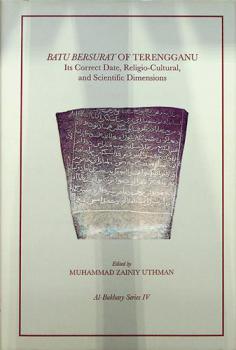

Une proposition de relecture de deux mots de l’inscription arabe préislamique de Ḥarrān (568-569 ap. J.-C.)
Among the pre-Islamic inscriptions which are in Arabic, in Arabic script and perfectly dated, that of Ḥarrān, south of present-day Syria. It is a bilingual Greek-Arabic inscription, dated 463 from the Roman province of Arabia (106 AD), corresponding to 568-569 AD. The date is given in Nabataean numerals in the Arabic part of the inscription. Since its decipherment by Dussaud and Macler (1903), the third and fourth words of the first line are read br/bn ẓlmw and interpreted as (Šarāḥīl) \"son of Ẓālim\". Yet, in Greek, we have (ΣΑΡΑΕΛΟΣ) ΤΑΛΕΜΟΥ/(SARAELOS) TALEMOU. ΟΥ- is clearly the genitive of filiation corresponding to br/bn ; -w is the suffix wāw what is found in the Arabic names of Nabataean inscriptions, as well as in some papyrus of the beginning of the Islamic era. We propose to read what is written as br ṭlmw (ṭ and ẓ are homographs in archaic Arabic script) and to see in this Bar Ṭālimū an Arabization of the Aramaic Bar Tâlmi (\"son of Ptolemy\", Bartholomew), a Christian name consistent with the building, a martyrium dedicated to a St. John.
Parmi les inscriptions préislamiques qui sont à la fois en arabe, en écriture arabe et parfaitement datées figure celle de Ḥarrān, dans le sud de l’actuelle Syrie. C’est une inscription bilingue grec-arabe, datée de 463 de l’ère de la province romaine d’Arabie (106 ap. J.C.), soit 568-569 de notre ère, la date étant en chiffres nabatéens. Depuis son déchiffrement par Dussaud et Macler (1903), les troisième et quatrième mots de la première ligne sont lus br/n ẓlmw et interprétés comme (Šarāḥīl) « fils de Ẓālim ». Pourtant, en grec, on a (ΣΑΡΑΕΛΟΣ) ΤΑΛΕΜΟΥ/(SARAELOS) TALEMOU. -ΟΥ est clairement le génitif de filiation correspondant à br/n ; -w est non moins clairement le suffixe wāw qu’on trouve dans l’onomastique arabe des inscriptions nabatéennes, ainsi que dans certains papyri arabes du début de l’ère islamique. Nous proposons de lire br ṭlmw (ẓ et ṭ sont homographes en scriptio defectiva) et de voir dans ce Bar Ṭālimū une arabisation de l’araméen Bar Tâlmi (« fils de Ptolémée », Barthélemy), nom chrétien en cohérence avec le bâtiment, un martyrium dédié à un Saint Jean.
Journal Article