
Catalogue Search | MBRL


Are you sure you want to remove the book from the shelf?

{{itemTitle}}
28
result(s) for
"Islamic modernism -- Iran"
Sort by:

Political Islam, Iran, and the Enlightenment
Ali Mirsepassi's book presents a powerful challenge to the dominant media and scholarly construction of radical Islamist politics, and their anti-Western ideology, as a purely Islamic phenomenon derived from insular, traditional and monolithic religious 'foundations'. It argues that the discourse of political Islam has strong connections to important and disturbing currents in Western philosophy and modern Western intellectual trends. The work demonstrates this by establishing links between important contemporary Iranian intellectuals and the central influence of Martin Heidegger's philosophy. We are also introduced to new democratic narratives of modernity linked to diverse intellectual trends in the West and in non-Western societies, notably in India, where the ideas of John Dewey have influenced important democratic social movements. As the first book to make such connections, it promises to be an important contribution to the field and will do much to overturn some pervasive assumptions about the dichotomy between East and West.
eBook

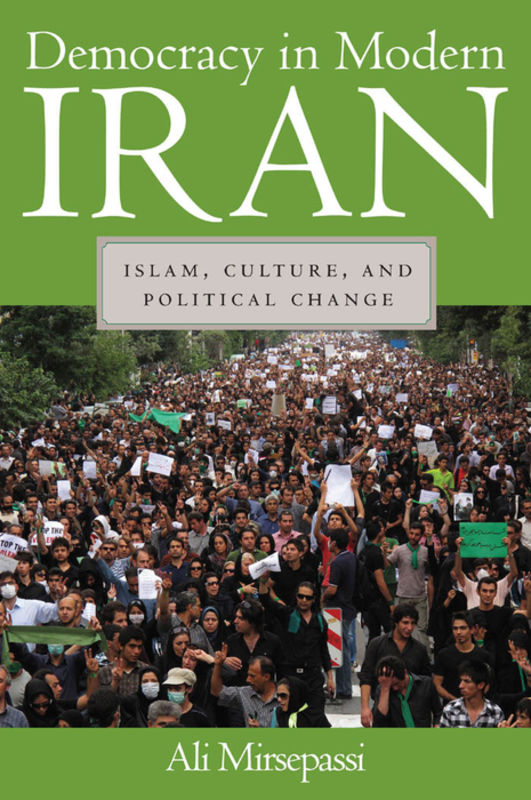
Democracy in Modern Iran
Can Islamic societies embrace democracy? In Democracy in Modern Iran, Ali Mirsepassi maintains that it is possible, demonstrating that Islam is not inherently hostile to the idea of democracy. Rather, he provides new perspective on how such a political and social transformation could take place, arguing that the key to understanding the integration of Islam and democracy lies in concrete social institutions rather than pre-conceived ideas, the every day experiences rather than abstract theories. Mirsepassi, an Iranian native, provides a rare inside look into the country, offering a deep understanding of how Islamic countries like Iran and Iraq can and will embrace democracy.Democracy in Modern Iran challenges readers to think about Islam and democracy critically and in a far more nuanced way than is done in black-and-white dichotomies of Islam vs. Democracy, or Iran vs. the West. This essential volume contributes important insights to current discussions, creating a more complex conception of modernity in the Eastern world and, with it, Mirsepassi offers to a broad Western audience a more accurate, less cliched vision of Iran's political reality.
eBook

A Guerrilla Odyssey
Emerging in the early 1970s, the Organization of Iranian People’s Fadai Guerrillas (OIPFG) became one of the most important secular leftist political organizations in Iran. Despite their lasting influence and the way in which their efforts helped shape the history of Iran for decades to come, little is known about the group. A Guerrilla Odyssey presents the first comprehensive examination of the rise and fall of the Fadai urban guerrilla movement in Iran. Drawing on exhaustive analyses of the published and unpublished works of the Fadai Guerrillas, as well as of archival material and interviews with activists, the author demonstrates historically and sociologically the conditions that surrounded the debut and demise of the urban guerrilla warfare that defined Iranian political life in the 1970s. Vahabzadeh offers a critique of various aspects of the Fadai’s theories of national liberation in an attempt to reconsider the painful relationship among modernization, secularism, and democracy in contemporary Iran. In addition, the author makes a compelling case explaining why older revolutionary social movements of the 1960s and 1970s have transformed into the new democratic social movements that emerged from the 1980s onward in the form of today’s women’s, student, and youth movements in Iran. A Guerilla Odyssey is a meticulously researched and engrossing narrative that promises to be a major contribution to the field of Iranian history.
eBook

Islamic Symbols in Salam! Greetings to Persia by Hồ Anh Thái
Islamic symbols are a profound source of spiritual and artistic inspiration in world literature. Salam! Greetings to Persia by H? Anh Thái records the author's journey to Iran, exploring layers of cultural, historical, and religious meaning. This study investigates how Islamic symbols function in the work through three dimensions - spiritual, ritual, and material - employing symbolic and myth criticism as interpretive frameworks. The analysis identi ies recurring images such as light, prayer, and journey as narrative codes that express the author's engagement with Persian culture. Findings show that these symbols not only embody Islamic spiritual and cultural values but are also reinterpreted through a modern Vietnamese sensibility, re lecting intercultural dialogue. This study contributes to understanding how Vietnamese literature interacts with Islamic civilization and broadens the comparative scope of contemporary travel writing. By decoding these symbolic layers, the research highlights H? Anh Thái's creative approach to cross-cultural representation.
Journal Article

From The Creators of Knowledge to the Specialists of Spirit: Anti-Clericalism in Iran’s Modernist Intellectual Discourse (1925–1941)
In the early twentieth century, the Iranian Reza Shah state (1925–1941), in conjunction with the emerging group of state-trained scholars, called the status of ulama as knowledge producers into question. Existing scholarship has primarily examined the impact of state modernization on the Muslim clergy and their responses to modernization but has paid lesser attention to the passive role of the ulama or their representation in modernist intellectual and literary discourses. I examine two major Persian sources of the period to argue that intellectual representation of the ulama, in both polemics and academic critique, aided the state in its attempt to push the ulama from the center of intellectual and social life to the margins of ritual purity. Among my primary sources is a previously unexamined academic thesis authored by Qasim Tuysirkani in 1938.
Journal Article

The Ulama in Contemporary Islam
From the cleric-led Iranian revolution to the rise of the Taliban in Afghanistan, many people have been surprised by what they see as the modern reemergence of an antimodern phenomenon. This book helps account for the increasingly visible public role of traditionally educated Muslim religious scholars (the `ulama) across contemporary Muslim societies. Muhammad Qasim Zaman describes the transformations the centuries-old culture and tradition of the `ulama have undergone in the modern era--transformations that underlie the new religious and political activism of these scholars. In doing so, it provides a new foundation for the comparative study of Islam, politics, and religious change in the contemporary world. While focusing primarily on Pakistan, Zaman takes a broad approach that considers the Taliban and the `ulama of Iran, Egypt, Saudi Arabia, India, and the southern Philippines. He shows how their religious and political discourses have evolved in often unexpected but mutually reinforcing ways to redefine and enlarge the roles the `ulama play in society. Their discourses are informed by a longstanding religious tradition, of which they see themselves as the custodians. But these discourses are equally shaped by--and contribute in significant ways to--contemporary debates in the Muslim public sphere. This book offers the first sustained comparative perspective on the `ulama and their increasingly crucial religious and political activism. It shows how issues of religious authority are debated in contemporary Islam, how Islamic law and tradition are continuously negotiated in a rapidly changing world, and how the `ulama both react to and shape larger Islamic social trends. Introducing previously unexamined facets of religious and political thought in modern Islam, it clarifies the complex processes of religious change unfolding in the contemporary Muslim world and goes a long way toward explaining their vast social and political ramifications.
eBook

Islamism and modernism : the changing discourse in Iran
While many previous books have probed the causes of Iran’s Islamic Revolution of 1979, few have focused on the power of religion in shaping a national identity over the decades leading up to it. Islamism and Modernism captures the metamorphosis of the Islamic movement in Iran, from encounters with Great Britain and the United States in the 1920s through twenty-first-century struggles between those seeking to reform Islam’s role and those who take a hardline defensive stance. Capturing the views of four generations of Muslim activists, Farhang Rajaee describes how the extremism of the 1960s brought more confidence to concerned Islam-minded Iranians and radicalized the Muslim world while Islamic alternatives to modernity were presented. Subsequent ideologies gave rise to the revolution, which in turn has fed a restructuring of Islam as a faith rather than as an ideology. Presenting thought-provoking discussions of religious thinkers such as Ha’eri, Burujerdi, Bazargan, and Shari‘ati, along with contemporaries such as Kadivar, Soroush, and Shabestari, the author sheds rare light on the voices fueling contemporary Islamic thinking in Iran. A comprehensive study of these interwoven aspects of politics, religion, society, and identity, Islamism and Modernism offers crucial new insight into the aftermath of the Iranian Constitutional Revolution fought one hundred years ago—and its ramifications for the newest generation to face the crossroads of modernity and Islamic discourse in modern Iran today.
eBook

From an Understanding to a Securitizing Discourse: The British Left’s Encounter with the Emergence of Political Islam, 1978–2001
The outburst of The Iranian Revolution in 1978 generated fear and hope at the same time for several political forces across the West and the East. The emergence of Islam as a political force came as a surprise across all political spectrums in Europe, even though religion was already at the time becoming a determining variable in the field of international relations. The echoes of The Iranian Revolution precipitated even further the making of several organizations of political Islam in the Middle East, forging transnational identities. Through primary and secondary sources drawn from mainly British leftist organizations, this study aims at examining the responses of the British Left towards Islamic revivalism. Thus, this article gives an historical outline of the intellectual production and the strategies of interpretation adopted by the British Left during the period of 1978–2001, by exploring the main historical events that involved (political) Islam, such as The Iranian Revolution, the Lebanese civil war, the Palestinian Intifada and The Algerian Civil War. The main argument postulated is that interpretation trajectories by the British Left were highly dependent on ideological and geostrategic lineages and respective synchronic political alliances, resulting in putting the centre of gravity sometimes on Islamic activism’s regressive nature and sometimes on its anti-imperialist perspectives.
Journal Article

Seen and Unseen: Visual Cultures of Imperialism
Seen and Unseen teases out and explores how visual mediums construct visual cultures that often create limited perspectives of certain issues and groups. This volume focuses in particular on the representation of Islam and Muslims. It deals with fixed and stereotypical visual representations and explores alternative and challenging visual representations that reconstruct and dismantle existing belief systems. It approaches the topic from a vantage point of diverse multiple perspectives. Covering issues from Brunei, Iran, Egypt, and England and cyberspace, the essays in this volume examine the visual cultures of how Islam and Muslims are understood, misunderstood, misrepresented, or even embraced visually. Scholars in this volume draw on historical paintings, books and their covers, photography, and news to demonstrate the diversity and sometimes contradictory visual cultures that construct and adhere meaning to how Islam and Muslim people are seen.Contributors: Hoda Afshar, Jared Ahmed, Syed Farid Alatas, Sanaz Fotouhi, Christiane Gruber, Layla Hendow, Raihana M.M., Bruno Starrs and Esmaeil Zeiny.
eBook