
Catalogue Search | MBRL


Are you sure you want to remove the book from the shelf?

{{itemTitle}}
50,401
result(s) for
"LITERARY CULTURES"
Sort by:

The Language of the Gods in the World of Men
In this work of impressive scholarship, Sheldon Pollock explores the remarkable rise and fall of Sanskrit, India's ancient language, as a vehicle of poetry and polity. He traces the two great moments of its transformation: the first around the beginning of the Common Era, when Sanskrit, long a sacred language, was reinvented as a code for literary and political expression, the start of an amazing career that saw Sanskrit literary culture spread from Afghanistan to Java. The second moment occurred around the beginning of the second millennium, when local speech forms challenged and eventually replaced Sanskrit in both the literary and political arenas. Drawing striking parallels, chronologically as well as structurally, with the rise of Latin literature and the Roman empire, and with the new vernacular literatures and nation-states of late-medieval Europe, The Language of the Gods in the World of Men asks whether these very different histories challenge current theories of culture and power and suggest new possibilities for practice.
eBook

Richard Marsh, popular fiction and literary culture, 1890-1915
Richard Marsh was one of the most popular and prolific authors of
the late-Victorian and Edwardian periods. His bestselling The
Beetle: A Mystery (1897) outsold Bram Stoker's
Dracula . A prolific author within a range of genres
including Gothic, crime, humour and romance, Marsh produced stories
about shape-shifting monsters, morally dubious heroes, lip-reading
female detectives and objects that come to life. However, while
Marsh's work appealed to a public greedy for sensationalist
fiction, both the cultural elite of the day and twentieth-century
literary critics looked askance at his popular middlebrow fiction.
In the wake of the recent rediscovery of Marsh's fiction, this
essay collection builds on burgeoning scholarly interest in the
author. Marsh emerges here as a fascinating writer who helped shape
the genres of popular fiction and whose stories offer surprising
responses to issues of criminality, gender and empire in this
period of cultural transition.
eBook

The Picture of Oscar Wilde
If I were to choose a single image to represent the interest and challenge of working with visual materials, I think it would be the rather outlandish bit of kitsch in figure 1 and not a more attractive or impressive example. Part of the appeal for me, I would have to admit, is the visual humor of the situation, for this image of Oscar Wilde appears on a collectible cigar card, one that adult smokers were apparently meant to save, just as young baseball fans now save and cherish the cards of their heroes. In fact, this must have been one of the first such cards, which had only been in use for a few years when it appeared sometime around 1882. The novelty of the enterprise of collectible cards might explain Wilde's unexpected appearance here, where it is surprising to find a literary subject.
Journal Article
Muslim Women and the Politics of Representation (2002)
This paper examines the politics of knowledge production as it relates to Muslim women in western literary traditions and contemporary feminist writing, with a view to understanding the political, ideological, and economic mediations that have historically framed these representations. The meta-narrative of the Muslim woman has shifted from the bold queens of medieval literature to colonial images of the seraglio’s veiled, secluded, and oppressed women. Contemporary feminist writing and popular culture have reproduced the colonial motifs of Muslim women, and these have regained currency in the aftermath of 9/11.Drawing upon the work of Mohja Kahf, this paper begins by mapping the evolution of the Muslim woman archetype in western literary traditions. The paper then examines how some contemporary feminist literature has reproduced in new ways the discursive tropes that have had historical currency in Muslim women’s textual representation. The analysis is attentive to the ways in which the cultural production of knowledge about Muslim women has been implicated historically by the relations of power between the Muslim world and the West. *This article was first published in the American Journal of Islamic Social Sciences 19, no. 4 (2002): 1-22
Journal Article
In the Opium Den
Among other things, photographs are deposits of social relations. To put it another way, they are social relations temporarily hardened into images—figured, captured, frozen. The most obvious of those relations, that between the photographer and the sitter, has been a regular subject of inquiry for art history. Acknowledging but leaving that kind of interest aside for the moment, we may explore other sorts of relations in and around a photograph and pursue a line of inquiry more in keeping with visual culture. Here's a quick example.
Journal Article
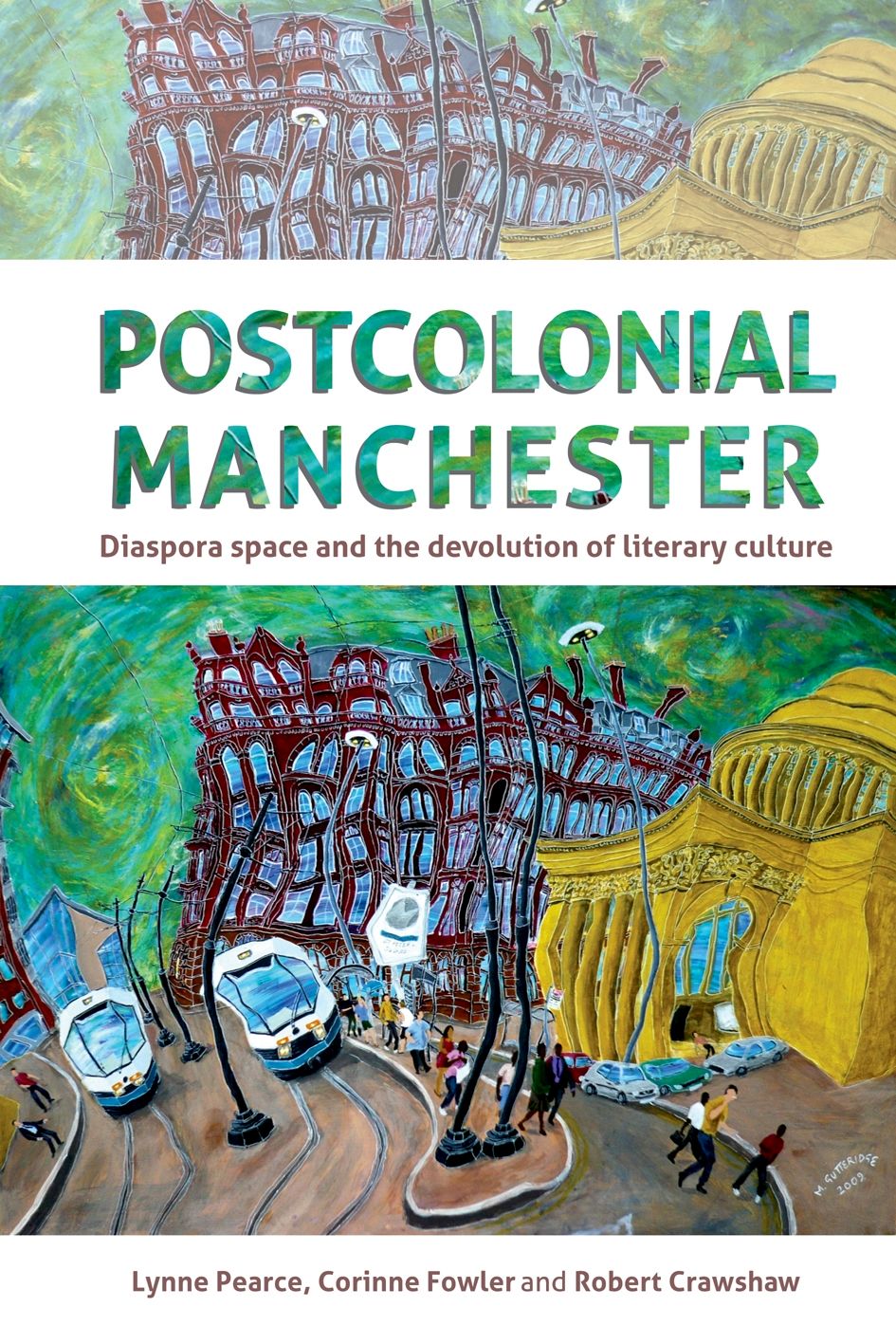
Postcolonial Manchester
Postcolonial Manchester offers a radical new perspective on Britain’s devolved literary cultures by focusing on Manchester’s vibrant, multicultural literary scene. Referencing Avtar Brah’s concept of ‘diaspora space’, the authors argue that Manchester is, and always has been, a quintessentially migrant city to which workers of all nationalities and cultures have been drawn since its origins in the cotton trade and the expansion of the British Empire. This colonial legacy – and the inequalities upon which it turns – is a recurrent motif in the texts and poetry performances of the contemporary Mancunian writers featured here, many of them members of the city’s long-established African, African-Caribbean, Asian, Chinese, Irish and Jewish diasporic communities. By turning the spotlight on Manchester’s rich, yet under-represented, literary tradition in this way, Postcolonial Manchester also argues for the devolution of the canon of English Literature and, in particular, recognition for contemporary black and Asian literary culture outside of London.
eBook
The Politics of a Good Picture: Race, Class, and Form in Jeff Wall's \Mimic\
Mimic (1982) is an early and much discussed picture by the Canadian photographer Jeff Wall, with the discussion centering largely on two topics: its subject matter and its setting (fig. 1). The subject is racism, and in this regard Mimic is “characteristic,” as Wall's best critic, Michael Fried, has observed, “of Wall's engagement in his art of the 1980s with social issues” (Why 235). Subsequently, as Fried also notes, “Wall has tended to distance himself from the overtly political concerns that are front and center in works like Mimic” (64). Indeed, in recent interviews Wall has insisted on this distance, remarking, for example, that “[t]wenty-five years ago I thought subject matter had some significance in itself” and going on to say that “Mimic was about racism in some way, about hostile gestures between races, but I'm glad the picture itself is good and it doesn't need that to be successful. Now I try to eliminate any additional subject matter—those things are for other people, they're not my problem” (Denes). His point here is not exactly that Mimic isn't antiracist—actually, its antiracism is so obvious and uncontroversial that a recent critic, Régis Michel, has complained that it “verges on political correctness” (63). The idea is rather that the success of the picture—the fact that it's a “good” picture—has nothing to do with those politics. Which leaves open the question of whether the picture's success has nothing to do with any politics or nothing to do with the particular politics of antiracism. In other words, is the picture's success independent of politics as such? Or is there a politics of the good picture?
Journal Article
Losing Perspective in the Age of News
When Ralph Waldo Emerson writes in “Experience” (1844) that “men seem to have learned of the horizon the art of perpetual retreating and reference,” he means that we see through our current moment by looking forward. The “art” that Emerson evokes to describe the restlessness and expansiveness of the nineteenth century is the art of perspective: we gain perspective, in other words, when we project for ourselves an image of the world in which everything takes shape in relation to something else. “All our days are so unprofitable while they pass,” says Emerson, because we orient our present toward our prospects; taking the long view “degrade[s] today” by distancing us from where we are. We retreat from our momentary positions to be part of the big picture. We want to stay relevant, but Emerson looks askance at our constant need to look toward the emerging pattern of events. “The men ask, ‘What's the news?‘” he says, “as if the old were so bad” (472).
Journal Article
About Time: Historical Reading, Historicity, and the Photograph
In what is of late one of the most quoted passages in American Letters, W. E. B. Dubois describes the Double Consciousness that makes the Negro “a sort of seventh son, born with a veil, and gifted with second-sight in this American world” (5). Paradoxically, given the visual logic of his accounting, the very power of DuBois's notion has obscured the incident whose recounting generates it. Describing his boyhood initiation into racial self-knowledge in his early life “as a little thing, away up in the hills of New England … in a wee wooden school-house,” DuBois focuses on a moment in which he and his schoolmates splurge on “gorgeous visiting-cards—ten cents a package—and exchange.” The social ritual is “merry” until an authoritative onlooker, a “tall girl, a newcomer,” “refused my card— refused it peremptorily, with a glance” (4). At this precise moment, we're meant to believe, the boy's individualist faith in character as destiny is “forever shattered” (Lewis 33). With the girl's refusal, “the shadow swept across me”; “it dawned upon me that I was different from the others, … shut out from their world by a vast veil” (DuBois 4).
Journal Article

Retranslation in Mughal South Asia: The Impressive Failure of a Persian Panchatantra
This paper explores Muṣṭafá Khāliqdād ʿAbbāsī's 1590s Persian retranslation of the Panchatantra , commissioned by the Mughal emperor Akbar. Examining this text vis-à-vis other translations by Khāliqdād, other court-commissioned Sanskrit-Persian translations from Akbar's time, and the long Kalīla wa Dimna tradition in the Persianate world, this paper argues that retranslations, particularly unsuccessful ones, are where literary traditions and translation norms are most clearly negotiated and contested. Studying retranslations, as shown here, is a useful methodology for revealing tensions between different contemporaneous perspectives on what it takes to fully Persianize a text.
Journal Article