
Catalogue Search | MBRL


Are you sure you want to remove the book from the shelf?

{{itemTitle}}
98
result(s) for
"Language and languages Study and teaching Computer network resources."
Sort by:

Social networking for language education
\"Social media are applications that have a networking dimension at the heart of their use. They attract language learners, teachers and providers for different reasons, although they are a controversial issue in language education as we lack evidence whether and how they promote language learning. This book studies the impact of networking with the social media on language learning, through a collection of chapters offering theoretical perspectives and empirical studies of learner experiences in a wide range of networking settings, illustrating through a variety of teaching as well as research methodologies. Through focusing on communities and socialization, together the editors and contributors help to identify priority issues (such as identity and community-building) that need attention if today's social media culture is to work to the benefit of language learners. \"-- Provided by publisher.
BOOK
Language-learner computer interactions : theory, methodology and CALL applications
This book focuses on learner-computer interactions (LCI) in second language learning environments drawing largely on sociocultural theories of language development. It brings together a rich and varied range of theoretical discussions and applications in order to illustrate the way in which LCI can enrich our comprehension of technology-mediated communication, hence enhancing learners’ digital literacy skills. The book is based on the premise that, in order to fully understand the nature of language and literacy development in digital spaces, researchers and practitioners in linguistics, sciences and engineering need to borrow from each others’ theoretical and practical toolkits. In light of this premise, themes include such aspects as educational ergonomics, affordances, complex systems learning, learner personas and corpora, while also describing such data collecting tools as video screen capture devices, eye-tracking or intelligent learning tutoring systems.
eBook

Second-language discourse in the digital world : linguistic and social practices in and beyond the networked classroom
Second-language Discourse in the Digital World illustrates a new, practice-driven approach to technology in second-language (L2) learning that begins with what L2 users do when they connect with others online. With its rich set of examples from a number of different languages and a variety of digital platforms, in and beyond the classroom, this book provides a structured account of L2 computer-mediated discourse. The book is divided into four sections. Section I considers how new media have changed language learning. Section II is about L2 participation in digital forms and practices in online communities. Sections III centers around L2 linguistic and other semiotic practices, including the use of multimodal and multilingual resources while section IV analyzes social practices to explore how networked L2 users build, maintain and challenge relationships. Written in accessible style, the volume will be an important read to anyone interested in L2 use and learning in Web 2.0.Finalist for the AAAL 2019 book award.
eBook

Mobile learning : languages, literacies and cultures
\"This book is a wide-ranging exploration of the use of mobile devices for teaching and learning language and literacies. It investigates the particular qualities of mobile devices which open up new educational possibilities, and examines the agendas behind the use of these tools in the developed and developing world alike. A history of the development of the hardware and software leads into a detailed study of how mobile devices can be used to teach language, which language areas and skills are already being taught around the world, and how the teaching of literacy, including digital literacies, can be supported. Eighteen case studies from across the globe are complemented by 13 vignettes by experienced mobile educators, thus building up a rich picture of contemporary mobile learning as well as sketching an outline of likely future developments\"-- Provided by publisher.
Book
Language Teacher Education and Technology
Language teachers’ competencies in computer-assisted language learning (CALL) are a crucial factor affecting their own implementation of CALL. However, there is still a concern that many language teachers are not adequately prepared to make effective use of CALL or to identify and evaluate potential CALL solutions. This can be the result of many different factors and raises the question of how to train teachers to develop their CALL knowledge and skills to a greater degree. The discussion of approaches to training language teachers in the use of technology adopted in areas of Australia, the UK and the US provides valuable insights for those already involved in this area, and inspiration for those who have some interest in carrying out this kind of training, but as yet have little or no experience. This book explores the current status of CALL teacher education and discusses issues and challenges CALL teacher educators face in their own contexts. Specifically, it looks at postgraduate CALL courses offered at different universities to find ways of improving CALL teacher training. It represents the first overview of a topic that is relevant to most postgraduate courses in Applied Linguistics or TESOL across the globe. The use of technology for language learning and teaching is increasingly common but, as is so often the case, training for teachers in how to use that technology remains limited, to a large extent by lack of expertise among trainers.
eBook
Electronic Discourse in Language Learning and Language Teaching
New technologies are constantly transforming traditional notions of language use and literacy in online communication environments. While previous research has provided a foundation for understanding the use of new technologies in instructed second language environments, few studies have investigated new literacies and electronic discourse beyond the classroom setting. This volume seeks to address this gap by providing corpus-based and empirical studies of electronic discourse analyzing social and linguistic variation as well as communicative practices in chat, discussion forums, blogs, and podcasts. Several chapters also examine the assessment and integration of new literacies. This volume will serve as a valuable resource for researchers, teachers, and students interested in exploring electronic discourse and new literacies in language learning and teaching.
eBook

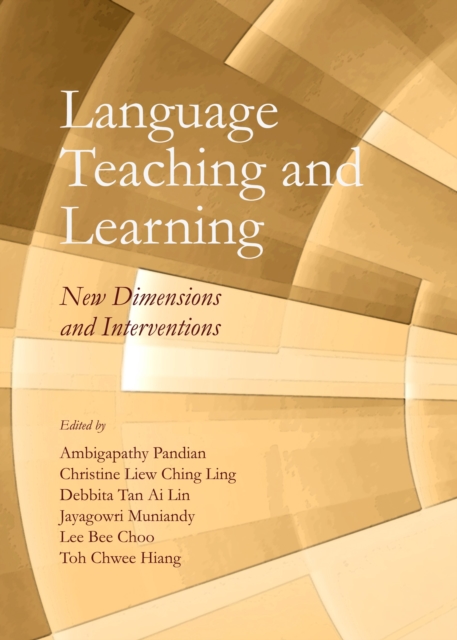
Language Teaching and Learning
In every discussion on the role that language plays in our lives, every orator - from prominent politicians and corporate figures to linguists, educational experts, and others - concedes that language is important in all spheres of life. Language is both personal and introspective, as well as public and communal. Without it, we would not be able to communicate and articulate our thoughts and feelings to ourselves, to those in our inner circles, and to those in the world at large. Without it, we would not be able to establish partnerships and collaborations, and to unite peoples of diverse backgrounds and intrinsic values. Without it, too, we would not be able to learn new discoveries and gain new knowledge. The nurturing of a language learning culture is of the utmost importance to ensure that language teaching and learning supports the development of individuals, societies, nations, and populations. Language researchers, educators, and practitioners need to ensure that their learners are empowered to remain relevant. They need to produce critical and analytical thinkers, and successful language users in listening, speaking, reading, and writing.The collection of chapters in this volume addresses language teaching and learning dilemmas and draws attention to the challenges researchers have overcome and those they continue to face. The book chapters here reflect the transcendence by language teaching and learning of ordinary boundaries, especially with the advent of the digital revolution, and provide new perspectives, pedagogies, and approaches that help shape ethical, responsible, and sustainable policies. Readers of this volume, whether language practitioners, students, researchers, policy - and decision-makers, concerned educationists, or any interested individual, will gain new insights and experiences as they explore new identities, new
instructional media for interactive teaching and learning and new modes of meaning in diverse local and global contexts.
eBook
