
Catalogue Search | MBRL


Are you sure you want to remove the book from the shelf?

{{itemTitle}}
41,687
result(s) for
"Learning Mathematical models."
Sort by:

Modelling learners and learning in science education : developing representations of concepts, conceptual structure and conceptual change to inform teaching and research
This book sets out the necessary processes and challenges involved in modeling student thinking, understanding and learning. The chapters look at the centrality of models for knowledge claims in science education and explore the modeling of mental processes, knowledge, cognitive development and conceptual learning. The conclusion outlines significant implications for science teachers and those researching in this field.
Book

Gaussian Processes for Machine Learning
Gaussian processes (GPs) provide a principled, practical, probabilistic approach to learning in kernel machines. GPs have received increased attention in the machine-learning community over the past decade, and this book provides a long-needed systematic and unified treatment of theoretical and practical aspects of GPs in machine learning. The treatment is comprehensive and self-contained, targeted at researchers and students in machine learning and applied statistics.The book deals with the supervised-learning problem for both regression and classification, and includes detailed algorithms. A wide variety of covariance (kernel) functions are presented and their properties discussed. Model selection is discussed both from a Bayesian and a classical perspective. Many connections to other well-known techniques from machine learning and statistics are discussed, including support-vector machines, neural networks, splines, regularization networks, relevance vector machines and others. Theoretical issues including learning curves and the PAC-Bayesian framework are treated, and several approximation methods for learning with large datasets are discussed. The book contains illustrative examples and exercises, and code and datasets are available on the Web. Appendixes provide mathematical background and a discussion of Gaussian Markov processes.
eBook

Learning and decision-making from rank data
The ubiquitous challenge of learning and decision-making from rank data arises in situations where intelligent systems collect preference and behavior data from humans, learn from the data, and then use the data to help humans make efficient, effective, and timely decisions. Often, such data are represented by rankings. This book surveys some recent progress toward addressing the challenge from the considerations of statistics, computation, and socio-economics. We will cover classical statistical models for rank data, including random utility models, distance-based models, and mixture models. We will discuss and compare classical and state-of-the-art algorithms, such as algorithms based on Minorize-Majorization (MM), Expectation-Maximization (EM), Generalized Method-of-Moments (GMM), rank breaking, and tensor decomposition. We will also introduce principled Bayesian preference elicitation frameworks for collecting rank data. Finally, we will examine socio-economic aspects of statistically desirable decision-making mechanisms, such as Bayesian estimators. This book can be useful in three ways: (1) for theoreticians in statistics and machine learning to better understand the considerations and caveats of learning from rank data, compared to learning from other types of data, especially cardinal data; (2) for practitioners to apply algorithms covered by the book for sampling, learning, and aggregation; and (3) as a textbook for graduate students or advanced undergraduate students to learn about the field. This book requires that the reader has basic knowledge in probability, statistics, and algorithms. Knowledge in social choice would also help but is not required.
Book

Machine learning : a Bayesian and optimization perspective
This tutorial text gives a unifying perspective on machine learning by covering both probabilistic and deterministic approaches -which are based on optimization techniques - together with the Bayesian inference approach, whose essence lies in the use of a hierarchy of probabilistic models.The book presents the major machine learning methods as.
eBook

Computational trust models and machine learning
\"This book provides an introduction to computational trust models from a machine learning perspective. After reviewing traditional computational trust models, it discusses a new trend of applying formerly unused machine learning methodologies, such as supervised learning. The application of various learning algorithms, such as linear regression, matrix decomposition, and decision trees, illustrates how to translate the trust modeling problem into a (supervised) learning problem. The book also shows how novel machine learning techniques can improve the accuracy of trust assessment compared to traditional approaches\"-- Provided by publisher.
Book
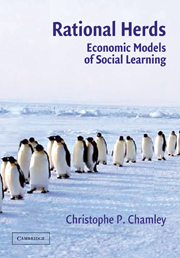
Rational Herds
Penguins jumping off a cliff, economic forecasters and financial advisors speculating against a currency, and farmers using traditional methods in India are all practising social learning. Such learning from the behavior of others may and does lead to herds, crashes, and booms. These issues have become, over the last ten years, an exciting field of research in theoretical and applied economics, finance, and in other social sciences. This book provides both an informal introduction and in-depth insights into the subject. Each chapter is devoted to a separate issue: individuals learn from the observations of actions, the outcomes of these actions, and from what others say. They may delay or make an immediate decision; they may compete against others or gain from cooperation; they make decisions about investment, crop choices, and financial investments. The book highlights the similarities and the differences between the various cases.
eBook

Advances in learning theory : methods, models and applications
This text details advances in learning theory that relate to problems studied in neural networks, machine learning, mathematics and statistics.
eBook

Machine Learning
Machine Learning: A Bayesian and Optimization Perspective, 2nd edition, gives a unified perspective on machine learning by covering both pillars of supervised learning, namely regression and classification.
eBook

Mastering TensorFlow 1. x
We cover advanced deep learning concepts (such as transfer learning, generative adversarial models, and reinforcement learning), and implement them using TensorFlow and Keras. We cover how to build and deploy at scale with distributed models. You will learn to build TensorFlow models using R, Keras, TensorFlow Learn, TensorFlow Slim and Sonnet.
eBook
Mathematical Modeling of the Learning Curve and Its Practical Applications
This book provides a detailed description of the application of mathematical learning curve modeling to analyze the state of learning and memory in humans and animals. The purpose of the book is to enable the readers to apply the knowledge gained in their own research on learning and memory. The authors hope that the readers may achieve success in this field of knowledge, expand and advance mathematical modeling of the learning curve, and that this book may aid in this process. For this, the authors have developed their own mathematical model based on the systems theory and proved its advantage in relation to those previously proposed. The authors developed MS Windows application \"Learning Curve Modeling Tool\" to help the reader modeling the learning curve from raw learning data in the California Verbal Learning Test, the Rey Auditory Verbal Learning Test, and other similar memory tests. Moreover, the book describes in detail the Windows and Android application \"Memory Monitoring Tool\", developed by the authors, which is suited well for mathematical modeling of the learning curves. The application aims to reveal initial signs of memory impairment. Besides, the section APPENDIX A describes a Web application - \"Learning curve simulator\" - developed by the authors for helping readers to get started with practically modeling the learning curve and testing their memory. This application is included in the book. The book will be useful for undergraduate students, graduate students, advanced graduate students, and professors, especially for professors who work on learning in both humans and animals, and those interested in the memory of marijuana users, alcoholics, and those suffering from diabetes and multiple sclerosis, as well as other neurological and psychological diseases and their neurological complications including those after COVID-19.
eBook