
Catalogue Search | MBRL


Are you sure you want to remove the book from the shelf?

{{itemTitle}}
554
result(s) for
"Learning and scholarship United States."
Sort by:


Planned Obsolescence
Choice's Outstanding Academic Title list for
2013 A bold approach to re-envisioning the future
of academic publishing Academic institutions are facing a
crisis in scholarly publishing at multiple levels: presses are
stressed as never before, library budgets are squeezed, faculty are
having difficulty publishing their work, and promotion and tenure
committees are facing a range of new ways of working without a
clear sense of how to understand and evaluate them. Planned
Obsolescence is both a provocation to think more broadly
about the academy's future and an argument for re-conceiving that
future in more communally-oriented ways. Facing these issues
head-on, Kathleen Fitzpatrick focuses on the technological
changes-especially greater utilization of internet publication
technologies, including digital archives, social networking tools,
and multimedia-necessary to allow academic publishing to thrive
into the future. But she goes further, insisting that the key
issues that must be addressed are social and institutional in
origin. Springing from original research as well as Fitzpatrick's
own hands-on experiments in new modes of scholarly communication
through MediaCommons, the digital scholarly network she co-founded,
Planned Obsolescence explores these aspects of scholarly work, as
well as issues surrounding the preservation of digital scholarship
and the place of publishing within the structure of the
contemporary university. Written in an approachable style designed
to bring administrators and scholars into a conversation, Planned
Obsolescence explores both symptom and cure to ensure that
scholarly communication will remain relevant in the digital future.
Related Articles: \"Do 'the Risky Thing' in Digital
Humanities\"-Chronicle of Higher Education \"Academic Publishing and
Zombies\"-Inside Higher Ed
eBook

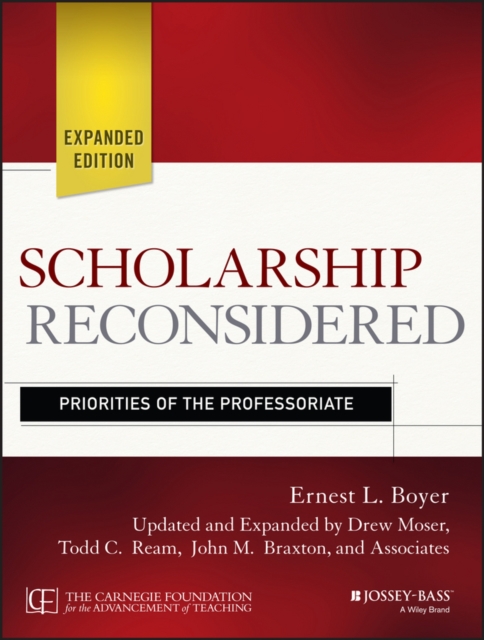
Scholarship reconsidered : priorities of the professoriate
Shifting faculty roles in a changing landscape
Ernest L. Boyer's landmark book Scholarship Reconsidered: Priorities of the Professoriate challenged the publish-or-perish status quo that dominated the academic landscape for generations. His powerful and enduring argument for a new approach to faculty roles and rewards continues to play a significant part of the national conversation on scholarship in the academy.
Though steeped in tradition, the role of faculty in the academic world has shifted significantly in recent decades. The rise of the non-tenure-track class of professors is well documented. If the historic rule of promotion and tenure is waning, what role can scholarship play in a fragmented, unbundled academy? Boyer offers a still much-needed approach. He calls for a broadened view of scholarship, audaciously refocusing its gaze from the tenure file and to a wider community.
This expanded edition offers, in addition to the original text, a critical introduction that explores the impact of Boyer's views, a call to action for applying Boyer's message to the changing nature of faculty work, and a discussion guide to help readers start a new conversation about how Scholarship Reconsidered applies today.
eBook

Worlds made by words : scholarship and community in the modern West
Revealing the microdynamics of the scholarly life, this text consists of a series of essays on institutions and on scholars ranging from early modern polymaths to modern intellectual historians to American thinkers and writers.
Book

Educating Scholars
Despite the worldwide prestige of America's doctoral programs in the humanities, all is not well in this area of higher education and hasn't been for some time. The content of graduate programs has undergone major changes, while high rates of student attrition, long times to degree, and financial burdens prevail. In response, the Andrew W. Mellon Foundation in 1991 launched the Graduate Education Initiative (GEI), the largest effort ever undertaken to improve doctoral programs in the humanities and related social sciences. The only book to focus exclusively on the current state of doctoral education in the humanities, \"Educating Scholars\" reports on the GEI's success in reducing attrition and times to degree, the positive changes implemented by specific graduate programs, and the many challenges still to be addressed. Over a ten-year period, the Foundation devoted almost eighty-five million dollars through the GEI to provide support for doctoral programs and student aid in fifty-four departments at ten leading universities. The authors examine data that tracked the students in these departments and in control departments, as well as information gathered from a retrospective survey of students. They reveal that completion and attrition rates depend upon financial support, the quality of advising, clarity of program requirements, and each department's expectations regarding the dissertation. The authors consider who earns doctoral degrees, what affects students' chances of finishing their programs, and how successful they are at finding academic jobs. Answering some of the most important questions being raised about American doctoral programs today, \"Educating Scholars\" will interest all those concerned about our nation's intellectual future. (Verlag).
eBook

Evaluating scholarship and research impact : history, practices, and policy development
Faculty members, scholars, and researchers often ask where they should publish their work; which outlets are most suitable to showcase their research? Which journals should they publish in to ensure their work is read and cited? How can the impact of their scholarly output be maximized? The answers to these and related questions affect not only individual scholars, but also academic and research institution stakeholders who are under constant pressure to create and implement organizational policies, evaluation measures and reward systems that encourage quality, high impact research from their members. The explosion of academic research in recent years, along with advances in information technology, has given rise to omnipresent and increasingly important scholarly metrics. These measures need to be assessed and used carefully, however, as their widespread availability often tempts users to jump to improper conclusions without considering several caveats. While various quantitative tools enable the ranking, evaluating, categorizing, and comparing of journals and articles, metrics such as author or article citation counts, journal impact factors, and related measures of institutional research output are somewhat inconsistent with traditional goals and objectives of higher education research and scholarly academic endeavors.
Book

Clueless in Academe
Gerald Graff argues that our schools and colleges make the intellectual life seem more opaque, narrowly specialized, and beyond normal learning capacities than it is or needs to be. Left clueless in the academic world, many students view the life of the mind as a secret society for which only an elite few qualify.In a refreshing departure from standard diatribes against academia, Graff shows how academic unintelligibility is unwittingly reinforced not only by academic jargon and obscure writing, but by the disconnection of the curriculum and the failure to exploit the many connections between academia and popular culture. Finally, Graff offers a wealth of practical suggestions for making the culture of ideas and arguments more accessible to students, showing how students can enter the public debates that permeate their lives.
eBook


The humanities and the dynamics of inclusion since World War II
The role played by the humanities in reconciling American diversity—a diversity of both ideas and peoples—is not always appreciated. This volume of essays, commissioned by the American Academy of Arts and Sciences, examines that role in the half century after World War II, when exceptional prosperity and population growth, coupled with America's expanded political interaction with the world abroad, presented American higher education with unprecedented challenges and opportunities. The humanities proved to be the site for important efforts to incorporate groups and doctrines that had once been excluded from the American cultural conversation.
Edited and introduced by David Hollinger, this volume explores the interaction between the humanities and demographic changes in the university, including the link between external changes and the rise of new academic specializations in area and other interdisciplinary studies.
This volume analyzes the evolution of humanities disciplines and institutions, examines the conditions and intellectual climate in which they operate, and assesses the role and value of the humanities in society.
Contents:
John Guillory, \"Who's Afraid of Marcel Proust? The Failure of General Education in the American University\"
Roger L. Geiger, \"Demography and Curriculum: The Humanities in American Higher Education from the 1950s through the 1980s\"
Joan Shelley Rubin, \"The Scholar and the World: Academic Humanists and General Readers\"
Martin Jay, \"The Ambivalent Virtues of Mendacity: How Europeans Taught (Some of Us) to Learn to Love the Lies of Politics\"
James T. Kloppenberg, \"The Place of Value in a Culture of Facts: Truth and Historicism\"
Bruce Kuklick, \"Philosophy and Inclusion in the United States, 1929–2001\"
John T. McGreevy, \"Catholics, Catholicism, and the Humanities, 1945–1985\"
Jonathan Scott Holloway, \"The Black Scholar, the Humanities, and the Politics of Racial Knowledge Since 1945\"
Rosalind Rosenberg, \"Women in the Humanities: Taking Their Place\"
Leila Zenderland, \"American Studies and the Expansion of the Humanities\"
David C. Engerman, \"The Ironies of the Iron Curtain: The Cold War and the Rise of Russian Studies\"
Andrew E. Barshay, \"What is Japan to Us\"?
Rolena Adorno, \"Havana and Macondo: The Humanities Side of U.S. Latin American Studies, 1940–2000\"
eBook