
Catalogue Search | MBRL


Are you sure you want to remove the book from the shelf?

{{itemTitle}}
10,071
result(s) for
"Liturgy"
Sort by:


Singing the New Song
InSinging the New Song, Katherine Zieman examines the institutions and practices of the liturgy as central to changes in late medieval English understandings of the written word. Where previous studies have described how writing comes to supplant oral forms of communication or how it objectifies relations of power formerly transacted through ritual and ceremony, Zieman shifts the critical gaze to the ritual performance of written texts in the liturgy-effectively changing the focus from writing to reading. Beginning with a history of the elementary educational institution known to modern scholars as the \"song school,\" Zieman shows the continued centrality of liturgical and devotional texts to the earliest stages of literacy training and spiritual formation. Originally, these schools were created to provide liturgical training for literate adult performers who had already mastered the grammatical arts. From the late thirteenth century on, however, the attention and resources of both lay and clerical patrons came to be devoted specifically to young boys, centering on their function as choristers. Because choristers needed to be trained before they received instruction in grammar, the liturgical skills of reading and singing took on a different meaning. This shift in priorities, Zieman argues, is paradigmatic of broader cultural changes, in which increased interest in liturgical performance and varying definitions attached to \"reading and singing\" caused these practices to take on a life of their own, unyoked from their original institutional settings of monastery and cathedral. Unmoored from the context of the choral community, reading and singing developed into discrete, portable skills that could be put to use in a number of contexts, sacred and secular, Latin and vernacular. Ultimately, they would be carried into a wider public sphere, where they would be transformed into public modes of discourse appropriated by vernacular writers such as Geoffrey Chaucer and William Langland.
eBook

Gender Differences and the Making of Liturgical History
Mapping uncharted territory in the study of liturgy's past, this book offers a history to contemporary questions around gender and liturgical life. Teresa Berger looks at liturgy's past through the lens of gender history, understood as attending not only to the historically prominent binary of \"men\" and \"women\" but to all gender identities, including inter-sexed persons, ascetic virgins, eunuchs, and priestly men.
Demonstrating what a gender-attentive inquiry is able to achieve, Berger explores both traditional fundamentals such as liturgical space and eucharistic practice and also new ways of studying the past, for example by asking about the developing link between liturgical presiding and priestly masculinity. Drawing on historical case studies and focusing particularly on the early centuries of Christian worship, this book ultimately aims at the present by lifting a veil on liturgy's past to allow for a richly diverse notion of gender differences as these continue to shape liturgical life.
eBook

Embodied Liturgical Experience as an Extension of the Eucharist
Historically, Christianity has always emphasized the embodiment of liturgical experience. Liturgy is not merely a metaphysical phenomenon, but one that is lived out and is, in turn, formative of the human being. To this end, the liturgy encompasses the totality of human experience to completely immerse the human being within itself. This includes the senses of smell, hearing, vision, touch, and, ultimately, taste. This uniting thread that runs throughout the human senses is teleologically directed toward the Eucharist. The Eucharist, being the climax of liturgy, is not a disembodied magical occurrence, but is, most fundamentally, formative of the human being. As the perpetuation of the incarnation throughout human history, the Eucharist calls people to be, most authentically, human beings, re-forming them into the likeness of God—the likeness of he who is known in the Eucharist. This paper will attempt to answer the question: How can the physical stimuli presented throughout the liturgy be understood as ‘Eucharistic’? Through a Coptic Orthodox theological hermeneutic, but drawing from a wider range of patristic and modern authors, this paper will attempt to answer this question by looking at how created things are ‘Eucharistic’ insofar as they reveal God. The paper will look at the possibility of primary knowledge—that is knowledge through experience—and the necessity of this form of knowledge within the scope of the liturgy. Finally, it will be shown how the liturgy offers a way to embody a narrative, thus immersing the human being into a way through which they are formed and experience the liturgy as Eucharist.
Journal Article
Passover Haggadah graphic novel New Milford = הגדה של פסח
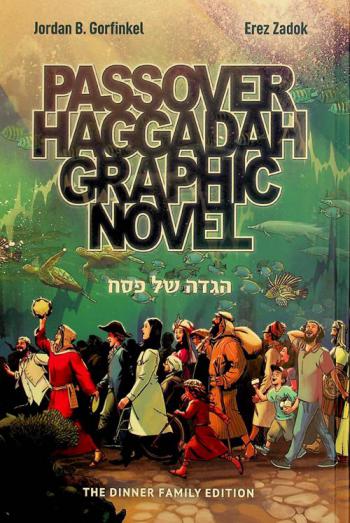
Koren Publishers is proud to announce the publication of the world's first Passover Haggadah Graphic Novel, conceived and written by acclaimed Batman comics creator and Jewish cartoonist Jordan B. Gorf Gorfinkel, and illustrated in gorgeous color by Israeli artist Erez Zadok. The Passover Haggadah Graphic Novel integrates a brand-new, modern translation into sophisticated and super-fun sequential art that brings the epic story to life. The result of extensive historical and linguistic research, every gorgeous panel imbues the classic narrative with renewed relevance and excitement. The graphic novel pages are presented alongside the unabridged, traditional Seder service text, in Hebrew and transliteration, and accompanied by how to instructional cartoons depicting all of the rituals, as celebrated every year for the last 4000 years in Jewish homes around the world. This historic publication will appeal to family members and guests of multiple generations and diverse backgrounds. After all, aspirational stories of heroes, liberation and hope are universal. And there s no more universal medium for telling heroic stories, one that bridges all cultures, faiths and languages, than the sequential art form of the graphic novel itself a Jewish innovation!
Book

Vera Figura Sancti: The Hagiographical Readings in the Roman Breviary
This article investigates the role of hagiography as a mediating genre between Scripture and liturgy. Hagiographical readings for saints (legenda) have been featured in the office of Matins in Rome from at least the eighth century. By the early modern period, these texts came under scrutiny for a lack of historical credibility, a concern echoed in the reform of the breviary after the Second Vatican Council which pruned the office of much legendary material. Yet recent scholarship on hagiography suggests that the dominant postconciliar concern—historicity—failed to fully understand the genre. Legenda were not bad history, but forms of narrative exegesis, a means to “display to the faithful fitting examples for their imitation” (SC 111). The liturgical function of the hagiographical readings emerges clearly in four case studies comparing Matins of the Breviarum Romanum 1568 to the Liturgia Horarum of 1971 for Agatha, Cecilia, Agnes, and Lucy. These feasts demonstrate both the motivation and the result of the directive to reform the readings of the saints to accord with the “facts of history” (SC 92c). This study demonstrates the need for further work on these understudied hagiographical readings, which use the liturgical and Scriptural context to propose saints as living extensions of the Gospel, rendered concrete and attractive through narrative.
Journal Article