
Catalogue Search | MBRL


Are you sure you want to remove the book from the shelf?

{{itemTitle}}
15
result(s) for
"Mass media and propaganda History 21st century."
Sort by:

Propaganda, power and persuasion : from World War I to Wikileaks
This title provides compelling evidence of how the study and practice of propaganda today is shaped by its history.
Book

Propaganda, Power and Persuasion
As Philip Taylor has written, ‘The challenge (of the modern information age) is to ensure that no single propaganda source gains monopoly over the information and images that shape our thoughts. If this happens, the war propagandists will be back in business again.’ Propaganda came of age in the Twentieth Century. The development of mass- and multi-media offered a fertile ground for propaganda while global conflict provided the impetus needed for its growth. Propaganda has however become a portmanteau word, which can be interpreted in a number of different ways. What are the characteristic features of propaganda, and how can it be defined? The distinguished contributors to this book trace the development of techniques of ‘opinion management’ from the First World War to the current conflict in Afghanistan. They reveal how state leaders and spin-doctors operating at the behest of the state, sought to shape popular attitudes - at home and overseas - endeavouring to harness new media with the objective of winning hearts and minds. The book provides compelling evidence of how the study and practice of propaganda today is shaped by its history.
eBook
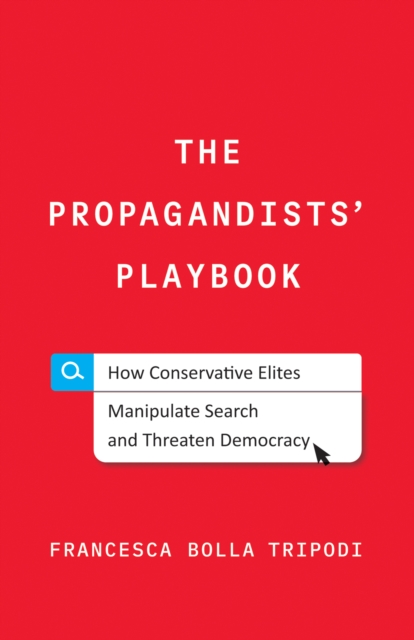
The Propagandists' Playbook
An examination of what algorithmic polarization means for
society and how conservative elites use media literacy tactics to
spread propaganda The Propagandists' Playbook
peels back the layers of the right-wing media manipulation machine
to reveal why its strategies are so effective and pervasive, while
also humanizing the people whose worldviews and media practices
conservatism embodies. Based on interviews and ethnographic
observations of two Republican groups over the course of the 2018
Virginia gubernatorial race-including the author's firsthand
experience of the 2017 Unite the Right rally-the book considers how
Google algorithms, YouTube playlists, pundits, and politicians can
manipulate audiences, reaffirm beliefs, and expose audiences to
more extremist ideas, blurring the lines between reality and
fiction. Francesca Tripodi argues that conservatives who embody the
Christian worldview give authoritative weight to original texts and
interrogate the media using the same tools taught to them in Bible
study-for example, using Google to \"fact check\" the news. The
result of this practice, tied to conservative marketing tactics, is
more than a reaffirmation of existing beliefs: it is a
radicalization of content and a changing of narratives adopted by
the media. Tripodi also demonstrates the pervasiveness of white
supremacy in the conservative media ecosystem, as well as its
mainstream appeal, scope, and spread.
eBook
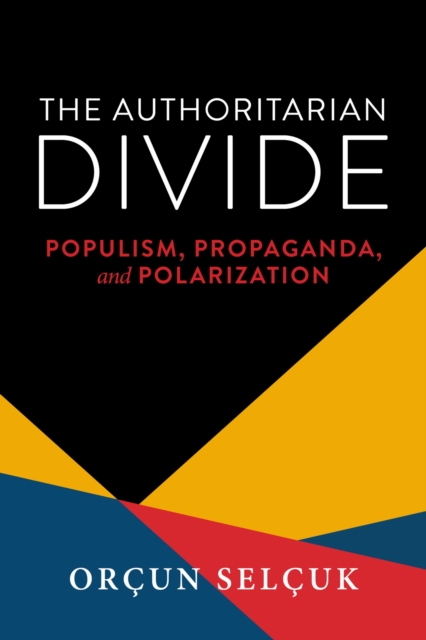
The authoritarian divide : populism, propaganda, and polarization
In the context of the global decline of democracy, The Authoritarian Divide analyzes the tactics that populist leaders in Turkey, Venezuela, and Ecuador have used to polarize their countries. Political polarization is traditionally viewed as the result of competing left/right ideologies. In The Authoritarian Divide, Orçun Selçuk argues that, regardless of ideology, polarization is driven by dominant populist leaders who deliberately divide constituents by cultivating a dichotomy of inclusion and exclusion. This practice, known as affective leader polarization, stymies compromise and undermines the democratic process. Drawing on multiple qualitative and quantitative methodologies for support, as well as content from propaganda media such as public speeches, Muhtar Meetings, Aló Presidente, and Enlace Ciudadano, Selçuk details and analyzes the tactics used by three well-known populist leaders to fuel affective leader polarization: Recep Tayyip Erdo?an in Turkey, Hugo Chávez in Venezuela, and Rafael Correa in Ecuador. Selçuk's work provides a rubric for a better understanding of—and potential defense against—the rise in polarizing populism across the globe.
eBook

Pop culture goes to war
Pop Culture Goes to War, by Geoff Martin and Erin Steuter, explores the persistence of militarism in American popular culture in the war on terror, from 9/11 to the present day. The authors detail the role of Hollywood and the entertainment industries in rallying both the troops and the public for war and show how toys, video games, music, and television support contemporary militarism. At the same time that popular culture is enlisting support for militarism, it is also serving as a major source of resistance to the war on terror through the traditional mediums of music and movies, and increasingly through the humor and insight of anti-war artists who are jamming the culture of militarism. The satire of The Daily Show, The Simpsons, and South Park are further examples of so-called culture jamming. This book is for readers who question the persistence of a warrior culture and offers new insights into the perpetuation of militaristic values throughout American culture.
eBook

The Return of Trust? Institutions and the Public after the Icelandic Financial Crisis
This book examines the efforts of major Icelandic economic institutions to regain the public's trust, 10 years after the financial crisis that ruined personal savings and fostered anger towards business and politics. The studies collected here provide insights into restoring relationships between communities and institutions.
eBook

The Rise of the Tea Party
What to make of the Tea Party? To some, it is a grassroots movement aiming to reclaim an out-of-touch government for the people. To others, it is a proto-fascist organization of the misinformed and manipulated lower middle class. Either way, it is surely one of the most significant forms of reaction in the age of Obama. In this definitive socio-political analysis of the Tea Party, Anthony DiMaggio examines the Tea Party phenomenon, using a vast array of primary and secondary sources as well as first-hand observation. He traces the history of the Tea Party and analyzes its organizational structure, membership, ideological coherence, and relationship to the mass media. And, perhaps most importantly, he asks: is it really a movement or just a form of manufactured dissent engineered by capital? DiMaggio's conclusions are thoroughly documented, surprising, and bring much needed clarity to a highly controversial subject.
eBook

The Canadian Armed Forces \YouTube War\: A Cross-Border Military-Social Media Complex
The goal of this paper is to conceptualize, contextualize, and critically analyze the Canadian Armed Forces' (CAF) use of YouTube to promote itself, recruit soldiers, and frame its role in the post-9/11 U.S.-led NATO war in Afghanistan. The first section of this paper engages with scholarship on war and the media, the military-industrial-communications complex (MICC), and YouTube War to conceptualize YouTube as a tool and contested battle-space of 21st century new media wars. The second section contextualizes the rise of the CAF's YouTube channels--Canadian Forces and Canadian Army--with regard to post-9/11 Canadian foreign policy, the growth of the Canadian military publicity state, the creeping militarization of culture, and the CAF's \"social media policy\". The third section conceptualizes the CAF's two YouTube channels as tools and spaces of its publicity front; then, through a synoptic critical overview of numerous CAF-generated YouTube videos, it shows how the CAF uses YouTube to recruit personnel and frame its role in the war in Afghanistan. The conclusion discusses the characteristics of this cross-border military-social media complex and its contradictions, namely, the spread of pacifist and veteran-generated videos that contest the war in Afghanistan. Overall, the paper offers an initial political-economy of communication of the CAF's foray into the global battle-space of the Internet and its use of YouTube for publicity.
Journal Article

Terrorists and victims. Infrahumanization of Moroccans after 11-M
Infrahumanization studies have verified that most people attribute more secondary emotions to the ingroup than to the outgroup. However, these results may vary with changing contexts. The main objective of this study was to investigate the infrahumanization of Moroccans, depending on the context, after the 11-M attacks and seven years later. For this purpose, variations that occur in the allocation of essential human qualities--secondary emotions--were analyzed by activating images of outgroup members in two opposite contexts: Guilty of the terrorist attack or its victim. The results show that the infrahumanization of the Moroccans in the perpetrator context does not change significantly with regard to the control group. However, infrahumanization does not take place when Moroccans are associated with a victim context, though only immediately after the terrorist attack, because seven years later, this effect disappears.
Journal Article

The party line
The first in-depth, authoritative discussion of the role of the press in China and the way the Chinese government uses the media to shape public opinion China's 1.3 billion population may make the country the world's largest, but the vast majority of Chinese share remarkably similar views on these and a wide array of other issues, thanks.
eBook