
Catalogue Search | MBRL


Are you sure you want to remove the book from the shelf?

{{itemTitle}}
313
result(s) for
"Nam June Paik"
Sort by:


Poem without Language : When a Writing Becomes Traceless
What happens when a writing cannot perform its function of documentation and
indication? In the installation performance
, developed from the action score
, the multiple
closed-circuit videos raise the question of “who” can occupy the
position of the observer, challenging tunnel-vision perspectivism. Such an
orchestra of gazes resonates with the spatial organization in Chinese ink
landscape painting, which challenges the anthropocentric ordering of things;
responds to Nam June Paik’s approach to media, which disrupts the habitual
way of perceiving conditioned by the mass media; and resonates with the concept
of
(空無, emptiness,
nothingness) from Daoism and Buddhism.
Journal Article


Analog Circuit Palettes, Cathode Ray Canvases: Digital's Analog, Experimental Past
This paper contends that the development of digital filmmaking can, in part, be traced back to the efforts of experimental filmmakers seeking to make abstractions in time. In other words, the advent of computer-generated and computer-assisted filmmaking occurred via analog means, beginning in the early 1950s, in the oscilloscope films of Mary Ellen Bute. These ideas were expanded and refined by John Whitney in his work on the title sequence for Hitchcock's Vertigo. Whitney continued to develop analog computer technologies to make wonderfully rigorous and colorful non-objective films, as did the first generation of video artists, who developed artisanal analog devices to create new ways of synthesizing imagery.
Journal Article
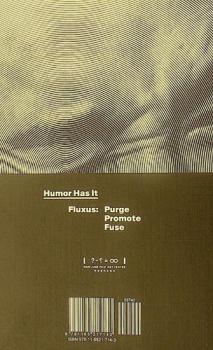
Humor has it : Fluxus : purge, promote, fuse = us-eo cheongsanhala : domohala peulleogseoseu : yeonhabhala
Humor Has It looks into Fluxus artists and Paik who challenged the traditional values of society and institutional art, from an angle of humor. Breaking boundaries, getting together freely, challenging social taboo, and counterattacking rules and norms, these characteristics are well represented by Paik's witty but revolutionary ideas and practices. Primarily drawing on Nam June Paik Art Center's foremost resource, that is, its archives, this exhibition was an outcome of long-term cooperation with Lithuania's cultural center and embassy, and the Jonas Mekas Visual Arts Center, in commemoration of the 90th anniversary of Fluxus artist George Maciunas. This exhibition catalogue overviews how Fluxus is not limited to Paik's early period, but runs through his whole work including the later broadcast and satellite projects (Park Sang Ae), and scours through the larger picture of Fluxus and its major artists to lay a clear art historical pathway for understanding their core (Woo Jung-Ah). It also approaches Paik as a strategist who skidded down the slopes of internationalism and imperialism through his Fluxus activities (Hyejin Park), makes a focused analysis of event scores in the framework of humor (Jung Yunhoe), and uses Japan as a lens to reflect on the Fluxus era, which Paik spent living variously in Europe, the US, and Asia (Yook Youngshin). And this book adopted a form carrying on the Fluxus tradition of publishing experiments, and based on mail art, the images of the exhibited works were produced as a set of postcards. It is expected that, after the exhibition's closure, Paik's Fluxus will continue to spread in your everyday lives. -- Gallery website.
Book

The Intersections of Buddhism and Contemporary Korean Visual Culture
Religion has played a significant role in shaping social cohesion by providing stability and support that transcends the human capacity to resolve individual desires, aspirations, and concerns while contributing to national identity and unity. Religion has also become an inseparable element of human history, and the human desire to embody religious imagery has been with human history. Art has historically visualized the complex and subtle relationship between humans and religion directly and profoundly. In this way, religious works have provided a lens for examining how religious ideas permeate everyday life and influence cultural practices. This study explores how Buddhist philosophy and esthetics have influenced and coexisted in contemporary Korean artistic expression to emphasize the rich intersections between Buddhism and modern and contemporary Korean artworks. The concept of consilience, which refers to the integration of knowledge across diverse domains, aims to explain how Buddhist thought has transcended human conflict and promoted harmonious coexistence within Korean visual culture. The dynamic interplay between traditional Buddhist values and contemporary visual practices produces a rich cultural synthesis that highlights the importance of preserving Korea’s artistic heritage and expands and fosters the development of global visual culture today.
Journal Article

Nam June Paik
\"Nam June Paik (1932-2006) was a visionary artist who foresaw the importance of mass media and new technology, and its impact on visual culture. His cutting-edge, innovative yet playfully entertaining work continues to be a major influence on art and culture to this day. -- This groundbreaking book focuses on Paik's pioneering role in radical aesthetics and experimental art. Bringing together works that span a five-decade career, and including archival materials and excerpts of Paik's own writings, it offers an in-depth understanding of the artist's trailblazing practice and his vision of a multidisciplinary future. His ideas and profound insight into a global age are analysed in the context of transnationalism for the first time. In addition, texts elaborate upon Paik's collaborations with other artists, musicians and choreographers, such as Charlotte Moorman, John Cage, Merce Cunningham, Joseph Beuys, and Fluxus. Highlighting Paik's global trajectory and considerable impact on digital culture, the book connects Paik's art to a new generation.\" --publisher's description, lower cover.
BOOK
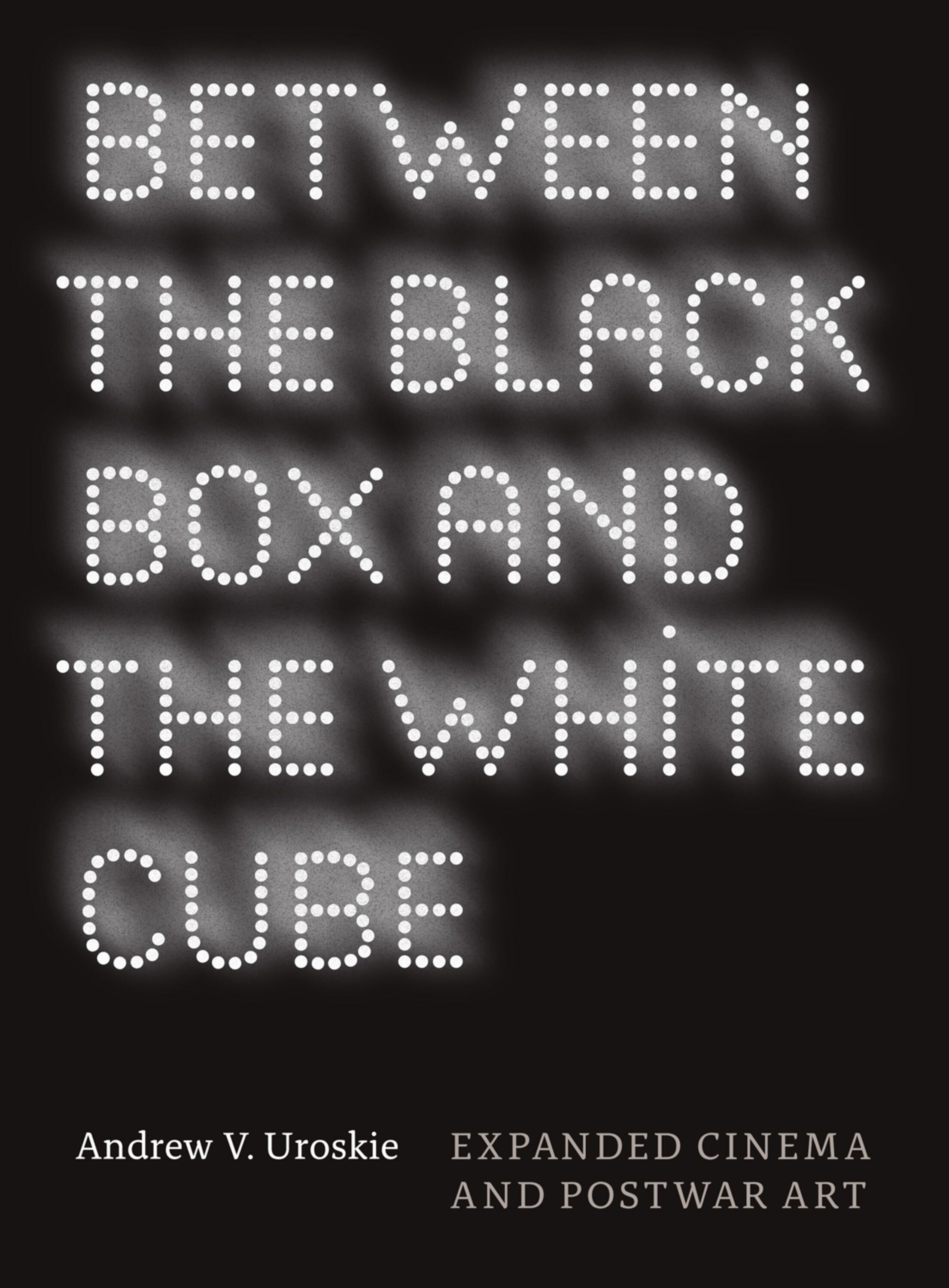
Between the black box and the white cube : expanded cinema and postwar art
Today, the moving image is ubiquitous in global contemporary art. The first book to tell the story of the postwar expanded cinema that inspired this omnipresence, Between the Black Box and the White Cube travels back to the 1950s and 1960s, when the rise of television caused movie theaters to lose their monopoly over the moving image, leading cinema to be installed directly alongside other forms of modern art.
Explaining that the postwar expanded cinema was a response to both developments, Andrew V. Uroskie argues that, rather than a formal or technological innovation, the key change for artists involved a displacement of the moving image from the familiarity of the cinematic theater to original spaces and contexts. He shows how newly available, inexpensive film and video technology enabled artists such as Nam June Paik, Robert Whitman, Stan VanDerBeek, Robert Breer, and especially Andy Warhol to become filmmakers. Through their efforts to explore a fresh way of experiencing the moving image, these artists sought to reimagine the nature and possibilities of art in a post-cinematic age and helped to develop a novel space between the \"black box\" of the movie theater and the \"white cube\" of the art gallery. Packed with over one hundred illustrations, Between the Black Box and the White Cube is a compelling look at a seminal moment in the cultural life of the moving image and its emergence in contemporary art.
eBook

Nam June Paik
Nam June Paik, an exhibit of video art by Nam June Paik at the Tate Modern in London, England from October 17, 2019 to February 9, 2020, is reviewed. Given Nam June Paik’s international status as the ‘father of video art’, it is surprising that this exhibition is the first monographic retrospective dedicated to the Korean-born artist (1932–2006) in London. Co-organised with the San Francisco Museum of Modern Art and building on the 2011 iteration of the exhibition at Tate Liverpool,1 it considers Paik’s ‘transnational’ position within the history of avant-garde movements of the last two centuries. It focuses in particular on the artist’s involvement in Fluxus in the 1960s and on his many collaborations with artists over the subsequent five decades of his career.
Journal Article