
Catalogue Search | MBRL


Are you sure you want to remove the book from the shelf?

{{itemTitle}}
790
result(s) for
"Neanderthals genetics."
Sort by:

Neanderthal man : in search of lost genomes
\"What can we learn from the genes of our closest evolutionary relatives? Neanderthal Man tells the story of geneticist Svante Pääbo's mission to answer that question, beginning with the study of DNA in Egyptian mummies in the early 1980s and culminating in his sequencing of the Neanderthal genome in 2009. From Pääbo, we learn how Neanderthal genes offer a unique window into the lives of our hominin relatives and may hold the key to unlocking the mystery of why humans survived while Neanderthals went extinct. Drawing on genetic and fossil clues, Pääbo explores what is known about the origin of modern humans and their relationship to the Neanderthals and describes the fierce debate surrounding the nature of the two species' interactions. A riveting story about a visionary researcher and the nature of scientific inquiry, Neanderthal Man offers rich insight into the fundamental question of who we are\"-- Provided by publisher.
Book

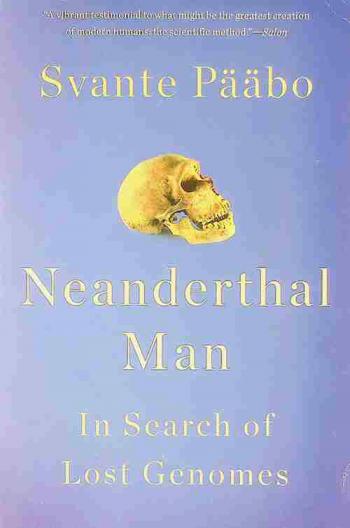
Neanderthal man : in search of lost genomes
\"What can we learn from the genes of our closest evolutionary relatives? Neanderthal Man tells the story of geneticist Svante P�a�abo's mission to answer that question, beginning with the study of DNA in Egyptian mummies in the early 1980s and culminating in his sequencing of the Neanderthal genome in 2009. From P�a�abo, we learn how Neanderthal genes offer a unique window into the lives of our hominin relatives and may hold the key to unlocking the mystery of why humans survived while Neanderthals went extinct. Drawing on genetic and fossil clues, P�a�abo explores what is known about the origin of modern humans and their relationship to the Neanderthals and describes the fierce debate surrounding the nature of the two species' interactions. A riveting story about a visionary researcher and the nature of scientific inquiry, Neanderthal Man offers rich insight into the fundamental question of who we are\"-- Provided by publisher.
Book

The major genetic risk factor for severe COVID-19 is inherited from Neanderthals
A recent genetic association study
1
identified a gene cluster on chromosome 3 as a risk locus for respiratory failure after infection with severe acute respiratory syndrome coronavirus 2 (SARS-CoV-2). A separate study (COVID-19 Host Genetics Initiative)
2
comprising 3,199 hospitalized patients with coronavirus disease 2019 (COVID-19) and control individuals showed that this cluster is the major genetic risk factor for severe symptoms after SARS-CoV-2 infection and hospitalization. Here we show that the risk is conferred by a genomic segment of around 50 kilobases in size that is inherited from Neanderthals and is carried by around 50% of people in south Asia and around 16% of people in Europe.
Risk of severe COVID-19 is conferred by a genomic segment that is inherited from Neanderthals and is carried by around 50% and 16% of people in south Asia and Europe, respectively.
Journal Article

Antediluvian
\"What if all our legends are true? A rousing, fast-paced novel of time travel unlike any other, from acclaimed author Wil McCarthy. What if our legends are older than we think? All the Stone Age has left behind are rocks and bones; all other materials have rotted away, leaving no trace. But what if \"cave men\" never existed, and the Stone Age was a time of great sophistication still preserved in our oldest stories? In a brilliant and dangerous brain hacking experiment, Harv Leonel and Tara Mukherjee are about to discover entire lifetimes of human memory coded in our genes, and reveal ancient legends - from knights and trolls, to flood myths, to the birth of humanity itself - that are as real as they are deadly. Before disaster erased the coastlines and river valleys of the Antediluvian age--before the Flood--men and women struggled and yearned and innovated in a world of savage contrasts into which Harv and Tara are thrust, unprepared. Will their science be enough to save them?\"-- Provided by publisher.
Book
The genomic landscape of Neanderthal ancestry in present-day humans
In the modern human genome, elevated Neanderthal ancestry is found at genes affecting keratin filaments, suggesting that gene flow with Neanderthals helped modern humans to adapt to non-African environments; deficiencies of Neanderthal ancestry are also found, particularly on the X chromosome and in genes expressed highly in testes, suggesting that some Neanderthal mutations were not tolerated on a modern human genetic background as they reduced male fertility.
Neanderthal genes today
The modern human genome contains traces of Neanderthal ancestry. But is Neanderthal DNA distributed uniformly across the human genome, or is it concentrated more in some parts than in others? Sriram Sankararaman
et al
. show that parts of the human genome enriched for genes affecting keratin filaments (in hair, for example) also contain a relatively high concentration of Neanderthal DNA, suggesting that this DNA helped modern humans adapt to the chillier non-African environment. On the downside, many Neanderthal-derived alleles are associated with disease risk. Other parts of the human genome contain a deficiency of Neanderthal alleles, implying their active removal in evolution. Among the 'lost' genes are a number expressed in the testis and on the X chromosome, implying that Neanderthal DNA reduced human fertility when moved to a modern human genetic background.
Genomic studies have shown that Neanderthals interbred with modern humans, and that non-Africans today are the products of this mixture
1
,
2
. The antiquity of Neanderthal gene flow into modern humans means that genomic regions that derive from Neanderthals in any one human today are usually less than a hundred kilobases in size. However, Neanderthal haplotypes are also distinctive enough that several studies have been able to detect Neanderthal ancestry at specific loci
1
,
3
,
4
,
5
,
6
,
7
,
8
. We systematically infer Neanderthal haplotypes in the genomes of 1,004 present-day humans
9
. Regions that harbour a high frequency of Neanderthal alleles are enriched for genes affecting keratin filaments, suggesting that Neanderthal alleles may have helped modern humans to adapt to non-African environments. We identify multiple Neanderthal-derived alleles that confer risk for disease, suggesting that Neanderthal alleles continue to shape human biology. An unexpected finding is that regions with reduced Neanderthal ancestry are enriched in genes, implying selection to remove genetic material derived from Neanderthals. Genes that are more highly expressed in testes than in any other tissue are especially reduced in Neanderthal ancestry, and there is an approximately fivefold reduction of Neanderthal ancestry on the X chromosome, which is known from studies of diverse species to be especially dense in male hybrid sterility genes
10
,
11
,
12
. These results suggest that part of the explanation for genomic regions of reduced Neanderthal ancestry is Neanderthal alleles that caused decreased fertility in males when moved to a modern human genetic background.
Journal Article
The complete genome sequence of a Neanderthal from the Altai Mountains
We present a high-quality genome sequence of a Neanderthal woman from Siberia. We show that her parents were related at the level of half-siblings and that mating among close relatives was common among her recent ancestors. We also sequenced the genome of a Neanderthal from the Caucasus to low coverage. An analysis of the relationships and population history of available archaic genomes and 25 present-day human genomes shows that several gene flow events occurred among Neanderthals, Denisovans and early modern humans, possibly including gene flow into Denisovans from an unknown archaic group. Thus, interbreeding, albeit of low magnitude, occurred among many hominin groups in the Late Pleistocene. In addition, the high-quality Neanderthal genome allows us to establish a definitive list of substitutions that became fixed in modern humans after their separation from the ancestors of Neanderthals and Denisovans.
A complete genome sequence is presented of a female Neanderthal from Siberia, providing information about interbreeding between close relatives and uncovering gene flow events among Neanderthals, Denisovans and early modern humans, as well as establishing substitutions that became fixed in modern humans after their separation from the ancestors of Neanderthals and Denisovans.
Genome sequence of Neanderthal woman
Recent excavations in the Denisova Cave in the Altai Mountains of southern Siberia have yielded a wealth of hominin fossils from a site that has been occupied for perhaps 250,000 years or more. Now a high-quality genome sequence has been determined from a circa 50,000-year-old toe bone — a proximal toe phalanx — excavated from the east gallery of Denisova Cave in 2010. The sequence is that of a Neanderthal woman whose parents were closely related — perhaps half-siblings or uncle and niece. Such inbreeding was also common among her recent ancestors. Comparisons with other archaic and present-day human genomes reveal several gene-flow events among Neanderthals, the closely related Denisovans and early modern humans, possibly including gene flow into Denisovans from an unknown archaic group. The high-quality Neanderthal genome also helps to establish a definitive list of substitutions that became fixed in modern humans after their separation from the ancestors of Neanderthals and Denisovans.
Journal Article
Reconstructing the genetic history of late Neanderthals
Genetic similarity among late Neanderthals is predicted well by their geographical location, and although some of these Neanderthals were contemporaneous with early modern humans, their genomes show no evidence of recent gene flow from modern humans.
Late Neanderthal relations
Many questions remain about the relationship between populations of Neanderthals around the time of their final interactions with modern humans, and how this contributed to the evolution of modern humans. Janet Kelso, Svante Pääbo and colleagues sequenced the genomes of five Neanderthals that lived between 39,000 and 47,000 years ago, broadening the temporal and geographical range of available Neanderthal genomes. They analyse these genomes together with previously sequenced ancient genomes and find that relatedness among Neanderthals is related to geographic proximity. They find that the majority of gene flow into early modern humans originated from one or more Neanderthal populations that diverged from the late Neanderthals at least 70,000 years ago, but after their split from the Altai Neanderthal approximately 150,000 years ago.
Although it has previously been shown that Neanderthals contributed DNA to modern humans
1
,
2
, not much is known about the genetic diversity of Neanderthals or the relationship between late Neanderthal populations at the time at which their last interactions with early modern humans occurred and before they eventually disappeared. Our ability to retrieve DNA from a larger number of Neanderthal individuals has been limited by poor preservation of endogenous DNA
3
and contamination of Neanderthal skeletal remains by large amounts of microbial and present-day human DNA
3
,
4
,
5
. Here we use hypochlorite treatment
6
of as little as 9 mg of bone or tooth powder to generate between 1- and 2.7-fold genomic coverage of five Neanderthals who lived around 39,000 to 47,000 years ago (that is, late Neanderthals), thereby doubling the number of Neanderthals for which genome sequences are available. Genetic similarity among late Neanderthals is well predicted by their geographical location, and comparison to the genome of an older Neanderthal from the Caucasus
2
,
7
indicates that a population turnover is likely to have occurred, either in the Caucasus or throughout Europe, towards the end of Neanderthal history. We find that the bulk of Neanderthal gene flow into early modern humans originated from one or more source populations that diverged from the Neanderthals that were studied here at least 70,000 years ago, but after they split from a previously sequenced Neanderthal from Siberia
2
around 150,000 years ago. Although four of the Neanderthals studied here post-date the putative arrival of early modern humans into Europe, we do not detect any recent gene flow from early modern humans in their ancestry.
Journal Article
The genome of the offspring of a Neanderthal mother and a Denisovan father
Neanderthals and Denisovans are extinct groups of hominins that separated from each other more than 390,000 years ago
1
,
2
. Here we present the genome of ‘Denisova 11’, a bone fragment from Denisova Cave (Russia)
3
and show that it comes from an individual who had a Neanderthal mother and a Denisovan father. The father, whose genome bears traces of Neanderthal ancestry, came from a population related to a later Denisovan found in the cave
4
–
6
. The mother came from a population more closely related to Neanderthals who lived later in Europe
2
,
7
than to an earlier Neanderthal found in Denisova Cave
8
, suggesting that migrations of Neanderthals between eastern and western Eurasia occurred sometime after 120,000 years ago. The finding of a first-generation Neanderthal–Denisovan offspring among the small number of archaic specimens sequenced to date suggests that mixing between Late Pleistocene hominin groups was common when they met.
Genomic evidence of the offspring of a Neanderthal mother and a Denisovan father suggests that mixing among different hominin groups may have more been frequent than previously appreciated.
Journal Article
The genetic history of Ice Age Europe
Modern humans arrived in Europe ~45,000 years ago, but little is known about their genetic composition before the start of farming ~8,500 years ago. Here we analyse genome-wide data from 51 Eurasians from ~45,000–7,000 years ago. Over this time, the proportion of Neanderthal DNA decreased from 3–6% to around 2%, consistent with natural selection against Neanderthal variants in modern humans. Whereas there is no evidence of the earliest modern humans in Europe contributing to the genetic composition of present-day Europeans, all individuals between ~37,000 and ~14,000 years ago descended from a single founder population which forms part of the ancestry of present-day Europeans. An ~35,000-year-old individual from northwest Europe represents an early branch of this founder population which was then displaced across a broad region, before reappearing in southwest Europe at the height of the last Ice Age ~19,000 years ago. During the major warming period after ~14,000 years ago, a genetic component related to present-day Near Easterners became widespread in Europe. These results document how population turnover and migration have been recurring themes of European prehistory.
Analysis of ancient genomic data of 51 humans from Eurasia dating from 45,000 to 7,000 years ago provides insight into the population history of pre-Neolithic Europe and support for recurring migration and population turnover in Europe during this period.
Eurasian humans of the Upper Paleolithic
David Reich, Svante Pääbo and colleagues analyse ancient genomic data from 51 Eurasian humans who lived between 45,000 and 7,000 years ago. The data provide the most comprehensive view to date of the population history of pre-Neolithic Europe, and provide support for recurring migration and population turnover in European populations during this period. Neanderthal ancestry has reduced during the past 45,000 years from 3–6% to the present day value of around 2%.
Journal Article