
Catalogue Search | MBRL


Are you sure you want to remove the book from the shelf?

{{itemTitle}}
211
result(s) for
"Niger-Congo languages"
Sort by:
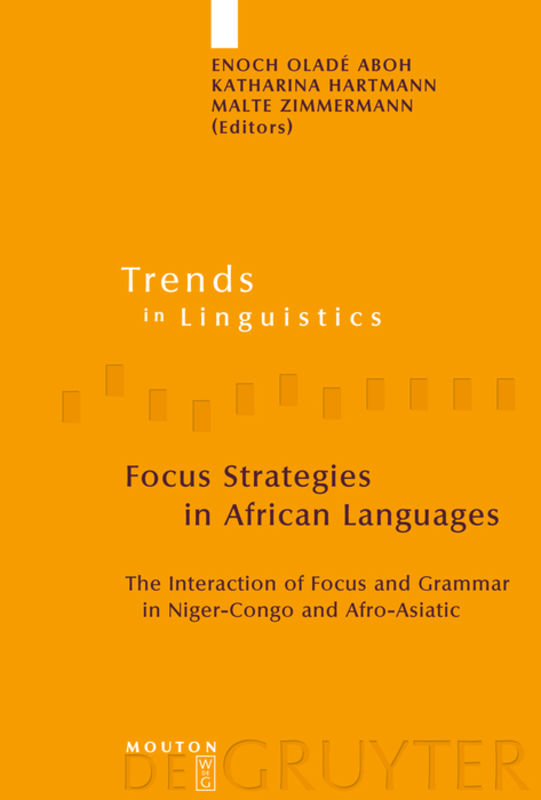
Focus Strategies in African Languages
Over the last two decades, focus has become a prominent topic in major fields in linguistic research (syntax, semantics, phonology). Focus Strategies in African Languages contributes to the ongoing discussion of focus by investigating focus-related phenomena in a range of African languages, most of which have been under-represented in the theoretical literature on focus. The articles in the volume look at focus strategies in Niger-Congo and Afro-Asiatic languages from several theoretical and methodological perspectives, ranging from detailed generative analysis to careful typological generalization across languages. Their common aim is to deepen our understanding of whether and how the information-structural category of focus is represented and marked in natural language. Topics investigated are, among others, the relation of focus and prosody, the effects of information structure on word order, ex situ versus in situ strategies of focus marking, the inventory of focus marking devices, focus and related constructions, focus-sensitive particles. The present inquiry into the focus systems of African languages has repercussions on existing theories of focus. It reveals new focus strategies as well as fine-tuned focus distinctions that are not discussed in the theoretical literature, which is almost exclusively based on well-documented intonation languages.
eBook

Ebonics, to Be or Not to Be? A Legacy of Trans-Atlantic Slave Trade
This article discusses the historical underpinnings of Ebonics as a product of linguistic influence of Bantu languages spoken in West Africa today. Many teacher educators preparing White pre-service teachers for linguistic diversity in public schools tend to focus mostly on respecting culturally different students' home languages without employing historical, lexical, grammatical, and phonological evidence to challenge students' deficit thinking about Ebonics, which is often associated in the mainstream with a physiological deficiency. Thus, the study uses several Niger-Congo languages to explain the origin of Ebonics and the influences of the Niger-Congo languages on the grammatical and phonological structures of Ebonics, and concludes by defining it as a respectable variety of English with its own sophisticated grammar.
Journal Article

The timing of speech and gesture in two Niger-Congo languages: Implications for word-level prominence
Co-speech gestures are timed to occur with prosodically prominent syllables in several languages. In prior work in Indo-European languages, gestures are found to be attracted to stressed syllables, with gesture apexes preferentially aligning with syllables bearing higher and more dynamic pitch accents. Little research has examined the temporal alignment of co-speech gestures in African tonal languages, where metrical prominence is often hard to identify due to a lack of canonical stress correlates, and where a key function of pitch is in distinguishing between words, rather than marking intonational prominence. Here, we examine the alignment of co-speech gestures in two different Niger-Congo languages with very different word structures, Medʉmba (Grassfields Bantu, Cameroon) and Igbo (Igboid, Nigeria). Our findings suggest that the initial position in the stem tends to attract gestures in Medʉmba, while the final syllable in the word is the default position for gesture alignment in Igbo; phrase position also influences gesture alignment, but in language-specific ways. Though neither language showed strong evidence of elevated prominence of any individual tone value, gesture patterning in Igbo suggests that metrical structure at the level of the tonal foot is relevant to the speech-gesture relationship. Our results demonstrate how the speech-gesture relationship can be a window into patterns of word- and phrase-level prosody cross-linguistically. They also show that the relationship between gesture and tone (and the related notion of ‘tonal prominence’) is mediated by tone’s function in a language.
Journal Article

Tone in Mabia Languages: Structure and Processes
The Mabia languages belong to the Niger–Congo family and are spoken primarily across the savannah and Sahelian regions of West Africa, including northern Ghana, Ivory Coast, Togo, Benin, Nigeria, Burkina Faso, Niger, and Mali. Tone plays a crucial role in these languages, shaping both lexical meaning and grammatical structure. This study is a synthesis or an overview of previously described facts about the tonal phenomena in six Mabia languages, Dagaare, Dagbani, Gurenɛ, Kusaal, Likpakpaln, and Buli—highlighting their tonal inventories, structures, and distinctive tonal processes. Dagaare and Dagbani exhibit a two-tone system (high and low), with an additional down-stepped high tone. Kusaal, Likpakpaln, and Buli employ a three-tone system (high, mid, and low), while the tonal status of Gurenɛ remains contested: some scholars describe it as a two-tone language, whereas others provide evidence for a three-tone system. The mid tone, though relatively less productive, appears to represent a later innovation within the group. The mid tone performs both lexical and grammatical functions. Notable tonal phenomena across these languages include tonal polarity, low tone spreading, and restrictions on contour tones, with Buli exhibiting particularly productive low tone spread. In all six languages, tone plays both lexical and grammatical functions. This paper explores these features and offers basic theoretical explanations for their occurrence. Overall, tone is a defining characteristic of the Mabia languages, intricately shaping their phonological and morphological structures.
Journal Article

Productive phrasal opacity in Gua: A challenge to Stratal Optimality Theory
We present new evidence for a special opaque interaction between phonological processes in Gua, a nearly endangered Guang (Niger-Congo) language spoken in eastern Ghana. This interaction, which was first observed by Obiri-Yeboah (
2021
), is between ATR vowel harmony and hiatus-resolution processes that render harmony opaque. A few properties of this interaction make it special. First, ATR harmony and hiatus resolution interact productively across arbitrary combinations of words. We show this using grammatical-yet-nonsensical Gua sentences akin to Chomsky’s (
1957
)
Colorless green ideas sleep furiously
, which could not have been memorized by speakers. This makes the interaction a clear case of opacity acquired by speakers. Second, the interaction involves multiple kinds of opacity in different derivations—specifically, counterbleeding, (self-)counterfeeding, and the recently labeled “countershifting” (Rasin
2022
)—which pose a challenge to nonserial phonological theories like Parallel Optimality Theory (Prince and Smolensky
1993/2004
). Stratal Optimality Theory (Bermúdez-Otero
1999
; Kiparsky
2000
,
2015
) is a serial version of Optimality Theory that attempts to account for opacity by assigning opaquely interacting processes to different serially ordered strata. A central prediction of Stratal Optimality Theory is that opacity should correlate with morphosyntactic structure, because strata are limited to morphological or syntactic domains (Jaker and Kiparsky
2020
). Building on Obiri-Yeboah and Rose (
2022
), we provide new evidence that ATR harmony and hiatus resolution in Gua apply only once to the entire utterance and thus cannot be attributed to different morphosyntactic domains, suggesting that Stratal Optimality Theory’s limited serialism is insufficient for solving the opacity problem for Optimality Theory, and that a purely phonological mechanism for deriving opacity is needed.
Journal Article

Eleven vowels of Imilike Igbo including ATR and RTR schwa
In this paper, we examine the acoustics of vowels in the Imilike [ìmìlìkè] dialect of Igbo (Igboid, Niger-Congo), which has not previously been done. While Standard Igbo has eight vowels, previous auditorily-based research has identified eleven vowels in Imilike. Like Standard Igbo, Imilike contrasts vowels in Advanced/Retracted Tongue Root (ATR vs. RTR). We find that there are eleven vowels, distinguished most reliably by F1, B1, energy (dB) of voiced sound below 500Hz and duration. The results of this study also suggest that RTR vowels in Imilike might involve the laryngeal constriction and movement that accompany pharyngealization. The ATR and RTR schwas have similar phonological distribution and acoustic patterns as the other ATR and RTR vowels in the language.
Journal Article

When words sail through the desert
Wolof is generally classified as a North-Atlantic language within the Niger-Congo phylum. However, despite a considerable number of cognates ( Merrill 2021b ), this classification is more of a working hypothesis than a demonstrated fact. Linguists such as Wilson (1989) and Lüpke (2020) consider that the Atlantic group resembles more an areal/typological class rather than a genealogical unit, thus pointing to intense dynamics of language contact in the area. In this paper, as a follow-up of Bourdeau and Rojas-Berscia (2023) , we focus on a potential Wolof-Songhay non-genetic connection, based on triangulation (q.v. Kuorikoski & Marchionni 2016 ) between linguistic, historical and archaeological evidence. We further argue that Wolof is a language in layers, resulting from constant polylectal interaction between various peoples of the West Sudan world-system ( Kea 2004 ).
Journal Article
Exhaustive control as movement: The case of Wolof
This paper investigates control constructions in the Niger-Congo language Wolof, which offers several insights into the phenomenon of control. First, I show that one and the same predicate can take infinitival complements of different sizes, giving additional suport to the claims in Wurmbrand (2014c, 2015), Wurmbrand and Lohninger (2023). Next, I present arguments in favor of Grano’s (2012, 2015) claim that Exhaustive Control (EC) and Partial Control (PC) are derived via different strategies, specifically, that EC is the result of movement (Hornstein 1999 et seq.). Control in Wolof is only exhaustive, both with cross-linguistically typical EC predicates and with typical PC predicates, and, notably, all control constructions in Wolof restructure, and all control verbs are monotransitive, properties that usually characterize EC, but not PC predicates. This confirms a correlation between EC, restructuring, and monotransitivity argued for by Cinque (2004, 2006) and Grano (2012, 2015). While Cinque’s and Grano’s approaches treat EC predicates as functional verbs, I argue that this bundle of properties cannot be a simple consequence of monoclausal syntax and propose that movement of the subject from the infinitival into the matrix clause must be available in bi-clausal constructions as well, supporting the view that at least one type of control is derived via movement, and does not involve PRO. An additional argument for this claim comes from ditransitive verbs: I show that Wolof does not have object control, and attribute this property to the larger size of infinitival complements in ditransitive constructions, resulting in the subject movement into the higher clause being impeded.
Journal Article
Tima
Tima (ISO 639-3: tms) is a Niger-Congo language spoken by roughly 7,000 people in the Nuba mountains of Sudan, in north-eastern Africa, as well as in smaller communities in the bigger towns of Sudan such as Khartoum and Port Sudan. It is part of the Katla language group which includes the languages Katla and Julut as well as Tima, with Tima being the most distinct of the three. All three languages are regarded as endangered, mainly due to the spreading influence of Arabic in recent decades, but also due to greater speaker mobility. Broadly speaking, there is a decline in speaker fluency from older to younger speakers of Tima. The Tima people are not only exposed to Arabic as the lingua franca and official language of Sudan, but also to English and Kiswahili. These latter languages were introduced into the school system during the extremely difficult circumstances of the second civil war (1983–2005), when teachers from Kenya came to the Tima region (in addition, many Tima people went to Kenya for further education).1
Journal Article

BONDU-SO VOWEL HARMONY: A DESCRIPTIVE ANALYSIS WITH THEORETICAL IMPLICATIONS
This paper provides a descriptive analysis of the [ATR] vowel harmony system of Bondu-so (Dogon, Mali), a previously undocumented language. Data come from fieldwork and have not yet been published. While Bondu-so has seven surface vowels, namely, two [+ATR, +high] vowels ([i], [u]), a [-ATR +low] vowel [a] and a [±ATR] contrast in the mid vowels with front [e]/[ε] and back [o]/[...], there is evidence for a more abstract vowel system phonologically consisting of ten vowels with [±ATR] contrasts with all vowel heights. Further, the language shows a three- way contrast with respect to the feature [ATR] on suffixal vowels: some suffixal vowels act as [+ATR] dominant, spreading their [+ATR] feature onto the root; other suffixes act as [-ATR] dominant, spreading [-ATR] onto the root, and still other suffixes have vowels unspecified for [ATR] receiving their [±ATR] feature by rightward spreading of the [±ATR] value of the root vowel. We offer an autosegmental analysis and then discuss the theoretical implications of such an analysis. These implications include the ternary use of [ATR], the issue of phonological versus morphological harmony, the relationship between vowel inventories and [ATR] harmony systems, and the question of abstractness in phonology. [PUBLICATION ABSTRACT]
Journal Article