Catalogue Search | MBRL


Are you sure you want to remove the book from the shelf?

{{itemTitle}}
1,647,779
result(s) for
"POPULATION"
Sort by:


How population change will transform our world
In How Population Will Transform Our World, Sarah Harper looks at fertility rates and age structures of populations in different regions of the world against the backdrop of urbanization and climate change, drawing out the profound implications and challenges for societies, economies, and the environment in the decades to come.
eBook
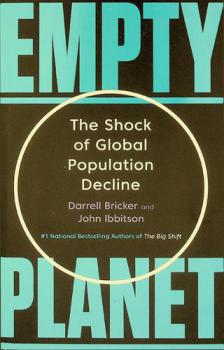
Empty planet : the shock of global population decline
\"For half a century, statisticians, pundits, and politicians have warned that a burgeoning planetary population will soon overwhelm the earth's resources. But a growing number of experts are sounding a different kind of alarm. Rather than growing exponentially, they argue, the global population is headed for a steep decline - and in many countries that decline has already begun. In Empty Planet, Ibbitson and Bricker find that a smaller global population will bring with it a number of benefits: fewer workers will command higher wages; the environment will improve; the risk of famine will wane; and falling birthrates in the developing world will bring greater affluence and autonomy for women. But enormous disruption lies ahead, too. We can already see the effects in Europe and parts of Asia, as aging populations and worker shortages weaken the economy and impose crippling demands on healthcare and social security. Canada and the United States are well-positioned to successfully navigate these coming demographic shifts--that is, unless growing isolationism and anti-immigrant backlash lead us to close ourselves off just as openness becomes more critical to our survival than ever before. Rigorously researched and deeply compelling, Empty Planet offers a vision of a future that we can no longer prevent--but one that we can shape, if we choose\"--Jacket.
Book

Population aging : is Latin America ready?
The past half-century has seen enormous changes in the demographic makeup of Latin America and the Caribbean (LAC). In the 1950s, LAC had a small population of about 160 million people, less than today's population of Brazil. Two-thirds of Latin Americans lived in rural areas. Families were large and women had one of the highest fertility rates in the world, low levels of education, and few opportunities for work outside the household. Investments in health and education reached only a small fraction of the children, many of whom died before reaching age five. Since then, the size of the LAC population has tripled and the mostly rural population has been transformed into a largely urban population. There have been steep reductions in child mortality, and investments in health and education have increased, today reaching a majority of children. Fertility has been more than halved and the opportunities for women in education and for work outside the household have improved significantly. Life expectancy has grown by 22 years. Less obvious to the casual observer, but of significance for policy makers, a population with a large fraction of dependent children has evolved into a population with fewer dependents and a very large proportion of working-age adults. This overview seeks to introduce the reader to three groups of issues related to population aging in LAC. First is a group of issues related to the support of the aging and poverty in the life cycle. Second is the question of the health transition. Third is an understanding of the fiscal pressures that are likely to accompany population aging and to disentangle the role of demography from the role of policy in that process.
eBook


Ecological orbits : how planets move and populations grow
The main focus of the book is the presentation of the inertial view of population growth. This view provides a rather simple model for complex population dynamics, and is achieved at the level of the single species without invoking species interactions. An important part of the account is the maternal effect. Investment of mothers in the quality of their daughters makes the rate of reproduction of the current generation depend not only on the current environment, but also on the environment experienced by the previous generation.
eBook