
Catalogue Search | MBRL


Are you sure you want to remove the book from the shelf?

{{itemTitle}}
20
result(s) for
"Post-communism -- Kazakhstan"
Sort by:

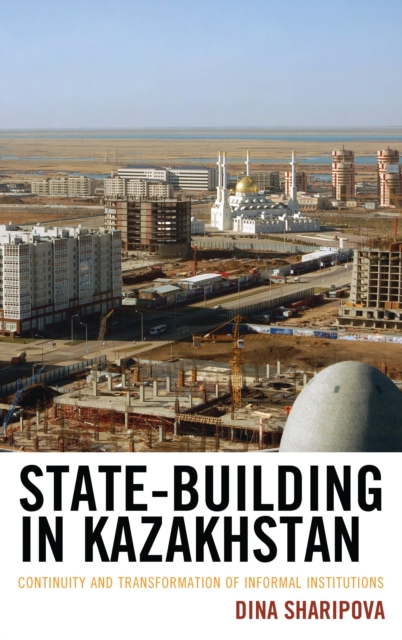
State-building in Kazakhstan
This book challenges the conventional wisdom that informal institutions—networks, clientelism, and connections—have to disappear in modern societies due to liberalization of the economy, rapid urbanization, and industrialization. The case of Kazakhstan shows that informal reciprocal institutions continue to play an important role in people’s everyday lives. Liberalization of the economy and state retrenchment from the social sphere decreased the provision of public goods and social support to the population in the post-independence period. Limited access to state benefits has, in turn, stimulated people’s engagement in informal reciprocal relations. The author investigates informal channels and mechanisms people use to gain access to quality public goods—education, housing, and healthcare. Comparing the Soviet and post-Soviet periods, the author shows that people are more likely to rely on family networks and clientelist relations rather than on help from the state to obtain scarce resources. The book provides an important contribution to the literature on informal institutions and explains the relationship between a formal welfare state and informal reciprocity.
eBook

State-building in Kazakhstan : continuity and transformation of informal institutions
\"This study examines informal institutions of reciprocity and their connections to state-building in Kazakhstan. The author analyzes both how these institutions changed over time and how they bridged the transition from the Soviet to post-Soviet periods\"-- Provided by publisher.
Book
Post-Soviet Chaos
In the 1990s, the former states of the Soviet Union underwent dramatic and revolutionary changes. As a result of enforced, neoliberal reforms the fledgling republics were exposed to the familiar effects of globalised capital. Focusing on Kazakhstan, where violence and corruption are now facts of everyday life, Joma Nazpary examines the impact of the new capitalism on the people of Central Asia.
Nazpary explores the responses of the dispossessed to their dispossession. He uncovers the construction of 'imagined communities', grounded in Soviet nostalgia, which serve to resist the economic order, as well as the more practical survival strategies, especially of women, often forced into prostitution where they are subject to violence and stigma. By revealing the extent to which Kazakh society has disintegrated and the cultural responses to it, Nazpary argues that dispossession has been a stronger unifying force than even ethnicity or religion.
Comparing the effects of neoliberal reforms in Kazakhstan with those in other regions, he concludes that causes, forms and consequences of dispossession in Kazakhstan are particular instances of a much wider global trend.
eBook
Postcards from Stanland : journeys in Central Asia
Central Asia has long stood at the crossroads of history. It was the staging ground for the armies of the Mongol Empire, for the nineteenth-century struggle between the Russian and British empires, and for the NATO campaign in Afghanistan.
eBook

Kazakhstan and Azerbaijan as Post-Soviet Rentier States: Resource Incomes and Autocracy as a Double 'Curse' in Post-Soviet Regimes
This article presents an analysis of two post-Soviet states, Kazakhstan and Azerbaijan, which can be identified as post-Soviet rentier states. Both countries are characterised economically by enormous national resources of gas and oil and low economic diversification as well as politically by strong autocratic presidentialism with neopatrimonial structures. These two factors, combined with further post-Soviet legacies such as a low level of political interest in the respective societies and a basically hierarchical orientation of the population, lead to a specific post-Soviet variety of rentierism. From a political science perspective, this article reveals the impact of resource policies on these comparably new political systems and concludes with a summary of core features of these post-Soviet rentier states.
Journal Article

Development In Central Asia and the Caucasus
Michael Barr explores the complex and covert networks of power at work in one of the world's most prosperous countries – the city-state of Singapore. He argues that the contemporary networks of power are a deliberate project initiated and managed by Lee Kuan Yew – former prime minister and Singapore's 'founding father' – designed to empower himself and his family. Barr identifies the crucial institutions of power - including the country's sovereign wealth funds, and the government-linked companies – together with five critical features that form the key to understanding the nature of the networks. He provides an assessment of possible shifts of power within the elite in the wake of Lee Kuan Yew's son, Lee Hsien Loong, assuming power, and considers the possibility of a more fundamental democratic shift in Singapore's political system.
eBook

Post-Soviet Chaos
'Essential reading for anyone who wants a deeper understanding of what capitalist globalization means for ordinary people, the grim social and political realities analysed in this book resonate far beyond the former USSR.' John Gledhill, Manchester University In the 1990s the former states of the Soviet Union underwent dramatic and revolutionary changes. As a result of enforced, neo-liberal reforms the fledgling republics were exposed to the familiar effects of globalised capital. Focusing on Kazakhstan, where violence and corruption are now facts of everyday life, Joma Nazpary examines the impact of the new capitalism on the people of Central Asia. Using in-depth interviews and material gathered over more than a year's fieldwork, Nazpary explores the responses of the dispossessed to their dispossession. He uncovers the construction of 'imagined communities', grounded in Soviet nostalgia, which serve to resist the economic order, as well as the more practical survival strategies, especially of women, often forced into prostitution where they are subject to violence and stigma. By revealing the extent to which Kazakh society has disintegrated and the cultural responses to it, Nazpary argues that dispossession has been a stronger unifying force than even ethnicity or religion. Comparing the effects of neo-liberal reforms in Kazakhstan with those in other regions, he concludes that causes, forms and consequences of dispossession in Kazakhstan are particular instances of a much wider global trend.
eBook

Building Business in Post-Communist Russia, Eastern Europe, and Eurasia
Prior to 1989, the communist countries of Eastern Europe and the USSR lacked genuine employer and industry associations. After the collapse of communism, industry associations mushroomed throughout the region. Duvanova argues that abusive regulatory regimes discourage the formation of business associations and poor regulatory enforcement tends to encourage associational membership growth. Academic research often treats special interest groups as vehicles of protectionism and non-productive collusion. This book challenges this perspective with evidence of market-friendly activities by industry associations and their benign influence on patterns of public governance. Careful analysis of cross-national quantitative data spanning more than 25 countries, and qualitative examination of business associations in Russia, Ukraine, Kazakhstan and Croatia, shows that postcommunist business associations function as substitutes for state and private mechanisms of economic governance. These arguments and empirical findings put the long-standing issues of economic regulations, public goods and collective action in a new theoretical perspective.
eBook
When economies change paths
While firms are attempting to expand into the global environment, many of the formerly communist nations are often misunderstood. Based on field research involving in-depth interviews in China, Central Asia, Myanmar and Indochina, this book provides academics, investors and policy-makers with an introductory overview of enterprise in these transitional economies. A theoretical framework precedes surveys of individual countries. Each chapter has been carefully refereed by national experts. Diligently referenced, the book includes citations of 250 relevant publications, guiding the future researcher through an extensive bibliography. This book is detailed, yet reader-friendly. It combines rigor with vigor, providing valuable insights into the rapidly emerging economies of Asia.
eBook