
Catalogue Search | MBRL


Are you sure you want to remove the book from the shelf?

{{itemTitle}}
3,827
result(s) for
"Progressive education"
Sort by:

Principles, practices, and creative tensions in progressive higher education : one institution's struggle to sustain a vision
In this case study the editors and contributors to the volume lay out significant challenges confronting not just non-traditional post-secondary colleges and universities but all institutions of higher education in today's rapidly changing context. Contending that nontraditional institutions are especially challenged in these turbulent times, they argue that these organizations' distinctive academic programs are among the most threatened in the landscape of higher education today. The 19 essays that make up this volume highlight and examine key creative tensions, rich interplays of emphases and values in higher education, in order to illuminate and address more intentionally the questions that we must address: Can we make constructive use of these tensions? Can we recognize what is at stake? And can we chart a course that will both respond innovatively to rapid change and sustain a vision and the purposes and principles on which that vision rests? Taken as a whole, this volume sheds light on the questions and creative tensions that can, with thoughtful attention, help to keep an alternative, progressive vision of adult higher education alive.
Book

Stories of the Eight-Year Study
Winner of the 2008 AERA Division B Outstanding Book
Award Presenting the first complete history of the
Progressive Education Association's Eight-Year Study, which took
place during the 1930s and the 1940s, this book corrects common
misinterpretations of one of the most important educational
experiments of the twentieth century and explores the study's value
for reexamining secondary education in America today.
eBook


A progressive education?
A Progressive Education? argues that concepts of both childhood and adolescence were transformed in English and Welsh primary and secondary modern schools between 1918 and 1979, and that, by putting childhood at the centre of the history of education, we can challenge the stories we tell about how and why schooling itself changed. A ‘progressive’ or ‘child-centred’ education began to emerge theoretically in the United States and Western Europe from the late nineteenth century, claiming to rewrite curriculums to suit children and young people’s needs, wants and abilities. Existing work suggests that progressivism both rose and retreated in Britain in the 1960s and 1970s, when a right-wing backlash against permissive teaching and the deschooling movement led to the imposition of central state control over education. However, the child-centred pedagogies that became mainstream in English and Welsh schools after 1945 rested on a fundamentally different vision of childhood. Unlike utopian deschoolers, post-war child-centred educationalists assumed that the achievements of mass democracy and the welfare state must be carefully preserved. Children needed to be socialised by adult educators to ensure that they acquired the necessary physical, intellectual, social and emotional maturity to become full citizens. Teachers, far from enthusiastically advocating child-centred methods, perceived them as a profound challenge to their authority in the classroom, and implemented them partially and reluctantly. Child-centred education, in alliance with developmental psychology, thus promoted a much more restrictive and pessimistic image of childhood and youth as it came to dominate mainstream schooling after the Second World War.
eBook


School Was Our Life
The late 1930s and early 1940s were the peak of progressive education in the United States, and Elisabeth Irwin's Little Red School House in New York City was iconic in that movement. For the first time, stories and recollections from students who attended Little Red during this era have been collected by author Jane Roland Martin. Now in their late eighties, these classmates can still sing the songs they learned in elementary school and credit the progressive education they loved with shaping their outlooks and life trajectories. Martin frames these stories from the former students \"tell it like it was\" point of view with philosophical commentary, bringing to light the underpinnings of the kind of progressive education employed at Little Red and commenting critically on the endeavor. In a time when the role of the arts in education and public schooling itself are under attack in the United States, Martin makes a case for a different style of education designed for the defense of democracy and expresses hope that an education like hers can become an opportunity for all.
eBook

Flora White
Flora White: In the Vanguard of Gender Equity draws on a collection of personal papers (only recently made available to scholars) to present the life of a colorful New England educator who lived from the Civil War to the Cold War.
eBook

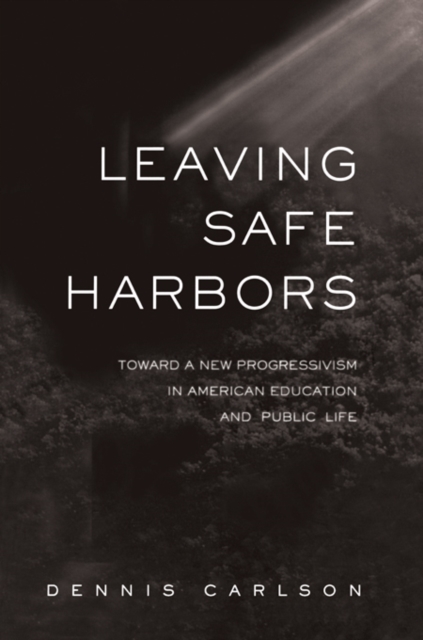
Leaving Safe Harbors
To rise to the challenges of postmodern culture, Carlson argues, progressives will need to leave the safe harbors of what is familiar and comfortable. A new progressivism can only be forged of a fundamental re-thinking and re-mythologizing of democratic education. Drawing upon cultural studies perspectives, Carlson interrogates philosophy through popular culture for mythologies that might guide such a progressivism. Carlson uses Platonic, Hegelian, Nitzschean, and Heideggerian \"mythologies\" to elaborate a progressive model that provides powerful ways of \"thinking\" democratic education and public life.
Dennis Carlson is Senior Professor in the Department of Educational Leadership and Director of the Center for Education and Cultural Studies at Miami University of Ohio
eBook