
Catalogue Search | MBRL


Are you sure you want to remove the book from the shelf?

{{itemTitle}}
1,323
result(s) for
"Realismo"
Sort by:

Representations are (still) theoretical posits
The debate over whether cognitive science is committed to the existence of neural representations is usually taken to hinge on the status of representations as theoretical posits: it depends on whether or not our best-supported scientific theories commit us to the existence of representations. Thomson and Piccinini (2018) and Nanay (2022) seek to reframe this debate to focus more on scientific experimentation than on scientific theorizing. They appeal to arguments from observation and manipulation to propose that experimental cognitive neuroscience gives us non-theoretical reasons to be ontologically committed to representations. In this paper, I challenge their claims about observation and manipulation, and I argue that the question of whether we are ontologically committed to representations is still best understood as a question about the level of support we have for our representation-positing scientific theories.
El debate sobre si la ciencia cognitiva está comprometida con la existencia de representaciones neuronales suele centrarse en el estatus de las representaciones como postulados teóricos: depende de si nuestras teorías científicas mejor fundamentadas nos comprometen o no con la existencia de representaciones. Thomson y Piccinini (2018) y Nanay (2022) buscan reformular este debate y enfocarlo más en la experimentación científica que en la teorización científica. Apelando a argumentos basados en la observación y la manipulación, sugieren que la neurociencia cognitiva experimental nos proporciona razones no teóricas para comprometernos ontológicamente con las representaciones. En este artículo cuestiono sus afirmaciones sobre la observación y la manipulación, y sostengo que la cuestión de si estamos ontológicamente comprometidos con las representaciones debería interpretarse como una cuestión sobre el grado de apoyo que tienen nuestras teorías científicas que postulan representaciones.
Journal Article

Iliá Yefimovich Repin
Nació el 5 de agosto de 1844 en la pequeña ciudad ucraniana de Chuguev. Hijo de un colono agricultor y exmilitar, y al igual que muchos hijos de colonos militares, fue a la academia de topografía de la escuela militar, donde surgió su pasión por el dibujo, la pintura y la escultura. A los trece años demostró su facultad para hacer retratos y se dedicó a realizar íconos religiosos y restauraciones para las iglesias ortodoxas de su pueblo, bajo la enseñanza del iconografista Bunakov.
Journal Article
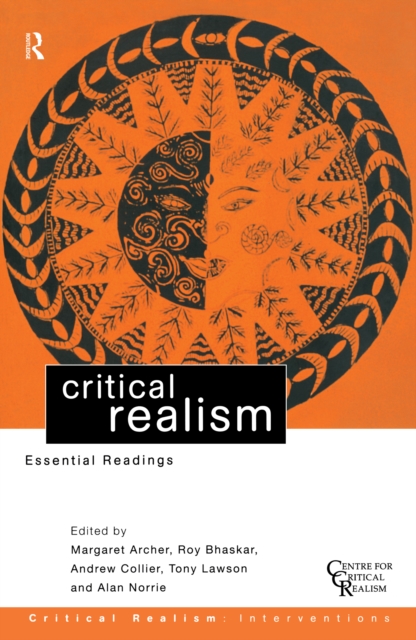
Critical Realism
Critical realism is a movement in philosophy and the human sciences most closely associated with the work of Roy Bhaskar. Since the publication of Bhaskars A Realist Theory of Science, critical realism has had a profound influence on a wide range of subjects. This reader makes accessible, in one volume, key readings to stimulate debate about and within critical realism. It explores the following themes:
transcendental realist
the theory of explanatory critique
dialectics
Bhaskar's critical naturalist philosophy of science.
eBook

Magic(al) Realism
Bestselling novels by Angela Carter, Salman Rushdie, Gabriel Garcia Marquez and a multitude of others have enchanted us by blurring the lines between reality and fantasy. Their genre of writing has been variously defined as 'magic', 'magical' or 'marvellous' realism and is quickly becoming a core area of literary studies. This guide offers a first step for those wishing to consider this area in greater depth, by:
exploring the many definitions and terms used in relation to the genre
tracing the origins of the movement in painting and fiction
offering an historical overview of the contexts for magic(al) realism
providing analysis of key works of magic(al) realist fiction, film and art.
This is an essential guide for those interested in or studying one of today's most popular genres.
'[Bower's] overall purpose is \"to guide the non-expert through the minefield of terms, to identify the origins of the terms and concepts in art, literature and film and to introduce readers to a range of innovative and engaging fictions\". All of this she achieves: the text is easily understood without being simplistic, and the glossary, though short, is clear and very helpful.' British Bulletin of Publications
'What renders Bower's Magic(al) Realism such a valuable and comprehensive introduction is that in addition to literature, she also considers artefacts from other fields of cultural production ... Bower's analysis of magical realism also proves exceptional in that she repeatedly draws attention to the importance of the cultural location of the audience in receiving a work as magic realist.' - Wasafiri
Introduction 1. Origins of Magic(al) Realism 2. Delimiting the Terms 3. Locations of the Magic(al) Realism 4. Transgressive Variants of Magical Realism 5. Cross-cultural variants of Magical realism 6. Magic(al) Realism and Cultural Productions 7. The Future of Magic(al) Realism Glossary Bibliography Index
Maggie Ann Bowers teaches American and Canadian literature at the University of Antwerp, Belgium. She has published numerous articles on contemporary American and Canadian authors, and is the co-editor of Convergences and Interferences (2002).
eBook

Sulla concezione bardiliana dell'arbitrio. Una preparazione al realismo logico
Partendo da una visione sintetica della critica condotta alia filosofia pratica di matrice kantiana dal punto di vista del realismo bardiliano e rein-holdiano (§2), l'articolo ne ricostruisce la genesi attraverso una lettura dell'interpretazione data da Bardili del rapporto tra volere, legge e liberta nello scritto del 1796 Uber den Ursprung des Begriffes der Freiheit des Willens. In tutti questi contribuiti appare chiaro come nella discussione post-kantiana il ricorso al soggettivismo non rappresenti una risoluzione, per così dire, positiva delle questioni lasciate aperte da Kant, ma una 'nemesi' del modello di ragione proposto da Kant che mette in primo piano la questione della concretezza dell'esistenza (Zöller) e della provvisorietà della pratica filosofica (Rockmore), di fronte, tanto a una interpretazione semplici-stica dell'idealismo come riduzione della realtà alla sfera di una spiritualità produttrice e trasparente a se stessa, quanto a una esaltazione della ragione come sviluppo organico di una essenza completamente pura. 2 Cfr. su questo punto la sintesi molto efficace data da McDowell, 1996: 81, n. dove, nel discutere le tesi di Allison, McDowell spiega come nella discussione post-kantiana la possibilità di isolare condizioni di possibilità per la conoscenza di una cosa che siano indipendenti dalla condizione di possibilità della cosa stessa non conduce necessariamente a uno psicologismo ma a una concezione ampia della razionalità, che oltrepassa le prestazioni cognitive del soggetto (Cfr. ad esempio McDowell, 1996: 62). 3 Una presentazione molto efficace, e filosoficamente rilevante, di questi sviluppi è data giá da Lask, 1903, su cui cfr. 4 Cfr. 5 Cfr. solo come esempio Bondeli, 1995. 6 Una sintesi della biografia e del percorso intellettuale di Bardili è data da Klemme & Kuhen, 2016: 37-40. 7 Cfr. per una descrizione panoramica della struttura, dei riferimenti e degli obiettivi dei Contributi reinholdiani, Bondeli, 2020. 8 Per tutte le abbreviazioni cfr. la bibliografia a fine testo. 9 Una ricostruzione critica di questo tema in Kant è stata data da Noller, 2015. Per quello che ci interessa è sufficientedell'interpretazione data da Bardili del rapporto tra volere, legge e libertà nello scritto del 1796 Sull'origine del concetto di libertà del volere (Über den Ursprung des Begriffes der Freiheit des Willens). Tale ritmo sarebbe manifestazione del fondamentale principio di identità, condizione di possibilità di ogni nostra conoscenza oggettiva e al di là del quale non ci sarebbe altro che un arbitrio assolutamente libero e imprevedibile (BW: 105-106)8. Solo attraverso la percezione di queste differenze è possibile che la filosofia si liberi dal «servo arbitrio, conosciuto in epoca moderna come io puro, autoattività, libertà e ragione» (BW: 122).
Journal Article
What is Wrong with the Pessimistic Induction? Truth and Certainty in the Realism versus Antirealism Debate
This paper presents an analysis of the debate between realists and anti-realists taking as specific object of study the pessimistic induction and the no-miracles argument. The hypothesis of the paper is that the apparent lack of consensus between realists and anti-realists in addressing the problem of the veracity of our scientific theories is to some extent related to the use of different conceptual frameworks on the truth. Specifically, I will argue that Laudan’s pessimistic induction is a skeptical argument built on a certainty–based concept of truth which is inoperative for understanding the scientific practice. The paper is structured as follows: first, the pessimistic induction and the no-miracles argument are characterized, then the most significant criticisms of both arguments and the replies will be presented and, finally, the validity of the concept of truth underlying those arguments will be briefly analyzed and evaluated.
Journal Article
The unfeasibility of onto-representationalism
Much effort has been devoted to explaining in what sense models represent their corresponding target systems. This has been considered a pivotal philosophical problem since representational models have been widely assumed to canalize our knowledge and understanding of reality. The aim of the paper is to analytically structure the framework commonly adopted to address the Scientific Representation Problem (SR-P), i.e., onto-representationalism, and to examine its main problems. Due to its very theoretical conditions, I conclude that onto-representationalism constitutes an inadequate meta-scientific platform to approach SR-P. I locate the problem in the semantic assumption. To materialize these analyses, I examine the main arguments proposed by the main variants of onto-representationalism: classical onto-representationalism and sophisticated onto-representationalism.
Se ha dedicado un esfuerzo notable a intentar explicar cómo los sistemas modelos representan a sus correspondientes sistemas objetivo. Dado que los modelos representacionales son centrales a la hora de canalizar nuestro conocimiento y comprensión de la realidad, se ha considerado que el Problema de la Representación Científica (P-RC) constituye una cuestión filosófica central. El objetivo del presente artículo es estructurar analíticamente el marco comúnmente adoptado a la hora de abordar el P-RC, i.e., el onto-representacionalismo, y examinar sus principales problemas. Argumento que el onto-representacionalismo constituye una plataforma meta-científica inadecuada a la hora de ofrecer una solución satisfactoria al P-RC. Localizo las dificultades en el presupuesto semántico. Para materializar estos análisis, examino los principales argumentos propuestos por las principales variantes del onto-representacionalismo: el onto-representacionalismo clásico y el onto-representacionalismo sofisticado.
Journal Article

Neoclassical Realism, the State, and Foreign Policy
Neoclassical realism is an important new approach to international relations. Focusing on the interaction of the international system and the internal dynamics of states, neoclassical realism seeks to explain the grand strategies of individual states as opposed to recurrent patterns of international outcomes. This book offers the first systematic survey of the neoclassical realist approach. The editors lead a group of senior and emerging scholars in presenting a variety of neoclassical realist approaches to states' grand strategies. They examine the central role of the 'state' and seek to explain why, how, and under what conditions the internal characteristics of states intervene between their leaders' assessments of international threats and opportunities, and the actual diplomatic, military, and foreign economic policies those leaders are likely to pursue.
eBook
The metaphysics of symmetries: A map
My main aim in this paper is to lay out a metaphysical map of the possible metaphysical attitudes that philosophers may hold with respect to physical symmetries. Even though it is customary to distinguish between realism vs. anti-realism, I show that the metaphysical landscape looks a bit more complex. To show this, I differentiate at least nine different views that have been held, or might be held, concerning which place physical symmetries occupy in one’s ontology.
Mi objetivo en este artículo es desarrollar un mapa metafísico de las posibles actitudes metafísicas que los filósofos pueden adoptar con respecto a las simetrías en física. Aunque es usual distinguir entre realismo y anti-realismo, en este artículo muestro que el panorama metafísico es un poco más complejo que eso. Para ello, distingo al menos nueve posiciones diferentes que han sido adoptadas, o podrían ser adoptadas, en relación al lugar que las simetrías pueden ocupar en la ontología que uno conciba.
Journal Article

PLANTS, PATHOGENS, AND THE POLITICS OF CARE
Almonds were once “the gold of Mallorca,” a source of modest wealth and a pillar of diversified farming systems for smallholders on the largest of Spain’s Balearic Islands. Now researchers believe nearly every rainfed almond tree on the island will be dead within as few as five years. The introduced bacteria Xylella fastidiosa, enabled by its spittle-bug vector, and emboldened by climate change, has flooded the xylem of these rainfed trees, impeding the flow of fluid and nutrients to the point where the tree can no longer survive. This article enrolls feminist theorizations of care and agential realism to broaden the political scope and stakes of a plant epidemic. I argue that by attending to the care relations underlying pathogenicity we can shift from narratives of landscape purification toward a more-than-human politics of care.
Una vez las almendras eran “el oro de Mallorca,” una fuente de riqueza modesta y un pilar de un sistema de agricultura diversificada para los payeses (campesinos) de la isla más grande del archipiélago balear de España. Actualmente los investigadores creen que casi todos los almendros de la isla pueden morir dentro de cinco años. Una bacteria introducida, Xylella fastidiosa, apoyada por su insecto vector, el salivazo, y animada por el cambio climático, ha inundado la xilema de los almendros de secano, impidiendo la circulación de fluidos y nutrientes hasta el punto de que el árbol no puede sobrevivir. Este artículo emplea teorizaciones feministas del cuidado y del realismo agencial para ampliar el alcance político de una epidemia de plantas. Argumento que teniendo en cuenta las relaciones de cuidado subyacentes de la patogenicidad, podemos pasar de los temas de purificación del paisaje a una política más-que-humano del cuidado.
Journal Article