
Catalogue Search | MBRL


Are you sure you want to remove the book from the shelf?

{{itemTitle}}
338
result(s) for
"Reality television programs Political aspects."
Sort by:

Reality bites back : the troubling truth about guilty pleasure TV
Takes a look at how our favorite shows reinforce stereotypes and force-feed us messages about who we're supposed to be and what we're supposed to want. Pozner exposes the commercial and political agendas behind the genre, revealing how the shows negatively impact women, people of color, and future generations.
Book

Reality Television and Arab Politics
What does it mean to be modern outside the West? Based on a wealth of primary data collected over five years, Reality Television and Arab Politics analyzes how reality television stirred an explosive mix of religion, politics, and sexuality, fuelling heated polemics over cultural authenticity, gender relations, and political participation in the Arab world. The controversies, Kraidy argues, are best understood as a social laboratory in which actors experiment with various forms of modernity, continuing a long-standing Arab preoccupation with specifying terms of engagement with Western modernity. Women and youth take center stage in this process. Against the backdrop of dramatic upheaval in the Middle East, this book challenges the notion of a monolithic 'Arab Street' and offers an original perspective on Arab media, shifting attention away from a narrow focus on al-Jazeera, toward a vibrant media sphere that compels broad popular engagement and contentious political performance.
eBook

The politics of reality television : global perspectives
While the industrial history of the global migrations of reality television is well established, there has been less consideration of the theoretical & methodological implications of this expansion. This book considers ways in which these migrations test our understanding of reality television across the globe.
Book

The Politics of Reality Television
Reality television is global. Transnational television companies and international distribution networks facilitate the worldwide circulation of popular shows; the 1990s in particular saw the growth of media companies that specialize in the development of reality television formats that are easily adaptable to local variations. While the industrial history of the global migrations of reality television is well established, there has been less consideration of the theoretical and methodological implications of this expansion. The Politics of Reality Television encompasses an international selection of expert contributions which consider the specific ways these migrations test our understanding of, and means of investigating, reality television across the globe. The book addresses a wide range of topics, including: the global circulation and local adaptation of reality television formats and franchises; the production of fame and celebrity around hitherto “ordinary” people; the transformation of self under the public eye; the tensions between fierce loyalties to local representatives and imagined communities bonding across regional and ethnic divides; and the struggle over the meanings and values of reality television across a range of national, regional, gender, class and religious contexts. The Politics of Reality Television proposes ways in which we can think through the international dimensions of reality television in the context of highly mobile media, politics, and publics. It offers a global, comparative examination of reality television alongside empirical research about the genre, its producers and consumers.
eBook

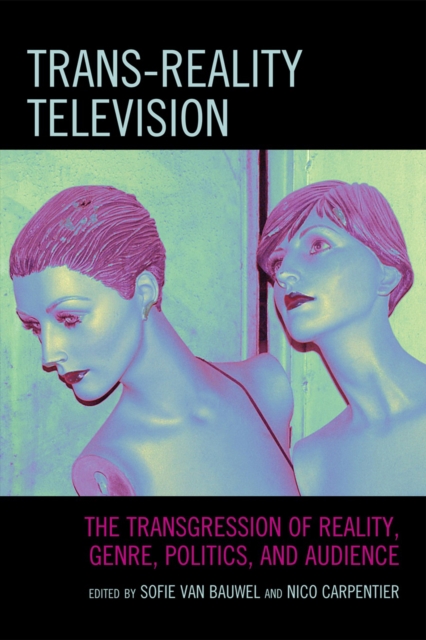
Trans-reality television
Trans-Reality Television: The Transgression of Reality, Genre, Politics, and Audience offers an overview of contributions which engage with the phenomenon of reality television as a tool to reflect on societal and mediated transformations and transgressions. While some contributors delve deep into the theoretical issues, others approach the topic at hand through empirical studies of specific reality television formats and programs. The chapters in this volume are divided into four sections, all of which deal with how we see the fluid social at work in reality television through the trans-real, trans-politics, trans-genre, and trans-audience. The first section stresses the concept of the trans-real. These chapters go into the complexity of the construction of reality in reality television. The second section, which deals with the concept of trans-politics, offers a diversity of perspectives on the articulation and re-articulation of politics and the political. In the third section, trans-genre, the chapters analyze how the modern conceptualizations of genre and format are transcended. Finally, the last set of chapters articulate the concept of trans-audiences, using case studies of particular audiences and a study of reality celebrities. Trans-Reality Television concludes by returning to the sense and nonsense of the use of these 'post' concepts.
eBook

Gender Politics and Performing for Fame in Big Brother Nigeria Reality Show
Existing studies have explored gender representation in reality shows, and the influence of such representations on viewers. In this study, I engage how female participants in romantic relationships on the Big Brother Nigeria reality show propagate and contest gender stereotypes. I answer the question: how have the propagation and contestation of extant gender ideologies been used to achieve fame and popularity on and beyond the show? I undertake a close reading of selected videos and comments from the Big Brother YouTube Channel across three editions of the show. I focus on the influence of showmance on the show’s competitors and how the female participants utilise their sexuality, gender identities, and gender stereotypes. I apply Pierre Bourdieu’s theory of agency towards analysing how female agency is negotiated within a space where men and women contest for fame and popularity. The analysis reveals that BBN is a field of cultural production where women’s choices are effectively intentional and strategic in their contestation for fame and success.
Journal Article
Pushing the Boundary: are Reality TV Shows Ruffling Feathers in Africa?
The article addresses the viability of Reality TV shows in Africa. It weighs this against the continent’s much acclaimed conservatism. It identifies key differences within African philosophical traditions that could militate against the tenets of this genre. It concludes that the trend towards presenting TV formats where individuals and families are exposed to ridicule and contempt, berated for dysfunctional activities or where homosexuality, incest, infidelity, strange fetishes, or transvestism are discussed, has the tendency to collide directly or indirectly with competing African moral frameworks and could prove polarizing in the African setting.
Journal Article

The Urgency and Affects of Media Studies
First, an understatement: the past two years have been emotionally challenging for members of academic communities in the humanities. According to the social media pages of many of my peers within the academy, 2016 and 2017 were full of stressors. Between the United Kingdom's \"Brexit\" referendum to leave the European Union, the election of reality television personality Donald Trump to the American presidency, and a number of terrorist attacks from Brussels to Orlando, many from around the world took to Facebook pages and Twitter feeds to vent, rant, mourn, express shock and denial, appropriately call out oppression in multiple forms, speculate on the motivations of white, working-class people, and threaten to move abroad. A common rhetorical strategy was to blame the media for sensationalizing bigotry and for placing ratings above the public interest. Expert lexicographers at Merriam-Webster proclaimed \"surreal\" (\"marked by the intense irrational reality of a dream\") as the dictionary's 2016 word of the year.The brazen cultivation of an environment in which democratic publics could not cleanly distinguish truth from fiction helped create what Lynne Joyrich has called the \"reality televisualization of political formations . . . a meshing of modes of thinking and modes of feeling, which has become the 'medium' in which our politics now exist.\" Even media studies scholars who are trained to pause and think critically about patterns across global media flows, it would appear, can succumb to the affects of dread and despair that spread rampantly across networked publics, accelerated by the crisis-like temporality indicative of these media technologies.
Journal Article

Realism's Housewives
Lieber argues that The Real Housewives series bring into focus certain questions about \"realism,\" a term whose meanings and connotations are a veritable staple of scholarly inquiry in the fields of literature and the arts, and especially about what that general social and aesthetic program and the shows' particular subject matter have to do with each other. Here, she examines the question of the popularity of the Real Housewives shows to reveal something important not only about the proliferation of reality television, but also about the prevalence of women on television, the current shape of television programming as a whole, the current generation's relationship to feminism, and even a certain type of aesthetic sensibility and experience that exceeds the limits of contemporary trends.
Journal Article