
Catalogue Search | MBRL


Are you sure you want to remove the book from the shelf?

{{itemTitle}}
10
result(s) for
"Report writing -- Study and teaching -- Data processing"
Sort by:

Virtual peer review : teaching and learning about writing in online environments
In a reassessment of peer review practices, Lee-Ann Kastman Breuch explores how computer technology changes our understanding of this activity. She defines “virtual peer review” as the use of computer technology to exchange and respond to one another’s writing in order to improve it. Arguing that peer review goes through a remediation when conducted in virtual environments, the author suggests that virtual peer review highlights a unique intersection of social theories of language and technological literacy.
eBook

Composing Media Composing Embodiment
\"What any body is-and is able to do-cannot be disentangled from the media we use to consume and produce texts.\" ---from the Introduction.
Kristin Arola and Anne Wysocki argue that composing in new media is composing the body-is embodiment. InComposing (Media) = Composing (Embodiment),they havebrought together a powerful set of essays that agree on the need for compositionists-and their students-to engage with a wide range of new media texts. These chapters explore how texts of all varieties mediate and thereby contribute to the human experiences of communication, of self, the body, and composing. Sample assignments and activities exemplify how this exploration might proceed in the writing classroom.
Contributors here articulate ways to understand how writing enables the experience of our bodies as selves, and at the same time to see the work of (our) writing in mediating selves to make them accessible to institutional perceptions and constraints. These writers argue that what a body does, andcan do, cannot be disentangled from the media we use, nor from the times and cultures and technologies with which we engage.
To the discipline of composition, this is an important discussion because it clarifies the impact/s of literacy on citizens, freedoms, and societies. To the classroom, it is important because it helps compositionists to support their students as they enact, learn, and reflect upon their own embodied and embodying writing.
eBook

Wiring The Writing Center
Published in 1998, Wiring the Writing Center was one of the first few books to address the theory and application of electronics in the college writing center. Many of the contributors explore particular features of their own \"wired\" centers, discussing theoretical foundations, pragmatic choices, and practical strengths. Others review a range of centers for the approaches they represent. A strong annotated bibliography of signal work in the area is also included.
eBook

Composition in Convergence
Composition in Convergence: The Impact of New Media on Writing Assessment considers how technological forms--such as computers and online courses--transform the assessment of writing, in addition to text classroom activity. Much has been written on how technology has affected writing, but assessment has had little attention. In this book, author Diane Penrod examines how, on the one hand, computer technology and interactive material create a disruption of conventional literacy practices (reading, writing, interpreting, and critique), while, on the other hand, the influence of computers allows teachers to propose and develop new models for thinking and writing to engage students in real-world settings.This text is intended for scholars and educators in writing and composition, educational assessment, writing and technology, computers and composition, and electronic literacy. In addition, it is appropriate for graduate students planning to teach and assess electronic writing or teach in online environments.
eBook

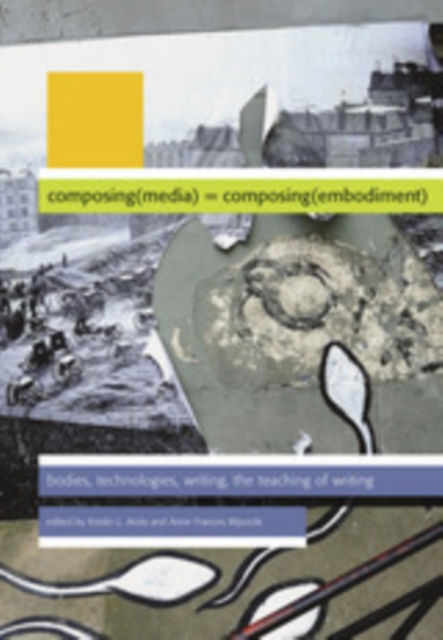
Composing(media) = composing(embodiment): bodies, technologies, writing, the teaching of writing
\"What any body is-and is able to do-cannot be disentangled from the media we use to consume and produce texts.\" ---from the Introduction.Kristin Arola and Anne Wysocki argue that composing in new media is composing the body-is embodiment. In Composing (Media) = Composing (Embodiment), they havebrought together a powerful set of essays that agree on the need for compositionists-and their students-to engage with a wide range of new media texts. These chapters explore how texts of all varieties mediate and thereby contribute to the human experiences of communication, of self, the body, and composing. Sample assignments and activities exemplify how this exploration might proceed in the writing classroom.Contributors here articulate ways to understand how writing enables the experience of our bodies as selves, and at the same time to see the work of (our) writing in mediating selves to make them accessible to institutional perceptions and constraints. These writers argue that what a body does, and can do, cannot be disentangled from the media we use, nor from the times and cultures and technologies with which we engage. To the discipline of composition, this is an important discussion because it clarifies the impact/s of literacy on citizens, freedoms, and societies. To the classroom, it is important because it helps compositionists to support their students as they enact, learn, and reflect upon their own embodied and embodying writing.
eBook

Handbook of Automated Essay Evaluation
This comprehensive, interdisciplinary handbook reviews the latest methods and technologies used in automated essay evaluation (AEE) methods and technologies. Highlights include the latest in the evaluation of performance-based writing assessments and recent advances in the teaching of writing, language testing, cognitive psychology, and computational linguistics. This greatly expanded follow-up to Automated Essay Scoring reflects the numerous advances that have taken place in the field since 2003 including automated essay scoring and diagnostic feedback. Each chapter features a common structure including an introduction and a conclusion. Ideas for diagnostic and evaluative feedback are sprinkled throughout the book.
Highlights of the book's coverage include:
The latest research on automated essay evaluation.
Descriptions of the major scoring engines including the E-rater®, the Intelligent Essay Assessor, the Intellimetric™ Engine, c-rater™, and LightSIDE.
Applications of the uses of the technology including a large scale system used in West Virginia.
A systematic framework for evaluating research and technological results.
Descriptions of AEE methods that can be replicated for languages other than English as seen in the example from China.
Chapters from key researchers in the field.
The book opens with an introduction to AEEs and a review of the \"best practices\" of teaching writing along with tips on the use of automated analysis in the classroom. Next the book highlights the capabilities and applications of several scoring engines including the E-rater®, the Intelligent Essay Assessor, the Intellimetric™ engine, c-rater™, and LightSIDE. Here readers will find an actual application of the use of an AEE in West Virginia, ps
eBook

Uncreative writing
Can techniques traditionally thought to be outside the scope of literature, including word processing, databasing, identity ciphering, and intensive programming, inspire the reinvention of writing? The Internet and the digital environment present writers with new challenges and opportunities to reconceive creativity, authorship, and their relationship to language. Confronted with an unprecedented amount of texts and language, writers have the opportunity to move beyond the creation of new texts and manage, parse, appropriate, and reconstruct those that already exist. In addition to explaining his concept of uncreative writing, which is also the name of his popular course at the University of Pennsylvania, Goldsmith reads the work of writers who have taken up this challenge. Examining a wide range of texts and techniques, including the use of Google searches to create poetry, the appropriation of courtroom testimony, and the possibility of robo-poetics, Goldsmith joins this recent work to practices that date back to the early twentieth century. Writers and artists such as Walter Benjamin, Gertrude Stein, James Joyce, and Andy Warhol embodied an ethos in which the construction or conception of a text was just as important as the resultant text itself. By extending this tradition into the digital realm, uncreative writing offers new ways of thinking about identity and the making of meaning.
eBook
Virtual Peer Review
In a reassessment of peer review practices, Lee-Ann Kastman Breuch explores how computer technology changes our understanding of this activity. She defines \"virtual peer review\" as the use of computer technology to exchange and respond to one another's writing in order to improve it. Arguing that peer review goes through a remediation when conducted in virtual environments, the author suggests that virtual peer review highlights a unique intersection of social theories of language and technological literacy.
eBook

The role of phonology in reading Chinese single characters and two-character words with high, medium and low phonological regularities by Chinese grade 2 and grade 5 students
Li presents a summary of her award-winning dissertation. She investigated the role of phonological processing in reading Chinese single character and two-character words, the effects of different levels of phonological regularity in compound Chinese characters, and the differences in phonological processing by more literate and less literate readers.
Journal Article