
Catalogue Search | MBRL


Are you sure you want to remove the book from the shelf?

{{itemTitle}}
42
result(s) for
"Roman américain -- 20e siècle -- Histoire et critique"
Sort by:

Coming of age in contemporary American fiction
This book explores the ways in which a range of recent American novelists have handled the genre of the 'coming-of-age' novel, or the Bildungsroman. Novels of this genre characteristically dramatise the vicissitudes of growing up and the trials and tribulations of young adulthood, often presented through depictions of immediate family relationships and other social structures.
eBook

Bodies of Tomorrow
Anxieties about embodiment and posthumanism have always found an outlet in the science fiction of the day. In Bodies of Tomorrow , Sherryl Vint argues for a new model of an ethical and embodied posthuman subject through close readings of the works of Gwyneth Jones, Octavia Butler, Iain M. Banks, William Gibson, and other science fiction authors. Vint’s discussion is firmly contextualized by discussions of contemporary technoscience, specifically genetics and information technology, and the implications of this technology for the way we consider human subjectivity.
Engaging with theorists such as Michel Foucault, Judith Butler, Anne Balsamo, N. Katherine Hayles, and Douglas Kellner, Bodies of Tomorrow argues for the importance of challenging visions of humanity in the future that overlook our responsibility as embodied beings connected to a material world. If we are to understand the post-human subject, then we must acknowledge our embodied connection to the world around us and the value of our multiple subjective responses to it. Vint’s study thus encourages a move from the common liberal humanist approach to posthuman theory toward what she calls ‘embodied posthumanism.’ This timely work of science fiction criticism will prove fascinating to cultural theorists, philosophers, and literary scholars alike, as well as anyone concerned with the ethics of posthumanism.
eBook

Unvarnishing Reality
Unvarnishing Reality draws original insight to the
literature, politics, history, and culture of the cold war by
closely examining the themes and goals of American and Russian
satirical fiction. As Derek C. Maus illustrates, the paranoia of
nuclear standoff provided a subversive storytelling mode for
authors from both nations-including Thomas Pynchon, Robert Coover,
John Barth, Walker Percy, Don DeLillo, Kurt Vonnegut Jr., Vasily
Aksyonov, Yuz Aleshkovsky, Alexander Zinoviev, Vladimir Voinovich,
Fazil Iskander, and Sasha Sokolov.
Maus surveys the background of each nation's culture, language,
sociology, politics, and philosophy to map the foundation on which
cold war satire was built. By highlighting common themes of
utopianism, technology, and propaganda, Maus effectively shows the
ultimate motive of satirists on both sides was to question the
various forces contributing to the cold war and to expose the
absurdity of the continuous tension that pulsed between the United
States and the Soviet Union for nearly half a century. Although
cold war literature has been studied extensively, few critics have
focused so keenly on comparisons of satirical fictions by Russian
and American writers that condemn and subvert the polarizing
ideologies inherent in superpower rivalry. Such a comparison
reveals thematic and structural similarities that transcend
specific national and cultural origins. In considering these works
together, Maus locates a thoroughgoing humanistic refutation of the
cold war and its operative doctrines as well as a range of proposed
alternatives. Just as the cold war combatants ultimately reconciled
in 1991 with the fall of the Soviet Union, Maus seeks to bring
these two literary canons together now. Their thematic scope
transcends cultural differences, and, as Maus demonstrates, these
writers saw that there was not only the atomic bomb to fear, but
also the dangers of complete national militarization and the
constant polarizing threat of emergency. Thus their cold war
critiques still resonate today and invite further comparative
studies such as this one.
eBook
Crisis y reemergencia
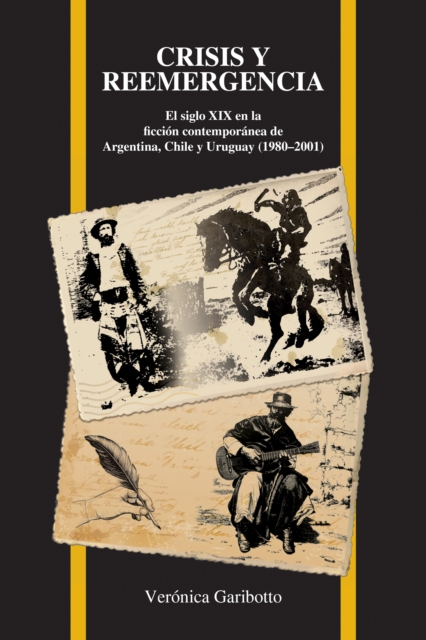
En las últimas décadas-especialmente a partir de los noventa-ha habido una visible reemergencia del siglo XIX en la cultura del Cono Sur. Figuras decimonónicas típicas (indios, gauchos, letrados y cautivas) han reaparecido en la escena literaria de Argentina, Chile y Uruguay. Héroes como San Martín y Artigas se han convertido en protagonistas principales de la literatura, el cine y el teatro. Géneros fundantes de la identidad nacional (el relato de viaje, la poesía gauchesca, el romance nacional) se han reciclado y transformado. Textos canónicos como La cautiva, el Martín Fierro y el Facundo han sido reescritos una vez más en diferentes campos artísticos. Y controvertidos eventos históricos (las guerras civiles, las masacres de las comunidades indígenas) han sido revisados y vueltos a narrar. Combinando el análisis textual con una perspectiva más abarcadora anclada en la teoría cultural, este libro responde a dos preguntas interrelacionadas: ¿por qué el siglo XIX ha resurgido de manera tan fuerte en las últimas décadas? ¿Cuáles son las implicaciones ideológicas de esta reemergencia? A través de una comparación transnacional de Argentina, Chile y Uruguay, y de una lectura de la ficción producida por figuras prominentes en los tres países (activistas políticos, intelectuales públicos y autores canónicos), Crisis y reemergencia contribuye a dilucidar cómo el campo cultural del Cono Sur ha cambiado desde los noventa: cómo la ética intelectual, las identidades nacionales y las estrategias discursivas que fueron funcionales a la consolidación del liberalismo en el siglo XIX han sido reformuladas, transformadas y repensadas en las últimas décadas. Apoyándose en el marxismo cultural, el análisis del discurso y la teoría poscolonial, el libro apunta a una triple contribución: definir los componentes ideológicos y discursivos que están en el corazón del siglo XIX, mostrar su continuidad hasta los noventa (y aclarar así las conexiones entre liberalismo y neo-liberalismo) y exponer su reciente transformaciónuna transformación que abrió el camino a lo que se ha llamado el \"retorno de lo político\" en la región. In the last decades-and especially since the 1990s-there has been a noticeable reemergence of the nineteenth century in Southern Cone culture. Popular nineteenth-century figures (indios, gauchos, letrados, and cautivas) have reentered the national literary scene in Argentina, Chile, and Uruguay. Nineteenth-century heroes such as San Martín and Artigas are again the main protagonists of Southern Cone theater, film, and literature. Canonical nineteenth-century texts (La cautiva, Martín Fierro, Facundo) are being rewritten one more time in different artistic fields. Foundational nineteenth-century genres (travel narratives, gauchesque poems, and national romances) are being transformed and recycled. Controversial nineteenth-century events (the civil wars, the massacre of indigenous communities) are being revisited and explored. Through a combination of close textual analysis and a broader perspective rooted in cultural theory, this book answers two interrelated questions: Why did the nineteenth century resurface so strongly in the last decades? What are the ideological implications of this reemergence? Based on a transnational comparison of Argentina, Chile, and Uruguay, and a survey of narratives that were mostly produced by well-known figures (political activists, public intellectuals, and canonical authors), Crisis y reemergencia helps to elucidate how the Southern Cone cultural field has changed since the 1990s: how intellectuals' ethics, national identities, and discursive strategies that were functional to the consolidation of liberalism in the nineteenth century have been challenged, transformed, and rethought in the last decades. Borrowing from cultural Marxism, discourse analysis, and postcolonial theory, the book pursues a triple contribution: to define the discursive and ideological components that were at the core of the nineteenth century, to show their continuity up to the 1990s (and thus clarify the connections between liberalism and neoliberalism), and to expose their recent transformation-a transformation that paved the way for the \"return of the political\" to the region.
eBook

Contemporary American women writers : narrative strategies
Ann Beattie, Annie Dillard, Maxine Hong Kingston, Toni Morrison, Cynthia Ozick, Grace Paley, Marge Piercy, Anne Redmon, Anne Tyler, and Alice Walker all seem to be especially concerned with narrative management.
eBook

A companion to american fiction, 1865–1914
A Companion to American Fiction, 1865-1914 is a groundbreaking collection of essays written by leading critics for a wide audience of scholars, students, and interested general readers.
eBook

Beyond the Gibson Girl
Challenging monolithic images of the New Woman as white, well-educated, and politically progressive, this study focuses on important regional, ethnic, and sociopolitical differences in the use of the New Woman trope at the turn of the twentieth century. Using Charles Dana Gibson's \"Gibson Girls\" as a point of departure, Martha H. Patterson explores how writers such as Pauline Hopkins, Margaret Murray Washington, Sui Sin Far, Mary Johnston, Edith Wharton, Ellen Glasgow, and Willa Cather challenged and redeployed the New Woman image in light of other \"new\" conceptions: the \"New Negro Woman,\" the \"New Ethics,\" the \"New South,\" and the \"New China.\"_x000B__x000B_As she appears in these writers' works, the New Woman both promises and threatens to effect sociopolitical change as a consumer, an instigator of evolutionary and economic development, and, for writers of color, an icon of successful assimilation into dominant Anglo-American culture. Examining a diverse array of cultural products, Patterson shows how the seemingly celebratory term of the New Woman becomes a trope not only of progressive reform, consumer power, transgressive femininity, modern energy, and modern cure, but also of racial and ethnic taxonomies, social Darwinist struggle, imperialist ambition, assimilationist pressures, and modern decay.
eBook
Modernist Fiction, Cosmopolitanism and the Politics of Community
In Modernist Fiction, Cosmopolitanism and the Politics of Community, first published in 2001, Jessica Berman argues that the fiction of Henry James, Marcel Proust, Virginia Woolf and Gertrude Stein engages directly with early twentieth-century transformations of community and cosmopolitanism. Although these modernist writers develop radically different models for social organization, their writings return again and again to issues of commonality, shared voice, and exchange of experience, particularly in relation to dominant discourses of gender and nationality. The writings of James, Proust, Woolf and Stein, she argues, not only inscribe early twentieth-century anxieties about race, ethnicity, nationality and gender, but confront them with demands for modern, cosmopolitan versions of community. This study seeks to revise theories of community and cosmopolitanism in light of their construction in narrative, and in particular it seeks to reveal the ways that modernist fiction can provide meaningful alternative models of community.
eBook

Crisis and covenant : the Holocaust in American Jewish fiction
This volume and the series which it inaugurates provide a forum for the interchange of ideas and the discussion of new directions in the study of Israel. Important works on Israel published in other languages will now be available to English-speaking audiences. At a time of rapid transformation in many spheres of Israeli life, this collection will inform and invigorate debates over Israel’s past, present, and future.
eBook